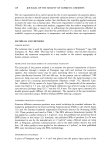
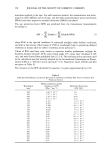
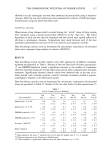
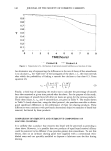
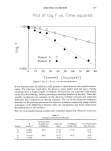
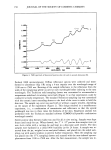
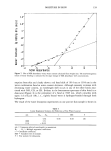
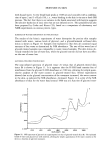
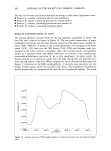
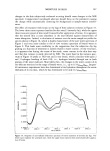
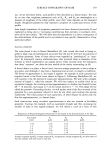
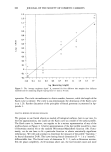
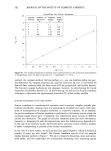
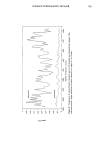
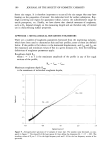
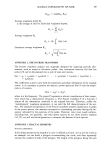
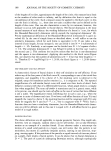
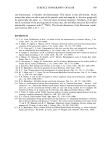
SHAVING CLOSENESS 147 Plot of log Y vs. Time squared 1.ooo• Product Product A 0 • • 0 400 ' ' ' ' ' ' ' ' ß 0 10 20 50 40 50 60 70 80 90 Time**2 (hours**2) Figure 2. •1ot of -In ¾ vs. t for two shaving products. It was theorized that the lubricant could promote a closer shave by two possible mecha- nisms. The lubricant could allow the shaver to press harder with the razor, thereby removing more or longer lengths of whiskers. Alternatively, the lubricant could remain on the face after shaving, thereby providing a smoother afterfeel to the skin. These two possible mechanisms are examples of the objective (whisker removal) and subjective (smoother feel) components of shaving closeness. The use of the subjective evaluation described in the previous section and an objective evaluation employing image analysis techniques could differentiate between these two mechanisms and better characterize the performance of this product. The two twin-bladed shaving systems were evaluated subjectively (Protocol 3) and ob- Table V Summary of Experimental Results Statistical level K of significance Half time % Difference % of Smooth faces Product (hours)-2 of difference hours of half times after six hours A 0.0057 99% 15.59 27.00 87.0 B 0.0107 11.38 70.0 A 0.0120 90% 10.74 10.25 70.0 B 0.0149 9.64 62.0

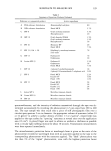
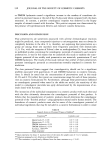
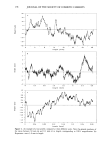
148 JOURNAL OF THE SOCIETY OF COSMETIC CHEMISTS Table VI Objective Evaluation of Beard Removal Efficacies of Standard and Modified Razors Parameter Ratio modified/standard Area 1.01 (not significant) Length 1.01 (not significant) jectively (image analysis) for their whisker removal performance and the lastingness of the shaves they provided. A purely objective measurement of the mean areas and lengths of the removed whiskers provided by image analysis revealed that both blades were equally effective at shaving off hair fibers (Table VI). Conversely, the subjective procedure showed that the blade which deposited lubricant onto the face was perceived to give a longer-lasting, smooth shave than did the standard twin-bladed system. This difference was significant at the 99% confidence limits (Table VII). Both results can be explained by a theory of shaving closeness which consists of objec- tive and subjective components. Since skin smoothness is important for the perception of a close shave, a shaving product which delivers lubrication to the face might be perceived as delivering a smoother, longer-lasting shave, while not actually removing additional whisker. DISCUSSION AND CONCLUSIONS The results of this investigation confirmed previous findings suggesting that, in sensory experiments, independent judges find it more difficult to assess intensities of sensory stimuli than to discern the presence or absence of the stimulus. Therefore, protocols that utilize this characteristic of human perception by asking a single question that can be answered either in the affirmative or in the negative (e.g., is the face smooth or not?) seem to have a better chance to produce statistically significant differences than pro- tocols based on measurements of perceived stimulus intensities. An additional advan- tage of these protocols is that they also provide time courses of the declines of stimulus intensities and, thus, furnish additional information that could be valuable especially for claim support of consumer products. The intensity differences at any time between this stimuli can be gauged by comparing the frequency of affirmative answers obtained at the given time after the application of the stimulus. The question of whether the advantages of protocols based on measuring the responses of judges at different times have a general applicability beyond the assessment of shaving closeness (i.e., into other product categories) is being tested in deodorant tests that use similar protocols. Table VII Subjective Evaluation of Shaving Closeness Provided by Standard and Modified Razors Statistical level K of significance Half time % Difference Product (hours) - 2 of difference hours of half times % of Smooth faces after six hours Modified 0.0184 8.68 99%, Standard 0.0269 7.17 11.30 52.0 40.0
Purchased for the exclusive use of nofirst nolast (unknown)
From: SCC Media Library & Resource Center (library.scconline.org)