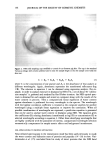
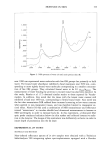
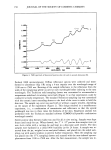
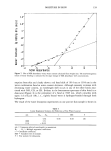
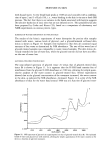
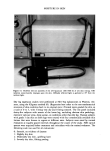
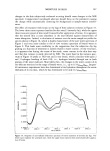
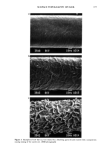
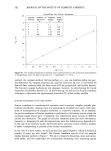
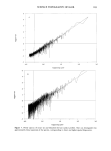
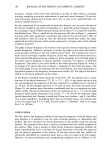
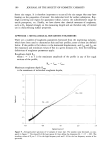
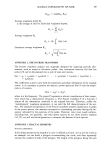
154 JOURNAL OF THE SOCIETY OF COSMETIC CHEMISTS Figure 2. NIR solid sampling cups modified to contain 4-cm-diameter pig skin. The cup is the standard Technicon design with ceramic pedestal used to raise the sample height so that the sample cover holds the skin taut. C = K 0 + K•A• + K2A 2 -{- KnAn (3) where C is the concentration of one analyte and An is the absorbance of that analyte at different wavelengths. Again, absorbance represents the transformed reflectance (log I/R). The solution to equation 3 can be obtained using regression analysis. For ex- ample, in order to analyze moisture in shampoo by NIR (13), a set of about 50 "calibra- tion samples" is gathered and analyzed by Karl Fisher titration. An NIR optical spec- trum is obtained for each sample and stored on computer along with the results of the water content in percent. Then a computerized linear regression of water content against absorbance is performed for every wavelength in the spectra. The wavelength with the highest correlation coefficient is retained as the computer searches for another wavelength using a multiple linear regression to improve the correlation. When all possible combinations of wavelengths are regressed, a prediction equation is generated that can be used to analyze water content in shampoo using NIR. The equation gives the coefficients (K) relating absorbance (transformed as log I/R) to concentration (C) at selected wavelengths accoMing to equation 3. Other than identifying wavelengths that are highly correlated with the parameter of interest, computerized wavelength selection automatically compensates for sample matrix effects and background interferences. NIR APPLICATIONS TO PROTEIN HYDRATION Near-infrared spectroscopy in the transmission mode has been used previously to study the water content and hydration state of proteins and peptides (14-16) in vitro. Van- dermeulen et al. (15) concluded from his study of intact proteins that the NIR band

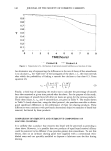
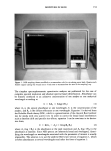
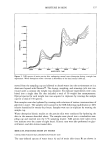
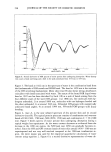
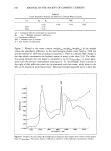
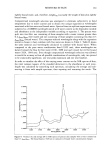
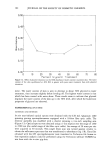
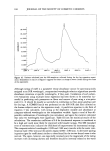
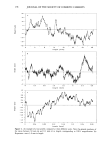
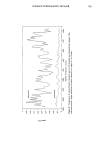
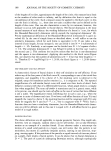
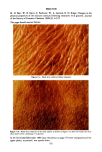
MOISTURE IN SKIN 155 I 600 400 200 ooo 800 600 400 I 200 0.000 t A i200 i400 i600 i800 t • t ' I 2000 2200 2400 HAVELENGTH (rim) Figure 3. NIR spectrum of water (A) and moist porcine skin (B). near 1900 nm represented water molecules with free OH groups due primarily to bulk water. The bound water absorbance exhibited a band maximum near 1950 nm, corre- sponding to more tightly bound water molecules corresponding to a smaller concentra- tion of free OH groups. They calculated bound water to be 0.1 gwater/gprotein . The measurement of water binding by proteins in excised tissue has also been reported. In this study, Ressler eta/. (17) obtained similar results to those reported by Vander- meulen. In addition, they noted that the tissue with the lowest water content still exhibited a band near 1950 nm, corresponding to firmly bound water. Also noted was the fact that transmission NIR suffered from increased scattering at low water contents when applied to non-transparent tissues, and was therefore limited to transparent ex- cised tissue. Norris (10) has used a combination of NIR transmittance and reflectance termed "interactance" to correlate skinfold and ultrasound measurements in humans to NIR wavelengths in order to estimate body fat. In this experiment, a bifurcated fiber optic probe conducted radiation below the skin surface and collected interactive radia- tion to the detector. The design of this instrument was deliberately occlusive in order to insure depth of penetration into the fat layer. EXPERIMENTAL (IN VITRO) MATERIALS AND METHODS Near-infrared reflectance spectra of in vitro samples were obtained with a Technicon InfraAnalyzer 500 integrating sphere spectrophotometer equipped with a Hewlett
Purchased for the exclusive use of nofirst nolast (unknown)
From: SCC Media Library & Resource Center (library.scconline.org)