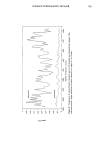
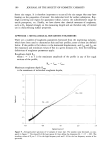
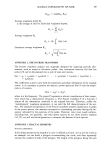
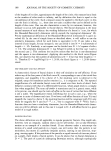
SURFACE TOPOGRAPHY OF HAIR 189 one-dimensional, is fractally two-dimensional. This fractal is also self-similar, which means that when we take a part of the particle path and magnify it, the new graph will be statistically the same, i.e., have the same statistical moments. Similarly, if we plot the X coordinate of the moving particle versus time, the self-affine function X(t) will be statistically congruent with fa-Dx(ft). The fractal dimension of the Brownian coordi- nate function X(t) is D = 1.5. REFERENCES (1) T. K. Cook, Profilometry of skin--A useful tool for the substantiation of cosmetic efficacy, J. Sac. Cosmet. Chem., 31, 339-359 (1980). (2) S. Makki, P. Agache, J. Mignot, and H. Zahouani, Statistical analysis and three-dimensional repre- sentation of the human skin surface, J. Soc. Cosmet. Chem., 35, 311-325 (1984). (3) T. H. Cook and T. J. Craft, Topographics of dry skin, non-dry skin, and cosmetically treated dry skin as quantified by skin profilometry, J. Soc. Cosmet. Chem., 36, 143-152 (1985). (4) U. Hoppe, G. Sauermann, and R. Lunderstadt, Quantitative analysis of the skin's surface by means of digital signal processing, J. Soc. Cosmet. Chem., 36, 105-123 (1985). (5) J. Mignot, H. Zahouani, D. Rondot, and P. Nardin, Morphological study of human skin relief, Bioeng. Skin, 3, 177-196 (1987). (6) G. Sauermann, U. Hoppe, R. Lunderstaedt, and B. Schubert, Measurement of the surface profile of human hair by surface profilometry. J. Soc. Cosmet. Chem., 39, 27-42 (1988). (7) J. Jachowicz, Hair damage and attempts to its repair, J. Soc. Cosmet. Chem., 38, 263-286 (1987). (8) B. B. Mandelbrot, The fractal geometry of nature (Freeman, New York, 1983). (9) R. F. Voss, Characterization and measurement of random fractals, Phys. Scr., 13, 27-32 (1986). 10) M. V. Berry and Z. V. Lewis, On the Weierstrass-Mandelbrot fractal function, Proc. R. Sac. London Ser. A, 370, 459-484 (1980). 11) S. R. Brown, A note on the description of surface roughness using fractal dimension, Geaphys. Res. Lett., 14, 1095-1098 (1987). 12) B. B. Mandelbrot, Self-affine fractals and fractal dimension, Phys. Scr., 32, 257-260 (1985). 13) There is a proliferation of various fractal dimensions, such as "chemical dimension," "fracton," "hull dimension," etc., defined for different fractal objects. Some of them have been found to be equivalent, some not, and the interrelations between them are only now being studied. See for example: On Growth and Form, H. E. Stanley and N. Ostrovski, Eds. (Martinus Nijhof, Boston, 1986). 14) J. Valdes, E. Lobbe, and M. Porfiri, Spectrum analysis of surface roughness signals obtained with the scanning tunneling microscope, Su•ace Sci., 181, 262-266 (1987). 15) E. L. Church, Fractal surface finish, Appl. Optics, 27, 1518-1526 (1988). (16) The linear dependence of log spectral power on log frequency is a ubiquitous phenomenon, observed first in electrical devices, and known as "1/f noise." For a recent survey of theories of 1/f noise, see ref 17 and E. W. Montroll and M. F. Shlesinger, Maximum entropy formalism, fractals, scaling phe- nomena and 1/f noise: A tale of tails, J. Statistic. Phys., 32, 209-230 (1983). (17) B. B. Mandelbrot, Why is Nature Fractal and When Should Noises be Scaling, in "Noise in Physical Systems and I/f noise," M. Savelli, G. Lecoy, and J.-P. Nougier, Eds. (Elsevier, New York, 1983).

j. Soc. Cosmet. Chem., 40, 191 (May/June 1989) Book Review CTFA COSMETIC INGREDIENT HANDBOOK, Joanne M. Nikitakis, Ed. The Cosmetic Toiletry and Fragrance Association, Inc., Washington, DC, 1988. Price: $95, CTFA members $175, nonmembers. This handbook is a companion reference source to the CTFA Cosmetic Ingredient Dic- tionary. It consists of five sections: Section 1 classifies ingredients used in cosmetics by chemical class, something that most organic chemists should know. Section 2 groups cosmetic ingredients according to function, i.e., antifoaming agents, hair- conditioning agents, skin protectants, etc., and is a more useful section. The third section is an alphabetic compilation accoMing to CTFA nomenclature. It de- fines the ingredient by source, function, chemical formula, and product type. This section is perhaps the most useful section of the handbook. The fourth section iden- tifies cosmetic ingredients according to product type, and the final section is a small glossary with some sixty definitions. To those beginning in cosmetics for- mulation, this handbook is a must. Even to those with several years experience it is a useful reference source and should be purchased in addition to the dictionary because of the additional information pro- vided on ingredient function and product type. If supplier information and registry numbers were included in this volume, there would be no need for the dictionary. I would like to offer the following sug- gestion. With new editions, the CTFA Cosmetic Ingredient Dictionary, in a few in- stances and for good reasons, has either changed or corrected its nomenclature. These changes have ocurred for most poly- meric cationic ingredients, for several am- photeric ingredients, and perhaps for other ingredients that I am not aware of. All handbooks of this type should list former CTFA names under the new no- menclature and should provide appro- priate cross references. In some--but not all--instances, these types of additions were included in the third edition of the dictionary. However, such additions are not included in this handbook. The CTFA Cosmetic Ingredient Handbook is a useful and valuable addition to those involved in cosmetics formulation and to the cosmetic scientist.--CLARENCE R. ROBBINS--Colgate Palmolive Co. 191
Purchased for the exclusive use of nofirst nolast (unknown)
From: SCC Media Library & Resource Center (library.scconline.org)