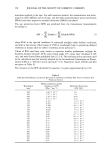
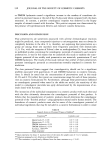
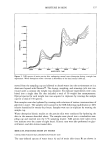
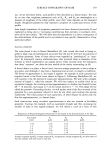
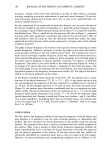
170 JOURNAL OF THE SOCIETY OF COSMETIC CHEMISTS Table IV Results of TUKEY-A Significant Difference Test for Dry Leg Rating After Lotion Treatment Near-infrared reflectance analysis Significant difference Product code N Means S.D. (p • .05) A 90 1.40 0.36 A vs. C, D B 81 1.52 0.53 B vs. C, D C 91 1.72 0.50 C vs. D D 91 2.01 0.55 Judges' score Significant difference Product code N Means S.D. (p • .05) A 120 1.01 0.85 A vs. B, C, D B 110 1.52 0.86 B vs. D C 120 1.71 0.84 C vs. D D 120 2.10 0.76 N = Number of samples. S.D. = Standard deviation. p = Probability statistic. other. Using the prediction equation of Table III, a rating can be obtained from NIR optical spectra taken during the dry leg regression experiment. Overall scores resulting from individual product treatments obtained from the judges or from NIR can then be subjected to ANOVA. The overall means, standard deviations, and significant differ- ences for the four products tested are listed in Table IV. As expected, since the score and NIR are highly correlated, the product ranks and magnitude are similar. The subjective evaluation shows a relative standard deviation of 58%, while that of NIR is 32%. Similar significant differences are also found in the multiple comparison test. These results indicate that the objective NIR prediction equation can differentiate product efficacy at least as well as the subjective judging method and that it can do so with a smaller relative standard deviation. SUMMARY Commercially available near-infrared reflectance spectrometers and their standard che- mometric data analysis software have proven to be a viable technique for the estimation of the moisture content of skin, both in vitro and in vivo. Optical spectra easily distin- guish between free water, indicated by a blue shifted narrow water combination band, versus bound water, indicated by a red shifted broad combination band. Correlation of NIR wavelengths with expert grader evaluations of skin condition was high, resulting in equal ability of NIR to differentiate between product treatments. The technique has proven to be fast, nonocclusive, and linearly correlated with water content and subjec- tive evaluation of dry leg. ACKNOWLEDGMENTS The authors would like to thank Dr. Norman Meltzer for his valuable commentary, and

MOISTURE IN SKIN 171 Louise Aust of Hill Top and Judith Rahn of our labs for scheduling the in vivo experi- ments. REFERENCES (1) R. O. Ports, Stratum corneum hydrarion: Experimental techniques and interpretation of results. J. Soc. Cosmet. Chem., 37, 9-33 (1986). (2) G. L. Grove, Design of studies ro measure skin care product performance. Bioeng. Skin, 3, 375-382 (1987). (3) J. R. Hansen and W. Yellin, "NMR and Infrared Spectroscopic Studies of Stratum Corneum Hydra- rion," in Water Structure at the Water-Polymer Interface, H. H. G. Jellinek, Ed. (Plenum, New York, 1972). (4) K. Walkley, Bound water in stratum corneum measured by differential scanning calorimetry, J. Invest. Dermatol., 59, 225-227 (1972). (5) S.C. Harvey and P. Hoeksrra, Dielectric relaxation spectra of water adsorbed on lysozyme, J. Phys. Chem., 76(21), 2987-2994 (1972). (6) S. L. Jacques, Water Content and Concentration Profie in Human Stratum Corneum, Thesis, University of California, Berkeley, 1984. (7) L. J. Bellamy, Some wider uses of group frequencies, Appl. Spectros., 33, 439-443 (1979). (8) A.M. Kligman, Regression method for assessing the efficacy of moisrurizers. Cosmet. Toiletdes, 93, 27-35 (1978). (9) K. H. Norris and J. R. Hart, "Direct Spectrophotometric Determination of Moisture Content in Seeds," in Proceedings of the 1963 International Symposium on Humidity and Moisture.' Principles and Methods of Measuring Moisture in Liquids and Solids, 4th ed. (Reinhold, New York, 1965), pp. 19-25. (10) J. M. Conway, K. H. Norris, and C. E. Bodwell, A new approach for the estimation of body com- position: Infrared interactance, Am. J. Clin. Nurt., 40, 1123-1130 (1984). (11) M. Martens and H. Martens, Near-infrared reflectance determination of sensory quality of peas. Appl. Spectros., 40(3), 303- 310 (1986). (12) D. E. Honigs, Near infrared analysis, Anal. Instr., 14, 1-62 (1985). (13) P. L. Walling and J. M. Dabney, Process control of shampoo with near-infrared reflectance spectros- copy,J. Soc. Cosmet. Chem., 39, 191-199 (1988). (14) D. L. Van der Meulen and N. Ressler, A near-infrared method for studying hydration changes in aqueous solution: Illustration with protease reactions and protein denaturation, Arch. Biochem. Biophys., 199, 180-190 (1980). (15) D. L. Van der Meulen and N. Ressler, A near-infrared analysis of water-macromolecule interactions: Hydration and the spectra of aqueous solutions of intact proteins, Arch. Biochem. Biophys., 199, 197-205 (1980). (16) N. Ressler and Ziauddin, An improved technique for the near infrared study of water binding by proteins, Biochim. Biophys. Acta, 295, 30-36 (1973). (17) N. Ressler, Ziauddin, C. Vyqantas, W. Janzen, and K. Karachorlu, Improved techniques for the near infrared study of water binding by globular proteins and intact tissues, Appl. Spectroscopy, 30, 295-302 (1976). (18) W. A. Luck, "The Hydrogen Bond," P. Shuster, G. Zundel, and C. Sandotty, Eds. (North Holland Publishing, Amsterdam, 1976), Vol. III, pp. 1369-1423. (19) R. Cooke and I. D. Kuntz, The properties of water in biological materials, Ann. Rev. Biophys. Bioeng., 3, 95-126 (1974). (20) J. Zar, "Multiple Comparisons," in Biostatistical Analysis, Ed. (Prentice-Hall, Inc., New Jersey, 1974).
Purchased for the exclusive use of nofirst nolast (unknown)
From: SCC Media Library & Resource Center (library.scconline.org)