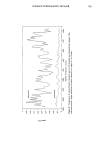
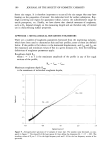
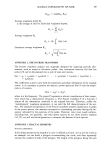
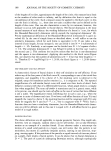
SHAVING CLOSENESS 149 Regarding the specifics of determining shaving closeness using Protocol 3, the fol- lowing points deserve emphasizing: The technique can only be used in a comparative mode, i.e., when two products are tested simultaneously in a "cross-over" protocol. The absolute values of the rate constants and half times do not have significances the values obtained in one test cannot be used for comparisons with those of other tests. Since it is difficult to always employ the same panelists and judges in different tests (e.g., in all three of our tests, the panelists and judges were not all the same people), the reproducibility of the absolute value of k is an insufficient measure of the reliability of the test. In addition, for an individual shaver, the rate of beard hair growth can fluctuate considerably (4), depending on climatic, emotional, and other conditions. Similar fluctuations, no doubt, occur in judges' assessments, too. Therefore, even if exactly the same panelists and judges could be used, considerable variations in the absolute values of k and t• would be expected. Our protocol minimizes this source of error but, by the same token, only allows conclusions regarding relative differences and not absolute values. In conclusion, we can state that we developed a technique that measures differences of perceived shaving closeness obtained with pairs of shaving products in a reproducible way. The technique also provides relative values of the lastingness of shaves. REFERENCES (1) C. Ackerman, M. Breuer, R. Sneath, and S. Pozzi. "The Measuring of Shaving Closeness by Image Analysis," in Proceedings of the 15th IFSCC Congress, Vol. 1, pp. 145-176 (1988). (2) S. S. Stevens, Psychophysics (John Wiley & Sons, New York, 1974). (3) E. L. Cusslet, Predicting Skin Feel in Cosmetic Science, Vol. I, M. Breuer, Ed. (Academic Press, New York, 1978). (4) M. Ono and T. Abe. J. Physiol. Soc. Japan, 25, 254 (1963).

j. Soc. Cosmet. Chem., 40, 151-171 (May/June 1989) Moisture in skin by near-infrared reflectance spectroscopy PRISCILLA L. WALLING and JACQUELYN M. DABNEY, Advanced Spectroscopy, Helene Curtis Inc., Chicago, IL 60639-4769. Received January 13, 1989. Synopsis The nature of water binding in excised porcine skin was evaluated by near-infrared reflectance spectroscopy. Prediction equations for "free" water and "bound" water were derived using multiple regression analysis. The technique was also used to correlate the subjective evaluation of "moisturizers" via the dry leg regres- sion method to near infrared wavelengths. The results indicate a high correlation between the ratings and near infrared wavelengths associated with water. INTRODUCTION • . The ability of a cosmetic preparation to alter the consumer perception of skin feel and appearance has long been ascribed to the product's ability to "moisturize" the skin. Although "moisturize" is difficult to define, it connotes to the consumer some ability of the product to moisten or retain moisture in the skin to alleviate uncomfortable dry skin conditions. Several instrumental techniques have been devised in an effort to corre- late moisture content of skin with "moisturizer" efficacy to dry skin. An excellent review of the recent technological advances in measuring water content in vivo has been published by Potts (1). These include transepidermal water loss (TEWL), mechanical deformation, electrical conductivity, infrared spectroscopy, and photoacoustic spectros- copy. All of these techniques have drawbacks. Several use probes or detection surfaces which are occlusive and thus cause a false water build-up at the skin's surface. Mid-in- frared attenuated total reflectance (MIR-ATR) spectroscopy, for example, is an occlu- sive technique which requires that the skin, usually of the forearm, be applied with pressure onto an internal reflectance element. This causes a chance in water content as the measurement progresses, usually in a minute or two. Electrical conductivity is not only occlusive and pressure-sensitive but is also not linearly correlated to water content. TEWL is extremely environment-sensitive and therefore requires several minutes of equilibration time in order to obtain stable readings. Grove (2) has addressed other problems associated with instrumental measurements, including the lack of commercial availability of an instrument for confirmation of results. Grove also is concerned that very little work has been done in correlating instrumental measurements with consumer perception and/or expert grader evaluations of skin condition. For the cosmetic chemist, the measurement of skin condition is limited to the thin outer sheath of the keratinized epidermis called the stratum corneum. This environ- 151
Purchased for the exclusive use of nofirst nolast (unknown)
From: SCC Media Library & Resource Center (library.scconline.org)