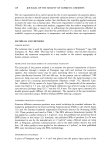
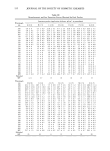
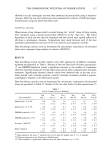
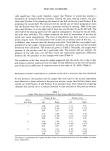
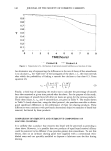
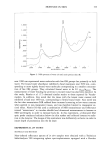
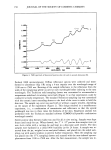
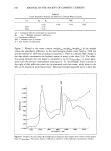
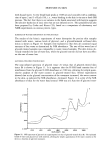
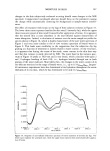
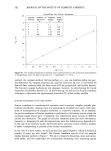
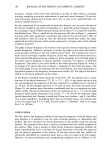
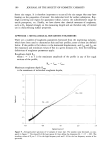
166 JOURNAL OF THE SOCIETY OF COSMETIC CHEMISTS The four oil-in-water test lotions described according to their major ingredients were: ß Product A, cationic containing glycerol and petrolatum ß Product B, anionic containing glycerol and ceteryl alcohol ß Product C, cationic containing petrolatum and mineral oil ß Product D, cationic containing propylene glycol RESULTS AND DISCUSSION (IN VIVO) The average spectrum obtained from the dry leg regression experiment in which 360 data files were collected is shown in Figure 14. The two peaks characteristic of water overshadow and merge into all other features except the CH characteristic doublet be- tween 1600- 1800 nm. A shown in the in vitro experiments, this merging of the water bands (1450, 1922 nm) into the NH bands (1500, 2050 nm) becomes more pro- nounced as the water content is increased. Also, the increased depth of penetration results in a spectrum from only diffuse reflectance in contrast to the transflectance (transmission/reflectance) spectrum of the in vitro experiment. In other words, the poorly resolved in vivo spectrum results from the high absorptivity and high-but-con- stant spectral scatter in the skin. When compared to the in vitro porcine skin spectra of Figure 5, reflectance at the NIR wavelengths for in vivo skin must penetrate into the deeper dermal tissues, which are saturated with water. This background interference should theoretically be compensated for with the use of regression analysis. The visual 1.4000- i.2000' • 1.0000' • 0.8000' 0.6000- 0.4000- 0.2000 1200 - • ---• •- I .... •- -½ .... • t i -I '- I 0 1400.0 1600.0 1800.0 2000.0 2200.0 2400.0 HAVELENGTH Figure 14. Average spectrum of 600-hundred-sample set collected during the dry leg regression experi- ment.

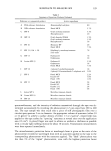
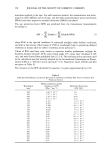
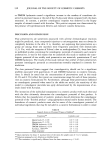
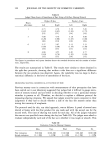
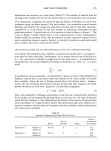
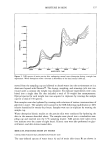
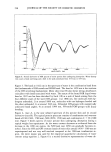
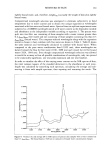
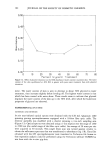
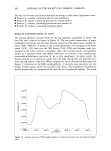
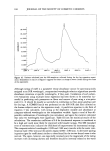
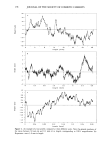
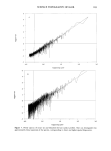
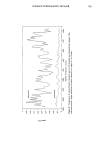
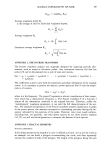
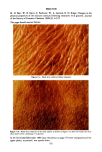
MOISTURE IN SKIN 167 changes in the skin subjectively evaluated as rating should cause changes in the NIR spectrum. Computerized wavelength selection should focus on the parameter causing the change while automatically correcting for background or sample-matrix interfer- ences. The effect of treatment with lotion on the legs of three subjects is shown in Figure 15. The lower three traces represent baseline for skin rated 3 (severely dry), while the upper three traces are typical of skin rated 0 (smooth) after application of lotion. It is apparent that the treated skin is more absorbant in the near-infrared regions characteristic of water absorption. Indeed, a calculation of variance over the entire sample set yields the spectra shown in Figure 16, which is highly characteristic of the pure water spectrum of Figure 3 and even more similar to the in vitro variance spectrum of bound water in Figure 9. This lends some credibility to the supposition that the subjective dry leg grading as a function of treatment is indeed related to water content. At the very least, it is apparent that during the course of the study, water content in the skin does vary and that this variance is easily detected by NIR. The water band in the variance spec- trum of Figure 16 peaks at 1929 nm and is very broad, which coincides with types 2 and 3 hydrogen bonding of Luck (18), i.e., hydrogen bonded through one or both protons of the water molecule. Most likely then, the changes in the water content of in vivo skin are restricted to the range of bound water, i.e., up to 0.34 gwater/gskin . Jacques' (6) microwave experiments have also determined a low hydration throughout the entire thickness of in vivo skin, which he has determined to be only 0.2 gwate•/g,kin- i.6000 • 1.4000' 1.2000 1.0000 0.8000 0.6000 0.4000' 0.2000 1200 ..... •-- -f ----•------f---- • I- •- • -- • 0 1400.0 1600.0 1800.0 2000.0 2200.0 2400.0 WAVELENGTH Figure 15. Response of near-infrared reflectance spectrum of lotion treatment of severely dry legs. The lower traces represent the untreated state, while the upper traces represent skin rated smooth after applica- tion of lotion.
Purchased for the exclusive use of nofirst nolast (unknown)
From: SCC Media Library & Resource Center (library.scconline.org)