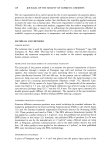
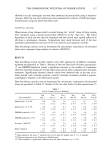
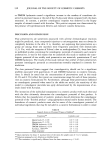
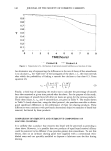
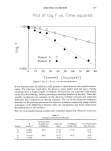
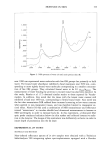
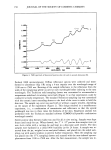
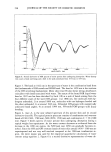
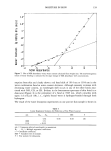
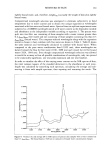
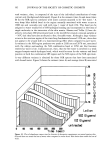
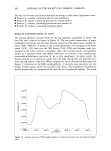
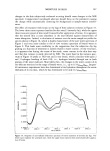
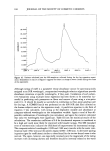
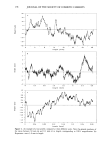
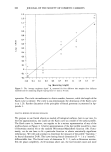
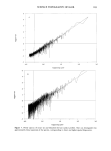
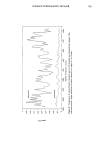
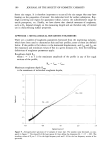
162 JOURNAL OF THE SOCIETY OF COSMETIC CHEMISTS total variance, then, is composed of the sum of the individual contributions of water content only (background eliminated). Figure 8 is the variance (trace A) and mean (trace B) for the NIR spectra correlated with water contents assumed to be "free water." A very sharp blue shifted band in the region normally associated with water occurs at 1888 nm and coincides very well with type 1 water of Luck (18). This band can be assigned to water totally free of OH hydrogen bonding and incorporated in the form of single molecules in the interstices of the skin matrix. Hansen and Yellin (3) have ob- served a very sharp OD (deuterium) band in the mid-IR for stratum corneum samples at - 50øC that they have also attributed to free, freezable water. Although a large variance occurs in the overtone region of the stretching fundamental around 1450 nm, there does not appear to be a band shift or a band-narrowing effect when compared to pure water. A variance in the NH region produces two peaks at 2020 nm and 2076 nm, associated with the valleys surrounding the NH combination band at 2050 nm that becomes resolved as water is lost. Indications are, then, that the free water is involved in a weak oxygen-lonepair-amide hydrogen bond, which would account for the variance and band position in both the combination OH region and the NH region of the NIR spectrum. A very different variance is obtained for those NIR spectra that have been associated with bound water. Figure 9 shows the variance (trace A) and average (trace B) associated io• • 1.25 I•l i.oo 0 C Lotion 50Z GI !dcero I 10Z Glycerol 0 IiO 100 11XI • 250 Time Figure 10. Plot of absorbance versus time for kinetics of desorption experiments on treated porcine skin. Glycerol does not retard the loss of water when compared to water alone. Skin lotion does retard the loss of water.

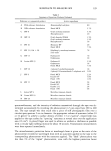
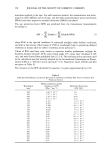
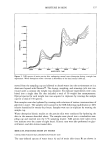
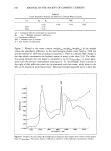
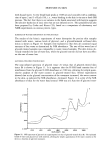
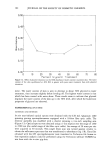
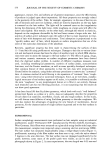
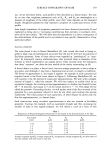
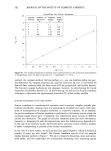
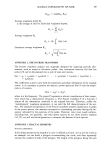
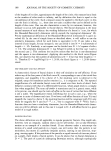
MOISTURE IN SKIN 163 with bound water. A very broad band peaks at 1928 nm and coincides with a combina- tion of types 2 and 3 of Luck (18), i.e., water binding in the skin is via one or both OH protons. The fact that there is no variance in the bands associated with keratin suggests the selective hydration of ionic sites that are not infrared-active. This possibility has also been proposed by Cooke and Kuntz (19), based on a comparison of calorimetry and NMR experiments on various protein types. KINETICS OF WATER DESORPTION IN PORCINE SKIN The results of the kinetic experiments of water desorption for porcine skin samples treated with water, various levels of glycerol, and a glycerol/mineral oil-based skin lotion is shown in Figure 10. Samples were hydrated so that they all contained equal amounts of free water as determined by NIR absorbance. The rate of free water loss of glycerol-treated samples was comparable to water-treated samples. The skin lotion ob- viously retarded the rate of water loss, while the glycerol content did not have any effect on the rate of water loss. GLYCEROL-TREATED PORCINE SKIN The near-infrared spectrum of glycerol (trace A) versus that of glycerol-treated skin (trace B) is shown in Figure 11. It is apparent that the H-OH band remains free of interference from the glycerol C-OH absorbance at 2100 nm, allowing for simple quan- titative analyses of the water content in glycerol-treated skin. Several experiments showed that as the glycerol concentration of the treatment increased, the water content in the skin, as indicated by NIR absorbance, decreased. Figure 12 is a plot of the NIR absorbance of skin for the water band around 1900 nm as a function of glycerol treat- 2.000. to t. 500. B z '• t .000- .500- • 0. 000 I ' I ' t- ' I * I ' I ' I ' 1200 t 400 1600 t{]00 2000 2200 2400 NAVELENGTH Figure 11. NIR spectrum of glycerol (A) superimposed on that of glycerol-treated skin (B). The hydroxyl bands of water and glycerol are well resolved, allowing for simple quantitation of the water content in the skin as a function of glycerol treatment.
Purchased for the exclusive use of nofirst nolast (unknown)
From: SCC Media Library & Resource Center (library.scconline.org)