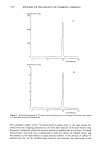
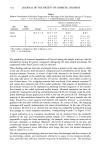
320 JOURNAL OF THE SOCIETY OF COSMETIC CHEMISTS extract chromatograms. One would expect, though, that if squalene is building up, this effect would be evident in our ten-cycle data even if much is vaporized after one cycle. However, there is no evidence of this, and we are at a loss to explain this anomaly between these and the Thompson data for the squalene component. In summary, our data show that for one soil/wash cycle, surfactants do selectively clean sebum components from hair at low concentrations. But, as a first approximation, the amount of sebum removed is a function of the detergency of the surfactant, and thus the difference between SLES-2 and ALS is primarily a function of the superior detergency of the former [as predicted by surfactant theory (10) SLES-2 has the lower cmc] rather than differences in selective cleaning. The non-polar sebaceous components (paraffin waxes, esters) are more difficult to remove than the more polar ones, but we contend that the overall surfactant detergency is the determining factor. For ten soil/wash cycles, we find that SLES-2 is superior, and a build-up is found on hair washed with ALS under both (a) the model conditions using 0.01% surfactant and bulk washing and (b) realistic conditions using 10% surfactant and handwashing. This we attribute to hard water/fatty acid interactions. We believe that the data of this paper provide suffi- cient evidence to warrant extended use testing of potential surfactant systems for oily soil detergency in the manner described. REFERENCES (1) M. Gloor, Determination and analysis of sebum on skin and hairs, Cosmet. Sci., 1, 217 (1978). (2) J. Koch, K. Aitzetmuller, G. B. Horf, and J Waibel, Hair lipids and their contribution to the perception of hair oiliness: Parts I and II, J. Soc. Cosmet. Chem., 33, 317- 343 (1982). (3) K. V. Curry and S. Golding, Hair lipids. I. The extraction of fatty materials from hair clippings, J. Soc. Cosmet. Chem., 22, 681 (1971). (4) A. W. Weitkamp, A.M. Smiljanic, and S. Rothman, The free fatty acids of human hair fat,J. Am. Oil Chem. Soc., 69, 1936 (1947). (5) D. A. Shaw, Hair lipid and surfactants. Extraction of lipid by surfactants and lack of effect of sham- pooing on rate of re-farting of hair, Int. J. Cosmet. Chem., 1, 291-302 (1979). (6) M. M. Breuer, Cleaning of hair, J. Soc. Cosmet. Chem., 32, 437-458 (1981). (7) D. Thompson, C. Lemaster, R. Allen, and J. Whittam, Evaluation of relative shampoo detergency, J. Soc. Cosmet. Chem., 36, 271-286 (1985). (8) W. G. Spangler, H. D. Cross, and B. R. Schaafsma, A laboratory method for testing laundry products for detergency, J. Amer. Oil Chem. Soc., 42, 723-727 (1965). (9) J. Clarke, Unpublished data. (10) Milton J. Rosen, Surfactants and Interfacial Phenomena, 2nd ed. (Wiley-Interscience, 1989), pp. 363-392.

j. Soc. Cosmet. Chem., 40, 321-333 (November/December 1989) Comedogenicity and irritancy of commonly used ingredients in skin care products JAMES E. FULTON, JR., Acne Research Institute, 1236 Somerset, Newport Beach, CA 92660. Received September 3, 1989. Presented at the Southern California Section, California Chapter, Society of Cosmetic Chemists, Spring 1989. Synopsis A survey, using the rabbit ear, of the comedogenicity and irritancy of several groups of skin care products indicates that many contain follicular and surface epithelial irritating ingredients. These ingredients fall into several chemical classes. Certain generalizations can be deduced by examining the results: (1) me- dium-chain-length fatty acids are more potent than short- or long-chain fatty acids in producing follicular keratosis, (2) the comedogenicity and irritancy of an organic material can be reduced by combining the molecule with a polar sugar or a heavy metal, (3) increasing the degree of ethoxylation in a molecule tends to reduce the comedogenicity and irritancy of the chemical, and (4) the longer chain lipids, i.e., waxes, appear too large to produce a reaction. By following the guidelines developed in this study, it is possible to formulate nonirritating, noncomedogenic moisturizers, sunscreens, hair pomades, cosmetics, and condi- tioners. INTRODUCTION The possibility of comedogenicity and irritancy of facial skin care products has been well documented (1- 3). Because of this work and an increasing public awareness, facial products that are less comedogenic are now becoming available (4). However, other skin care products such as hair conditioners, hair pomades, moisturizers, sunscreens, and even acne treatment products may be a source of cosmetic acne. By taking these products apart, testing their ingredients, and putting them back together and retesting them, an extensive ingredient listing has been created. By studying this list, the cos- metic chemist can begin to be selective in developing formulas for less irritating and less comedogenic products. The rabbit ear assay has been used since the mid-1950s as a method of measuring follicular keratinization by externally applied compounds (5). The advantage of this rapid screening tool is that it takes only two weeks to develop follicular impactions in the rabbit ear, while it may take six months to develop similar reactions on human skin. The disadvantage of the model is its extreme sensitivity. The fragile, protected epithe- lium of the inner ear is extremely sensitive. Not everything that irritates this model will also irritate human skin. However, this extensive screening of cosmetic formula- 321
Purchased for the exclusive use of nofirst nolast (unknown)
From: SCC Media Library & Resource Center (library.scconline.org)