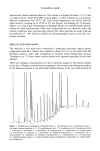
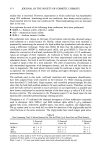
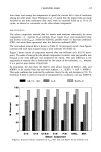
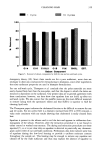
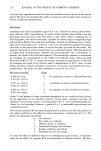
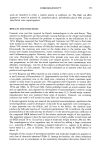
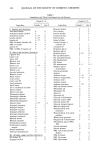
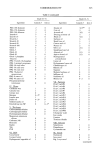
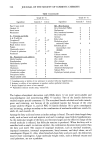
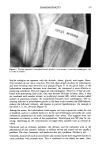
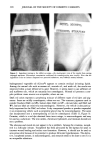
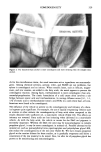
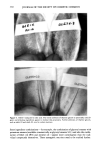
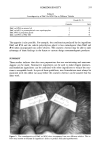
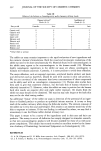
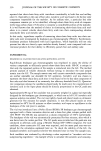
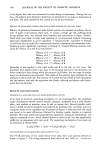
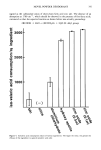
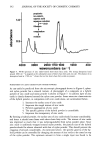
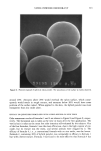
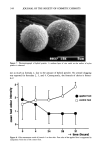
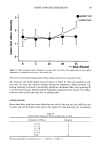
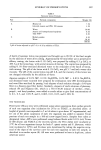
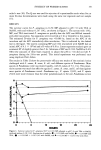
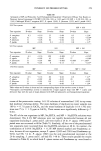
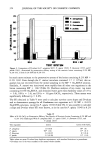
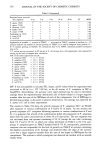
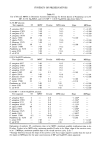
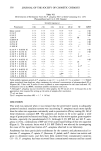
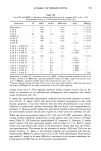
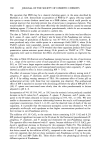
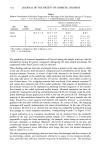
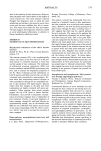
NOVEL POWDER DEODORANT 345 _ r- 0 •_ 0 E O- applied foot (•control foot 0 4 24 28 31 time (hours) Figure 9. Odor assessment result of formula 4 on foot odor. Foot odor of the applied foot is only slightly suppressed in comparison with that of the control foot. EFFICACY OF QUENCHERS FORMULATED WITH HYBRID POWDER ON AXILLARY ODOR The results of the double-blind trials are shown in Table II. The total number of sub- jects was 18, since two subjects resigned during the assessment. Hybrid powder con- taining quencher A showed a statistically significant deodorant effect over quencher B, a conventional formula. Hybrid powder-formulated quenchers were proven to be effica- cious not only on foot odor but also on axillary odor. CONCLUSIONS Short-chain fatty acids have been identified not only in the foot and the axilla but also in other sites of the human body such as the vagina (3), hair and scalp (4), and physio- Table II Double-Blind Assessment Results of Quenchers A and B Comparison of efficacy Evaluation A•B 4 AB 8 A=B 1 AB 4 A•B 1 Total 18 Wilcoxon sign-rank test evaluation: Uo = 1.7328 Po = 0.0831 +.

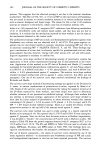
346 JOURNAL OF THE SOCIETY OF COSMETIC CHEMISTS logical fluids (5). Along with low-molecular-weight compounds containing nitrogen and sulfur, short-chain fatty acids seem to comprise a considerable portion of human body malodors. The best method to efficiently eliminate short-chain fatty acids was considered to be through chemical reaction converting them into their corresponding odorless metallic salts. Out of the several chosen candidates, zinc oxide was found to be most suitable. Taking into account the several shortcomings that zinc oxide possesses, we have devel- oped a hybrid powder consisting of a spherical nylon resin as the core whose surface is uniformly covered with fine particles of zinc oxide. This hybrid powder overcomes zinc oxide's drawbacks, especially those encountered upon formulating it into deodorant products, without sacrificing any of its deodorizing power. The body odor quenchers formulated with hybrid powder were assessed on subjects with strong foot and axillary odor, and were found to be more efficacious in eliminating malodors as compared with conventional antiperspirants and deodorants. The hybrid powder body odor quencher is a novel deodorizer that theoretically not only prevents the generation of body malodor as conventional products do, but also chemi- cally "quenches" body malodor once formed from short-chain fatty acids. This concept is applicable to body odors from regions other than the foot and axilla, provided that the key odor components are short-chain fatty acids. REFERENCES (1) F. Kanda, E. Yagi, M. Fukuda, K. Nakajima, T. Ohta, O. Nakata, and Y. Fujiyama, Elucidating body malodour to develop a novel body odour quencher, 15th IFSCC International Congress Preprints, Vol. 3, 529-562 (1988). (2) H. Boelens, H. G. Haring, and D. de Rijke, Threshold values of and human preferences for 4-ethyl octanoic and 3-methyl butanoic acid, Perfum. Flav., 8, 71-74 (1983). (3) G. Preti and G. R. Huggins: Cyclical changes in volatile acidic metabolites of human vaginal secre- tions and their relation to ovulation, J. Chem. Ecol., 1, 361 (1975). (4) N. Goetz, G. Kaba, D. Good, G. Hussler, and P. Bore, Detection and identification of volatile compounds evolved from hair and scalp using headspace gas chromatography, J. Soc. Cosmet. Chem., 39, 1-13 (1988). (5) T. L. Perry, S. Hansen, S. Diamond, B. Bullis, C. Mok, and S. B. Melacon, Volatile fatty acids in normal human physiological fluids, Clin. Chim. Acta, 29, 369-374 (1970).
Purchased for the exclusive use of nofirst nolast (unknown)
From: SCC Media Library & Resource Center (library.scconline.org)