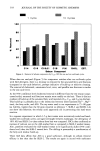
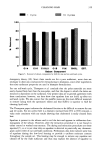
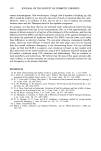
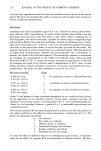
312 JOURNAL OF THE SOCIETY OF COSMETIC CHEMISTS The higher soiling level, however, was most often used in this work as it facilitates the subsequent gc analysis of the sebum. After the soiled tresses were dry, each was split into two swatches of about 1.7 to 1.8 g each. One of each pair was washed with the appropriate surfactant. The other portion remained unwashed and acted as an internal control. This was necessary to compensate for sample-to-sample variation in soiling levels. TEN-CYCLE SOIL/WASH EXPERIMENT For the ten-cycle soil/wash experiment, the tresses were split as described above, with one swatch kept as control. The other portion was then washed and dried (described below) and placed in a constant humidity room overnight. The next day these tresses were soiled again with sebum, allowed to dry at room temperature, and placed in the constant humidity room overnight. The following day the tresses were again washed with the appropriate surfactant. This soil/wash cycle was carried out ten times. The order for both soiling and washing procedures was randomized. HAIR-CLEANING PROCEDURE Cleaning of the soiled tresses was achieved using a bulk process similar to that described in reference 7. The soiled hair tress was suspended in 100 ml of either 0.1% or 0.01% aqueous surfactant at 110øF and agitated (magnetic stirrer) for five minutes. Tresses were then rinsed under running tap water (105øF) for 20 seconds (total rinse volume 500-600 ml). Heat from a hand-held drier was applied for one minute and the drying completed at room temperature. Conditioning in the humidity room followed. These surfactant concentrations are very low and for SODS-1 are below the cmc. Since oily soil removal occurs through solubilization via micelies, we would expect poor re- suits with this surfactant. In fact, even at concentrations above the cmc, SODS-1 is a poor detergent for removing oily soil. It is included in this study as a negative control. EXTRACTION OF SEBUM FROM HAIR Before the sebum residues were extracted, all tresses were placed in a forced air draft oven at 55-60øC for four hours. This helped to ensure a uniform moisture content throughout the sample set. About 1 g of hair from each tress was weighed into a vial, 20 ml of hexane added, and the sealed vial shaken on a mechanical shaker for 30 minutes. Hexane was used as the extraction solvent based on data presented in reference 7. These data claim chromatographic profiles of the hexane extract of sebum-soiled tresses to be comparable to profiles of standard sebum/hexane solutions. After shaking, 15 ml of solution was pipetted from each vial into a previously weighed second vial. The sample was evaporated to dryness (at room temperature) by gently blowing filtered nitrogen over the liquid surface. Subsequently the vials were weighed to estimate total extracted sebum, and the residues analyzed by gas chromatography to determine sebum composition. Sample residues were dissolved in hexane containing internal standard, Eicosane, to a concentration of approximately 6 mg/ml. Sample in- jection amount was 0.4 microliters. The analyses were performed on a Carlo Erba Mega 5360 High Resolution Capillary Gas Chromatograph fitted with a cold on-column

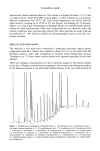
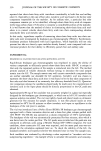
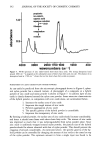
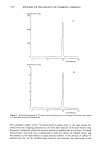
CLEANING HAIR 313 injector and a flame ionization detector. The column is a Supelco 60 meter X 0.75 mm i.d. glass column coated with SPB-1 liquid phase to a film thickness of 1.0 microns. Detector temperature was 325øC. GC oven initial temperature was 220øC, held for eight minutes, ramping up to 310øC at 4øC per minute, and holding for 55 minutes. Figure 1 is a typical gas chromatogram of Spangler sebum we confirmed peak identifi- cations by mass spectrometry. Note that triglycerides are not detected under the column conditions used previous data indicate that these materials are easily removed by surfactants (7). We intend to modify our chromatographic system to test this con- clusion ourselves. RESULTS AND DISCUSSION The objective in this work was to determine if surfactants selectively remove sebum components from hair. Tresses were washed in dilute (0.01 to 0.1%) bulk (100 ml) detergent solution rather than attempting to simulate actual shampooing, because Thompson et al. (7) have shown similar results with improved precision by the bulk method. These low detergent concentrations are used to facilitate analysis of the sebum residues on the hair. If higher concentrations are employed, the recovery and subsequent analysis of the sebaceous residue is not practically feasible because of the very small amount of 456 20 21 22 23 24 25 Figure 1. Capillary gas chromatogram of Spangler sebum. 1. Tetradecanoic acid 2. hexadecanoic acid 3. n-eicosane (internal standard) 4. 9, 12-octadecadienoic acid 5. 9-octadecanoic acid 6. octadecanoic acid 7. n-docosane 8. n-tricosane 9. n-tetracosane 10. n-pentacosane 11. n-hexacosane 12. n-heptacosane 13. n-octacosane 14. squalene 15. n-nonacosane 16. hexadecyl dodecanoate 17. n-triacontane 18. n- hentriacontane 19. cholesterol 20. hexadecyl tetradecanoate 21. n-dotriacontane 22. n-tritriacontane 23. hexadvcyl hexadecanoate 24. octadecyl hexadecanoate and hexadecyl octadecanoate 25. higher molec- ular weight ester.
Purchased for the exclusive use of nofirst nolast (unknown)
From: SCC Media Library & Resource Center (library.scconline.org)