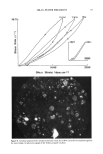
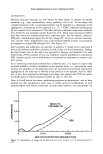
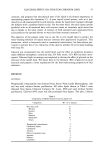
18 JOURNAL OF THE SOCIETY OF COSMETIC CHEMISTS Exo 1:10 1:20 1:30 1:60 1:120 __ ,,, Endo I I I t 50 6•0 70 TEMPERATURE (øC) Figure 10. Differential scanning calorimetry scans of aged ternary ceteth 20/cetearyl alcohol/water systems. The numbers are the molar ratios of surfactant to alcohol (29). little as 1 mole % surfactant, there does appear to be a definite range of surfactant concentrations over which the ternary viscoelastic gel network phases form. Within the range, the relative proportions of the gel, crystalline, and bulk water phases change as surfactant concentration alters.

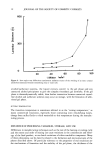
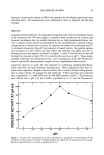
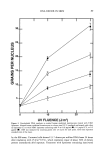
OIL-IN-WATER EMULSIONS 19 The effect of surfactant concentration in a ceteth 20/cetearyl alcohol/water ternary system was investigated recently (29). At surfactant concentrations greater than t0 mole % (l:t0), there is little crystalline phase and the system is translucent. As the surfactant concentration reduces, the crystalline phases become more prominent and the gel phases reduces, until at a molar ratio of 1:120 little gel phase is present. The changes in the relative proportions of the phases were followed by DSC where the low-temperature crystalline endotherm develops and the high-temperature gel en- dotherm diminishes as surfactant concentration increases (Figure t0). With high sur- factant concentrations (greater than approximately 30 mole %), the gel networks con- vert to an isotropic phase and systems are mobile. 4'0- 3.0 o . 2.0 1'0 ' 2'5 3'5 I •' 5 •5 6'0 ' Temperature (øC) Figure 11. Variation of apparent relative viscosity with temperature for a cetearyl alcohol/cetrimonium bromide emulsi•ing wax in 94% water and a liquid paraffin-in-water emulsion prepared with the same wax (1).
Purchased for the exclusive use of nofirst nolast (unknown)
From: SCC Media Library & Resource Center (library.scconline.org)