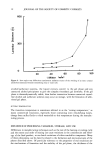
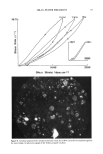
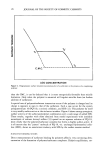
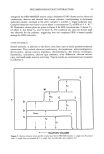
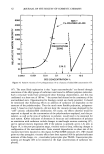
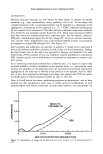
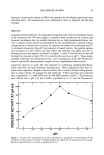
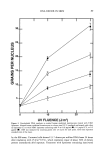
20 JOURNAL OF THE SOCIETY OF COSMETIC CHEMISTS I I: I i i • o ao •o Time {min) i I 70 90 s(iA) Figure 12. Correlation between (a) the weight of water evaporated from a ternary cetearyl alcohol/cetri- monium bromide/water system and (b) the changes in the low angle x-ray diffraction pattern of this system during evaporation. Each frame represents a two-minute collection period (31). ACCELERATED STABILITY A common method of assessing the physical stability of emulsions is to subject them to adverse storage conditions, including extreme variations in temperature (30). Attempts are then made to correlate stability at an elevated temperature with that at room tem- perature over a much longer time scale. Such data can, however, be misleading in emulsions stabilised by gel phases if the testing temperature is above the phase transi- tion temperature (unless, of course, such temperatures are relevant to normal storage and use). Figure 11 shows the effect on rheological properties of heating an ionic ternary system and emulsion to above the transition temperature. Consistency increases with increase in temperature up to the transition temperature, possibly because of increased incorporation of water between the bilayers, and then rapidly decreases above T c as the systems become mobile. The information gained at temperatures above the transition temperature is thus of limited usefulness in the evaluation of instabilities that might occur on extended storage at lower temperatures. MICROSTRUCTURAL CHANGES DURING USE So far the bulk microstructural properties of complex multiphase emulsions have been considered. However, when an aqueous emulsion such as a "bodied" lotion or cream is applied to the skin as a thin film, its composition will change as a result of the shearing forces of application, the penetration of skin secretions into, or the evaporation of water and volatile solvents out of the film. In recent work, the microstructural changes that occur when thin layers of o/w emulsions and their corresponding ternary systems evaporate were followed by simultaneous evaporation and x-ray diffraction measure- ments (Figure 12). The evaporation process proceeded in three distinct stages: an initial rapid stage where approximately 25 % of the bulk water was lost and there was little change in interlamellar distance a second stage where a further 15 % of the water was released and the first order diffraction patterns moved to shorter interlamellar distances, implying some loss of interlamellar water and the final very slow stage where only interlamellar water is lost and diffraction peaks move to shorter distances. Evaporation

OIL-IN-WATER EMULSIONS 21 under controlled conditions was not complete after 90 minutes, and the microstructural changes were kinetically driven. REFERENCES (1) G. M. Eccleston, "Properties of Materials Used in Semi-Solid Formulations," in Materials Used in Pharmaceutical Formulation, Critical Reports on Applied Chemistry, A. T. Florence, Ed. (Blackwell Scien- tific Publications, London, 1984), Vol. 6, pp. 124-156. (2) G. M. Eccleston, The microstructure of semisolid creams, Pharmacy International, 7, 63-70 (1986). (3) G. M. Eccleston, Application of emulsion stability theories to mobile and semisolid o/w emulsions, Cosmet. Toiletr. 101, 73-92 (1986). (4) G. J. T. Tiddy, Surfactant-water liquid crystal phases, Physics Reports, 57, 1-46 (1980). (5) P. J. Quin and D. Chapman, Membrane lipids, Crit. Reviews Blochem., 8, 1-101 (1980). (6) C. D. Adam, J. A. Durrant, M. R. Lowry, and G. J. T. Tiddy, Gel and liquid crystal phase struc- tures of the trioxyethylene glycol monohexadecyl ether/water system, J. Chem. Soc., Faraday Trans., 80, 789-801 (1984). (7) W. Curatolo, The lipoidal permeability barriers of the skin and alimentary tract, Pharmaceut. Res., 4, 271-277 (1987). (8) R. Rydhag, The importance of the phase behaviour ofphospholipids for emulsion stability, Fette Seifen Anstrich., 4, 168-173 (1979). (9) K. Tanaka, T. Seto, and T. Hayashida, Phase transformations of n-higher alcohols, Bull. Inst. Chem. Res., Kyoto Univ., 35, 123-139 (1958). (10) F. H. C. Stewart, Phase relationships and spreading behaviour of cetyl alcohol mixtures, Austn. J. Appl. Sci., 11, 157-168 (1960). (11) S. Fukushima, M. Yamaguchi, and F. J. Harusawa, Effect of cetostearyl alcohol on stabilization of oil-in-water emulsions, J. Colloid Int. Sci., 59, 159-165 (1977). (12) K. Larsson and N. Krog, Structural properties of the lipid-water gel phase, Chem. Phys. Lipids, 10, 177-180 (1973). (13) N. Krog and A. P. Borup, Swelling behaviour of lameIlar phases of saturated monoglycerides in aqueous systems,J. Sci. Fd. Agric., 24, 691-701 (1973). (14) H. Hauser, Some aspects of the phase behaviour of charged lipids, Biochim. Biophys. Acta, 772, 37-50 (1984). (15) S. Friberg and K. Larsson, "Liquid Crystals and Emulsions," in Advances in Liquid Crystals, G. M. Brown, Ed. (Academic Press, London, 1976), Vol. 2, pp. 173-195. (16) K. Mandani and S. Friberg, Van der Waals' interactions in three phase emulsions, Progr. Colloid Polymer Sci., 65, 164-178 (1978). (17) L. Rydhag and I. Wilton, The function ofphospholipids of soybean lecithin in emulsions, J. Am. Oil. Chem. Soc., 58, 830-837 (1981). (18) L. Rydhag and T. Gabran, Phase equilibria in the system dimyristoyl phosphatidyl choline/hexadecyl trimethylammonium bromide/water at 30øC. Swelling behaviour of the lameliar phase with different electrolyte solutions, Chem. Phys. Lipids, 30, 309-324 (1982). (19) H. E. Junginger, Colloidal structures of o/w creams, Pharmaceut. Weekblad, 6, 141-149 (1984). (20) G. M. Eccleston, M. K. Behan, G. R. Jones, and E. Towns-Andrews, Swelling properties of emul- sifying wax/water gel phases, J. Pharm. Pharmac., 39P (1988). (21) H. K. Patel, R. C. Rowe, J. McMahon, and R. F. Stewart, A systematic microscopical examination of gels and emulsions containing cetrimide and cetostearyl alcohol. Int. J. Pharmaceut., 25, 13-25 (1985). (22) T. de Vringer, J. G. H. Jooster, and H. J. Junginger, Characterisation of the gel structure in a nonionic ointment by small angle x-ray diffraction, Colloid and Polymer Sci., 262, 56-60 (1984). (23) G. M. Eccleston and L. Beattie, Microstructural changes during the storage of systems containing cetostearyl alcohol/polyoxyethylene alkyl ether surfactants, Drug Develop. and Indust. Pharm., 14, (15-17), 2499-2518 (1988). (24) H. K. Patel, R. C. Rowe, J. McMahon, and R. F. Stewart, Properties of cetrimide/cetostearyl al- cohol ternary gels preparation effects. Int. J. Pharmaceut., 25, 237-242 (1985). (25) G. M. Eccleston and L. Beattie, to be published. (26) G. M. Eccleston, The influence of fatty alcohols on the structure and stability of creams prepared with polyethylene glycol 1000 monostearate/fatty alcohols, Int. J. Cosmet. Sci., 4, 133-142 (1982).
Purchased for the exclusive use of nofirst nolast (unknown)
From: SCC Media Library & Resource Center (library.scconline.org)