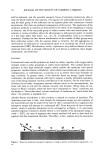
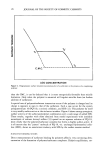
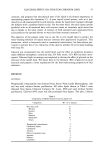
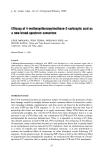
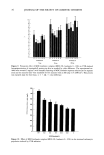
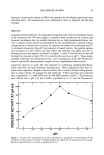
24 JOURNAL OF THE SOCIETY OF COSMETIC CHEMISTS will be hydrated, and the powerful energetic forces of solvation involved are able to carry the whole molecule into solution, even against the unfavorable process of transfer- ring the alkyl group of the surfactant into an aqueous phase that constitutes a hostile environment. But there are profound consequences of this action. The migrations of the surfactant molecule in solution are dominated by the desire of the headgroup to remain in solution, and of the non-polar group to reduce contact with this hostile phase. Ad- sorption at various interfaces allows the alkyl groups to self-associate and/or to transfer to a less polar phase than water, e.g., air, oil, or hydrophobic solid as an adsorbed monolayer. Perhaps the best known manifestation of the transfer of alkyl groups away from molecular contact with the aqueous phase is, however, the self aggregation or micellization of surfactants at concentrations equal to or exceeding the critical micelie concentration (CMC). Micellization, in fact, represents a very delicate balance of inter- molecular forces that is strongly influenced by such factors as surfactant chain length, temperature, and added salt. POLYMERS Conventional water-soluble polymers are based on carbon, together with oxygen and/or nitrogen atoms in polar groupings to confer water solubility. The cardinal feature of polymers is their high molecular weight, which endows the molecules with special properties. Another feature is flexibility, which allows macromolecules to adopt various configurations, or conformations, in solution so as to achieve their most favorable en- ergy condition. In general terms, if the solvation forces are strong ("good solvent" conditions), the polymer molecule will tend to expand, a readily observable manifesta- tion of this being maximal viscosity contribution to the solution. On the other hand, if solvation forces barely compensate internal cohesion forces in the macromolecule, the latter will tend to coil and the solution viscosity will decrease. [These ideas are em- braced in Flory's concepts, where the latter state corresponds to "theta" conditions and the former to "better than theta" solvent conditions. If conditions are "much worse than theta," the polymer is insoluble (5).] Another feature of polymers is their tendency to adsorb at a variety of interfaces. The important point here is that, even though the adsorption energy per each segment of the macromolecule may be small (of the order of lkT), cumulatively for n segments this adsorption energy will amount to a substantial nkT. From the point of view of mecha- nistics, events in polymer adsorption can be envisaged as in Figure 1 if a previously adsorbed segment of polymer desorbs [which is very feasible if the adsorption energy is weak ('" lkT)], the mass of segments that remain attached will tend to draw back the segment that has temporarily desorbed. This effect, in fact, explains why the adsorption b c d e Figure 1. Depiction of polymer adsorption: Segment a, trying to desorb, is held back by segments b, c, d, etc.

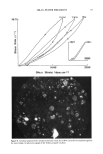
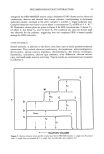
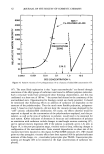
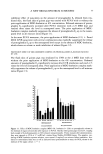
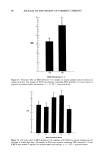
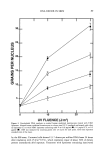
POLYMER/SURFACTANT INTERACTION 25 of polymers tends to be irreversible. It should be noted that both the above tendencies, i.e., to self aggregate or adsorb, are increased if the polymer contains hydrophobic groups. EVIDENCE OF POLYMER/SURFACTANT INTERACTION It is now of interest to discuss what occurs when these two entirely different types of material co-exist in the same aqueous solution. There is much evidence that they tend to associate. Many techniques have been employed to study the association of polymers and surfactants (3). Here we choose a half dozen or so for description and illustration of the phenomena that can occur. SURFACE TENSION A very simple and, as will be seen, informative technique for the study of polymer/sur- factant pairs involves ordinary measurements of surface tension. In these mixtures, it is often the case that the polymer is feebly surface-active hence, the measured surface tension will be a sensor of the free or uncomplexed surfactant in solution. Departure of the mixed systems from the surface tension behavior of polymer-free surfactant solutions is an indication of binding of the surfactant by the polymer or of complex formation. An ideal system is illustrated in Figure 2. Here, as the surfactant concentration is increased, the with- and without-polymer curves will coincide until a critical concentration (T•) for binding is reached. If the binding energy is high enough (and constant), the surfactant concentration, and hence the surface tension, will remain constant until the polymer binding sites are saturated. The resultant plateau will end at the saturation concentration T2'. Beyond this point the concentration of free surfactant will rise and the surface tension will drop along curve T 2' T 2 until regular micelies form, i.e., rejoin the curve of the polymer-free system. The concept of transition concentrations, T• and T2, was introduced by Jones (6) in his studies of polyethylene oxide (PEO)/sodium dodecylsulfate (SDS) pairs. His findings were confirmed and extended by Schwuger (7), who established that a minimum PEO molecular weight of 600 was necessary for the association reaction to occur. At MW 1550 the interaction was more pronounced, and beyond 4000 it was strong and essen- tially independent of molecular weight. See below. Another system that has been widely studied by the surface tension method [e.g., by Lange (8), Schwuger and Lange (9), and Arai and co-workers (10, 11)] is polyvinyl pyrrolidone (PVP)/SDS. Features, essentially similar to those noted with PEO, were obtained (Figure 3) and are summarized as follows: 1. Transition concentrations T• and T 2 straddled the CMC of SDS. 2. T 2 increased directly with the amount of polymer, while T• varied very little. 3. The presence of salt markedly reduced T•, i.e., association occurred at a much lower surfactant concentration in its presence. 4. Constancy of surface tension, implying constant SDS activity, was more evident at higher polymer concentration. The picture that emerges is that an association reaction (see below) of surfactant occurs in the presence of polymer. Since the association reaction starts at a lower concentration
Purchased for the exclusive use of nofirst nolast (unknown)
From: SCC Media Library & Resource Center (library.scconline.org)