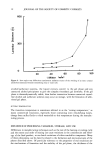
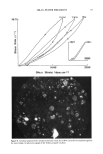
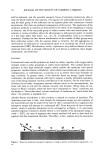
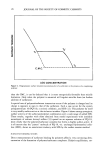
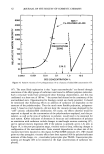
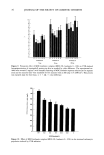
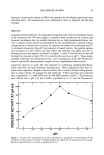
26 JOURNAL OF THE SOCIETY OF COSMETIC CHEMISTS Z z I- LOG CONCENTRATION Figure 2. Diagrammatic surface tension/concentration plot of a surfactant in the presence of a complexing polymer. than the CMC, it can be deduced that it is more energetically favorable than micelie formation. Only when the polymer is saturated will regular micelies form (on further addition of surfactant). A special case of polymer/surfactant interaction occurs if the polymer is charged and its charge is opposite in sign to that of the surfactant. Such a case occurs for the system polyquaternium 10 (PQ-10), a cationic cellulosic, and SDS (12). This polymer by itself is very weakly surface-active at the air/water interface. Figure 4 shows strong synergistic surface activity of the surfactant/polymer combination over a wide range of added SDS. These results, together with those obtained from model experiments with insoluble monolayers of sodium docosyl sulfate (13) spread on an aqueous solution of PQ-10, show clearly that the polymer/surfactant complex that forms is highly surface-active. It is of interest that the "parent" molecule of PQ-10, viz. uncharged hydroxyethyl cellu- lose (HEC), shows no association tendency with SDS by the surface tension method. SURFACTANT BINDING STUDIES Direct measurements of surfactant binding by polymers afford a very convincing dem- onstration of the formation of polymer/surfactant complexes. Dialysis equilibrium, tra-

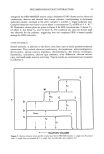
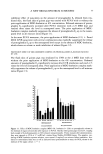
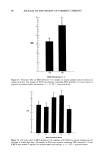
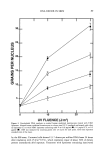
POLYMER/SURFACTANT INTERACTION 27 60 .-o. 50 40 PVP-CONCENTRATION •o• 0 g/I •o I g/I ß 3 g/I ß 10 g/I I I I 10-3 10-2 10-1 CT [10-3mol/I] Figure 3. Surface tension (•/)/concentration plot of SDS in the presence of PVP at various concentrations (8) "T" assignments follow Jones (6). ditionally used for protein binding studies, has been applied by a number of investi- gators to synthetic polymer/surfactant combinations. With this technique, one must add indifferent electrolyte (e.g., 0.1 M NaCI) to avoid Donnan membrane effects. As discussed later, the presence of salt can influence the oberved binding ratio. Combina- tions of SDS and a variety of nonionic polymers [PEO PVP polyvinyl acetate (PVAc) polyvinyl alcohol (PVOH) methyl cellulose (MeC)] have been examined by this method. Typical data for the PEO system (14) are given in Figure 5. It is seen that below a certain (monomer) concentration of SDS no binding occurs. The steepness of the uptake curve suggests a highly cooperative process, and this is followed by a pla- teau. Clearly, this behavior is fully compatible with the surface tension results. Ohbu et al. (15) carried out dialysis studies to study the binding of SDS by a series of cellulosic polymers of varying cationic substitution (CS). Binding was strong and coop- erative in all but the lowest CS case (0.05). The strength of binding was indicated by the fact that it occurred at very low concentrations of SDS at V2oth the CMC, the degree of binding [3 had already reached the value of 0.5 ([3 = 1 corresponds to one bound DS ion for each positive site on the polymer). As noted above, the reason for the strong interaction in such oppositely charge pairs is that potent electrostatic forces are brought into play. Specific ion electrodes. The development of "membrane" electrodes, specific for long-chain surfactant ions, has provided a very useful tool for studying the interaction of such ions with polymers. Illustrative data of Krescheck and Constantinidis (16) on binding of
Purchased for the exclusive use of nofirst nolast (unknown)
From: SCC Media Library & Resource Center (library.scconline.org)