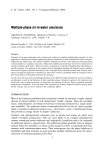
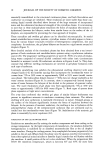
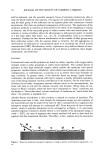
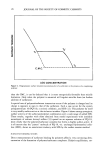
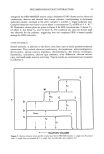
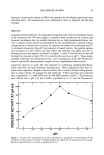
32 JOURNAL OF THE SOCIETY OF COSMETIC CHEMISTS 10 • 1.O ß • O.1 C C SPSPSP P //SP SP SPCC C C SPSPSP P/ P SP C C C C SP SP P// P T C C CC SPSP P/ P T CC - / - / - / - / - / / / I I I I I llll 0,• I I C- CLEAR T-TURBID P= PRECIPITATE SP- SLIGHT PRECIPITATE I '1 IIIII I • • I i II! 1 .O 10 TEALS, WT % Figure 8. Solubility diagram of polyquaternium 10/triethanolamine lauryl sulfate (TEALS) system (12). One can draw a number of conclusions from Cabane's work. First, the environment experienced by carbons C 4 through C•2 of the surfactant in the polymer/surfactant ag- gregate is indistinguishable from that in regular SDS micelies, suggesting that the aggregates themselves are modified micelies. On the other hand, the NMR data show that carbons C• through C 3 of SDS in the polymer/surfactant aggregate are in a different environment, and Cabane suggests that EO groups of the polymer replace water mole- cules in the outer region of the micelies. These ideas will be discussed later in the article. GEL FILTRATION A direct and convenient way to obtain information on the formation and properties of polymer/surfactant complexes involves the use of gel permeation. Sasaki et alo (23) in-

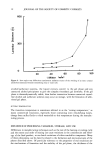
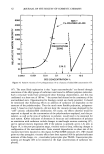
POLYMER/SURFACTANT INTERACTION 33 vestigated the PEO 6000/SDS system using a Sephadex G100 column and an electrical conductivity detector and showed that elution volumes, corresponding to decreasing molecular volume, increased in the order: complex micelles single surfactant ions. Complex formation was found to occur above a concentration (T•) of SDS of 4 X 10⁻³ M. Illustrative elution plots are given in Figure 9 for SDS concentrations (1) below T•, (2) above T• but below T2, and (3) above T 2. For condition (2), only one elution peak was observed for the polymer, suggesting that the complexed SDS is shared equally among the PEO molecules. OTHER TECHNIQUES Several methods, in addition to the above, have been used to study polymer/surfactant interactions. They include electrical conductivity, electrophoresis, ultracentrifugation, electro-optics, optical rotatory dispersion, photochemistry, fast kinetics techniques, fluorescence, calorimetry, electron spin resonance, x-ray diffraction, electron micros- copy, and small-angle neutron scattering. Typical results are summarized and reviewed in reference 3. S If • M c 2 -- ELUTION VOLUME Figure 9. Elution volumes versus specific conductance (K) for PEO-SDS systems: 1, single ions (S) present only 2, single ions and complex (C) 3, single ions, micelles (M), and complex (23).
Purchased for the exclusive use of nofirst nolast (unknown)
From: SCC Media Library & Resource Center (library.scconline.org)