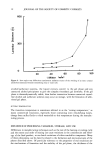
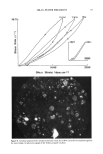
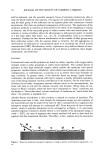
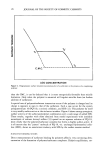
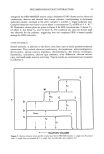
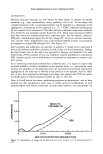
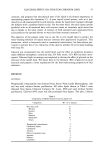
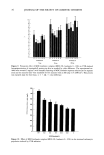
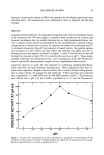
30 JOURNAL OF THE SOCIETY OF COSMETIC CHEMISTS 200- 180 - 160- ._. 140- tu 120 - 100- 80- ß . C. M.C.apparent z 3 2 I 0 -LOG [DS-] Figure 6. Emf, concentration plots of SDecS in the presence of PVP: (¸) 1.2% PVP ([•) 0.5% PVP (I) 0.25% PVP (O) 0% PVP. Each upper curve is raised progressively by 10 mV. For c.m.c. designations, see text (16). PRECIPITATION IN OPPOSITELY CHARGED PAIRS The studies of Kwak and other investigators were confined to relatively low levels of added surfactant, since binding in these systems is so energetic, i.e., occurs in most cases at concentrations a fraction of the CMC of the surfactant. When, however, the charged surfactant and oppositely charged polymer approach equivalence, on a charge basis, precipitation reactions occur since the charge-neutralized complex has limited solubility. An interesting feature is that the precipitated complex can be solubilized if excess surfactant is added to the system. These effects are illustrated in the "solubility diagram" for the cationic cellulosic, polyquaternium 10/triethanolamine lauryl sulfate combination. See Figure 8 (12). The 45 ø slope of the log/log plot, representing condi- tions of maximum precipitation, signifies a constant composition of the insoluble com- plex. It should be noted that resolubilization in such pairs depends on the specifics of both polyion and surfactant, and in some cases the resolubilization areas are only partial or even absent. For example, it has been found that if the charge density of the polyion is too high, resolubilization cannot be achieved. NUCLEAR MAGNETIC RESONANCE Early work by Muller and Johnson (20) on "F 3 SDS" (SDS in which the terminal CH 3

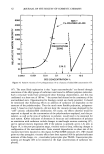
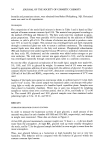
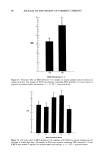
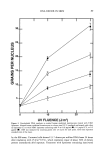
POLYMER/SURFACTANT INTERACTION 31 1.O 0.5 I i -4.5 -3.5 LOG Mi• Figure 7. Binding isotherms of polyacrylate (5 X 10 -4 M): comparison of alkyl-pyridinium and -tri- methylammonium ions. (/•) C•2PyCI (O) C•4PyBr (&) C•2TABr (O) C•4 TABr (18). group is replaced by a CF 3 group) showed a characteristic NMR shift (8) when this surfactant underwent micellization, i.e., when the CF 3 groups experienced a change from an aqueous environment to that of the micelies. In the presence of PEO (constant level) and at low F3SDS concentration, the chemical shift was the same as that of submicellar concentrations of F3SDS (21). At a certain concentration ("T•"), lower than the CMC of F3SDS, a slope change in the 8 vs. reciprocal concentration plot was ob- served. At a second concentration ("T2"), above the CMC, the slope changed again to a value close to that of polymer-free miceliar F3SDS solutions. T• was found to be independent of polymer concentration, while T2 increased with it. In other words, the results obtained are in good agreement with the behavior observed by other methods, e.g., surface tension and dialysis. The calculated binding ratio was 0.25 mol F3SDS/ base mol PEO, also in good agreement with the value obtained by direct binding studies. Results for PEO 7000 and 20,000 were essentially the same, but interaction was less pronounced for PEO 1500. The similar values of 8 for the polymer-bound surfactant and micellized surfactant confirmed again the concept of the surfactant mole- cules existing as aggregates in the former state. In an extensive study of the PEO/SDS system, Cabane investigated the •3C NMR shifts of the different carbons in SDS on adding increasing amount of PEO to miceliar solu- tions (22) of SDS. Substantial chemical shifts were noted for the three carbons (C•, C=, C 3) closest to the sulfate headgroup but were virtually absent for carbons C 4 through C•=. Furthermore, the shifts for C•, C=, and C 3 were linear up to a concentration of added PEO corresponding to the T= condition, i.e., where the polymer is just saturated with surfactant. When the experiment was done in reverse, i.e., SDS was added in increasing amounts to a fixed concentration solution of PEO, a linear shift in the •3C line of PEO was observed up to a concentration close to the T 2 value for the system.
Purchased for the exclusive use of nofirst nolast (unknown)
From: SCC Media Library & Resource Center (library.scconline.org)