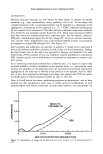
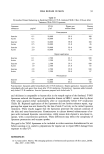
4 JOURNAL OF THE SOCIETY OF COSMETIC CHEMISTS over the range of temperatures relevant to the manufacture and storage of emulsions. The rest of this paper will describe the importance of these phases in emulsion tech- nology. EMULSIFIERS USED IN MULTIPHASE EMULSIONS Most commercial emulsions contain mixtures of emulsifiers formed from combinations of fatty amphiphiles and surfactants. Mixtures of sparingly soluble long-chain alcohols or glyceryl esters, such as glyceryl stearate (G.M.S.) with more soluble ionic or nonionic surfactants, are well known in cosmetic science. The emulsifier components are either added separately during the manufacture of the emulsion by dispersing the surfactant in water and the amphiphile in the oil with the aid of gentle heat, or, alternatively, they are added combined as a previously blended emulsifying wax. A selection of commonly used surfactants, amphiphiles, and emulsifying waxes is included in Table I. The surfactants, which alone are capable of stabilising simple oil-in-water emulsions, are generally referred to as the primary emulsifier, and the fatty amphiphiles, which are too lipophilic to promote oil-in-water emulsions, as the secondary, auxiliary, or co- emulsifier. It will be shown that this terminology is misleading, for the fatty amphi- phile is usually the dominant or primary emulsifier in such mixtures. INTERACTION OF EMULSIFIERS IN WATER EMULSIFIER COMPONENTS Surfactants. Polar lipids such as the soybean lecithins are sometimes used in preference to synthetic surfactants in dermatological emulsions, as they are considered less harmful to the skin. Lecithins from this source are usually composed of homologue admixtures of unsaturated C•6-C18 acids and may have gel-liquid crystalline transition tempera- tures as low as -22 ø (8). This means that although theoretically they can form gel phases, liquid crystals are present in most of the aqueous solutions studied. Table I Selection of Commonly Used Amphiphiles, Surfactants, and Emulsifying Waxes Amphiphiles Surfactants Cetearyl alcohol Triethanolamine stearate Cetyl alcohol Sodium lauryl sulphate Stearyl alcohol Cetrimonium bromide Glycerol stearate Ceteth 20 Stearic acid Lecithin Cholesterol PEG-20 stearate Emulsifying Waxes Components Emulsifying wax U.S.N.F. Cationic emulsifying wax B.P.C. Glyceryl stearate, S.E. Cetomacrogol emulsifying wax B.P.C. Cetearyl alcohol, polysorbate Cetearyl alcohol, cetrimonium bromide Glyceryl stearate, soap Cetearyl alcohol, ceteth 20

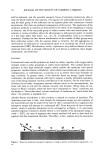
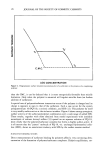
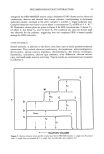
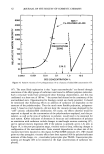
OIL-IN-WATER EMULSIONS 5 In contrast, synthetic surfactant emulsifiers do not form bilayer gel phases, although liquid crystalline phases are common. The chemical structures of synthetic surfactants in general are much simpler than those of the natural lipids, as most have only one hydrocarbon chain, containing 12-18 carbon atoms. In water, as the surfactant con- centration is increased, a variety of structures, including the bilayer neat phase, can form (Figure 2a). In the neat phase, the hydrocarbon chains are in the disordered or liquid crystalline state, similar to that described above for lipids above the phase transi- tion temperature. The thickness of the water layers is limited because excess water induces a phase transition to a miceliar solution. On cooling the neat phase to below the transition temperature, the surfactant crystallises out (Figure 2a). Fatty amphiphiles. Fatty amphiphiles such as long-chain alcohols, acids, and monoglyc- erides and pure saturated synthesised lecithins are too lipophilic to form bilayer phases in water, although they do exhibit marked crystalline polymorphism. For example, pure long-chain alcohols show at leat three solid modifications. The high-temperature o•-form separates first from the melt and is stable over a narrow temperature range. In this form the' hexagonally packed hydrocarbon chains are fully extended in the trans- conformation and there is rotational motion about the long axis of the molecule (cf. L• phase described above). At lower temperatures the [3 and 'y forms, where the hydro- carbon chains are non-rotating ([3-form) or tilted ('y-form), can co-exist, although the [3-form is usually in excess. The o•-[3 (or 'y-) transition temperature is lowered in the homologue admixtures such as cetearyl alcohol and in the presence of water, where the crystals often show limited swelling (9-11). These hydrated crystals (Figure 2b) are not usually referred to as gel phase, for their swelling is limited by the considerable strength of the van der Waals attractive forces between the lipid layers that balance osmotic repulsions. They are sometimes called "coagel"phase when dispersed as micro- crystals in water. MIXTURES OF SURFACTANTS AND AMPHIPHILES It is emphasised above that gel phases do not form when either surfactants or fatty amphiphiles alone are dispersed in water. However, under certain conditions (for ex- ample, in the presence of charged groups), the limited swelling of the fatty amphiphiles described above can be increased markedly to give gel phases. When heated to above the hydrocarbon chain melting temperature, the gel phase transforms to swollen la- meliar liquid crystalline phase (Figure 2c). The charge may arise from ionisable polar groups in the amphiphile itself. This is the case with neutralised monoglyceride emulsifiers, where neutralisation of free fatty acids normally present in the crude source material introduces small quantities of ionic sur- factant (12-14). Alternatively, the charge can arise from the addition of an ionic sur- factant, as in some fatty alcohol emulsifying waxes and the glyceryl monoester self- emulsifying waxes. Gel phases also form with fatty alcohols in the presence of small quantities of nonionic surfactant. Both the gel and liquid crystalline phases formed from these mixtures can swell to incorporate significant quantities of water in the interlamellar space. This distinguishes them from the "neat" liquid crystalline phases described above, where excess water will induce a phase transition. The swelling that occurs in the presence of charged groups is electrostatic and in some systems is so extensive at high water concentrations that it is
Purchased for the exclusive use of nofirst nolast (unknown)
From: SCC Media Library & Resource Center (library.scconline.org)