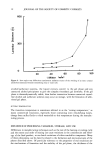
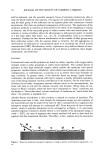
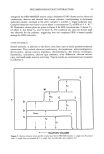
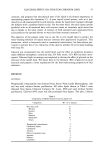
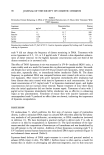
6 JOURNAL OF THE SOCIETY OF COSMETIC CHEMISTS (a) liquid crystal i Above T c Tc Below T c Soap crystal (b) molten state Above T c I,c Below Tc hydrated crystal (c) Water swollen liquid crystal 'IT• bøvcTcT Below Water swollen gel phase Figure 2. Summary of the aqueous phases that form below and above the hydrocarbon chain-melting temperature for mixed emulsifiers and their components. (a) hydrophilic surfactant: soap crystals below and liquid crystals above the transition temperature. (b) fatty amphiphile: hydrated crystals below and the melt above the transition temperature. (c) fatty amphiphile combined with small quantities of surfactant: swollen gel phases below and swollen liquid crystalline phases above the transition temperature. described as "infinite." Gel phases that form in the presence of nonionic surfactants are a result of hydration mechanisms. The significance of lamellar phase swelling to emul- sion stability will be discussed in more detail with specific examples below.

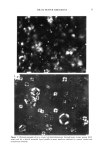
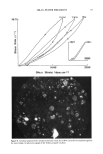
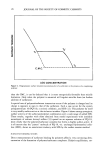
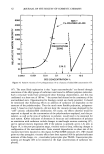
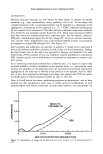
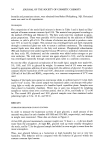
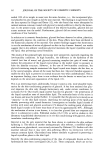
OIL-IN-WATER EMULSIONS 7 EMULSIONS STABILISED BY LIQUID CRYSTALLINE PHASES Liquid crystals form in the continuous phases of emulsions containing single-surfactant emulsifiers and various nonionic surfactant mixtures. They also form in emulsions pre- pared with commercial lecithins, and with mixtures composed of surfactants combined with medium-chain (less than C•2) alcohols where the liquid crystalline-gel transition temperatures are below the storage and testing temperatures of the emulsions. Such medium-chain alcohols are not used as bodying agents because of their low transition temperatures. The reasons for the increased emulsion stability in the presence of liquid crystalline phases are not fully understood. Friberg and his school (15-16) relate this phenomenon to the equilibrium conditions in ternary phase diagrams. They showed that stable emulsions are produced in the regions of the phase diagram where the oil, water, and lameliar liquid crystal (Lb) phase are in equilibrium. They suggest that multilayers of liquid crystals form around the oil droplets (Figure 3) that protect the disperse phase from coalescence by two major mechanisms: first, the reduction of the van der Waals forces of attraction between oil droplets to a very low value, and second, the retardation of the film-thinning process during coalescence due to the increased "viscosity" of the liquid crystalline phase. Rydhag and co-workers (17-18) demonstrated that emulsion stability is further en- hanced when the liquid crystalline multilayers are extensively swollen with water. With phospholipid emulsifiers, the swelling is controlled by the number of dissociated ionic groups and can be enhanced further by the addition of ionic surfactant. Batch variations in the amounts of negatively charged lipids contained in commercial lecithins can lead to differing emulsifying powers because of the variations in swelling properties of the resultant liquid crystalline multilayers. Liquid crystalline phases also form in emulsions containing long-chain fatty alcohols during the high temperatures of manufacture. These are of a transient nature, for they convert to gel phases as the emulsions cool, and will be discussed in the next section. EMULSIONS STABILISED BY GEL PHASES The gel-liquid crystalline transition temperatures of many amphiphile/surfactant com- binations are above ambient, so that liquid crystalline phases occur only during the high temperatures of preparation. On cooling, gel phases form, which are responsible for the structure and stabilities of many "bodied" oil-in-water emulsions. THE GEL NETWORK THEORY OF EMULSION STABILITY The gel network theory of emulsion stability gives a coherent explanation for the manner in which fatty amphiphiles and surfactants combined as mixed emulsifiers not only stabilise multiphase oil-in-water lotions and creams but also control their consis- tencies. Although most of the early work was performed using long-chain (i.e., C16-C18) fatty alcohols, the theory is general, and the same broad principles apply whichever amphiphile or surfactant (ionic or nonionic) is used. The theory relates the stabilities and physicochemical properties of multiphase oil-in-water emulsions to the presence or absence of viscoelastic gel networks in their continuous phases. The network
Purchased for the exclusive use of nofirst nolast (unknown)
From: SCC Media Library & Resource Center (library.scconline.org)