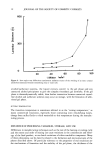
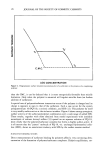
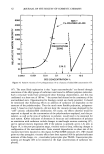
44 JOURNAL OF THE SOCIETY OF COSMETIC CHEMISTS be solubilized in the presence of excess surfactant or prevented by co-presence of a nonionic surfactant (54). CLOUD POINT ELEVATION OF POLYMERS Most uncharged polymers owe their solubility to the presence of polar groups, such as ether, hydroxyl, amide, and carboxyl, which will hydrate in the presence of water. This hydration, especially of the ether group, can diminish progressively with temperature, and the critical balance governing solubility can be upset at a specific temperature ("cloud point") at which the polymer comes out of solution. If the polymer can acquire charges, e.g., by ionization of acidic or basic groups or by the adsorption of a charged species such as a surfactant, enhanced solubility or elevation of the cloud point can be expected. There is much evidence in the literature to illustrate these effects. Although PEO itself is not amenable to such studies (its cloud point exceeds 100øC), related polymers pro- vide such information: PPO, by dint of possessing hydrophobic methyl groups, has much lower water solubility than PEO: PPOs of MW 1025 and 2000 have cloud points of about 40øC and 20øC, respectively. Pletnev and Trapeznikov (55) showed that SDS and NaDDBS can raise these values to above 90øC. (In one sense, standard nonionic surfactants can be regarded as PEO polymers: that one can raise their cloud point by addition of ionic surfactants is a fact already well known to formulators.) There are several references to increases of the cloud point of PVOH polymers by addition of anionic surfactants, and similar elevation is well known for MeC. The behavior of the latter polymer has recently been examined in great detail by Lindman (56) and co- workers and is somewhat complex. For example, while confirming the activity of SDS in raising the cloudpoint, they have found that in the presence of salt, first additions of SDS can actually reduce the solubility of MeC. Similar behavior has been found recently by Xie et al. for the PPO/SDS system (57). REDUCTION OF MONOMER CONCENTRATION The fact that, in the presence of polymer, aggregates of surfactant can form at concen- trations lower than the CMC means that the maximum monomer concentration of sur- factant is reduced. For nonionized polymer/ionic surfactant combinations, the region involved would be in the T•, T 2 concentration range. For polyelectrolyte/ionized sur- factant pairs this effect would be maximal in the preprecipitation binding zone. Because of the strong bonding forces involved in the latter case, the reduction in monomer concentration would tend to be much higher. Although the picture concerning the irritation to skin caused by exposure to surfac- rants, in particular anionic surfactants, is not completely clear, much evidence exists that suggests that lowered monomer concentration of the surfactant can correspond to lowered irritation (58). Coupled with this, there is evidence (59,60) that addition of selected polymers to solutions of anionic surfactants can reduce the irritation caused by the latter. The implication is that formulations of lowered irritation potential could be more reliably created on this basis if a knowledge of the binding characteristics of the particular polymer/surfactant combination chosen were established. On the other hand, a definite possibility always exists that any observed reduction of irritation occasioned by the presence of a polymer may involve more than one mechanism (61).

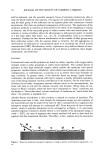
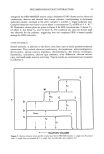
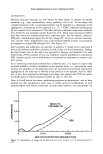
POLYMER/SURFACTANT INTERACTION SURFACE ACTIVITY AND ADSORPTION CHARACTERISTICS It has been pointed out that nonionized polymers may reduce the surface activity (air/ water interface) of ionic surfactants by binding the latter in the form of weakly surface- active complexes. On the other hand, the formation of highly surface-active complexes between polyelectrolytes and oppositely charged surfactants provides a synergistic en- hancement of the surface activity of the two components. Consequences of this enhance- ment could include improved emulsifying ability and, especially, foaming. [Instances of the latter have been reported (13,62).] At the same time, in the literature several references can be found to improvement of the foamability and foam quality of ionic surfactants by the addition of nonionized polymers, such as PVOH, PEO, modified starches, and cellulosics. Such implied alteration of surface properties can be understood if one considers the adsorbed layer of surfactant to resemble a surfactant micelie (in this case a "semi-inifinite hemi-micelle") able to interact with the polymer in a way similar to that depicted in Figure ! 1. In other words, in this case also, surfactant and polymer could influence each other's adsorption characteristics hence surface properties, in- cluding foaming, would be affected, even though the energy of association of the sur- factant and the base monomer may be weak. As regards solid surfaces, since both polymer and surfactant can adsorb on such surfaces, there has been much interest and considerable work done to determine what effect each has on the extent of adsorption of the other. Most of the work done has involved mineral (or latex) solids (3) and will not be detailed here. Suffice it to say that positive and negative effects have been found for both adsorbing components, depending on condi- tions, i.e., the acutal components themselves, addition sequence, the solid surface, the pH, and so on. As the adsorption energy per monomer unit of (especially) a nonionic polymer can be quite weak, it is not surprising that its adsorption overall can be af- fected by an added surfactant. The clear implication is that opportunities exist to modify the surface characteristics of chosen solids by appropriate choice of surfactants and polymers. Since the solid introduces a new phase (as in conditioning) and since other ingredients may also be present, determination of improved adsorption character- istics has to be done empirically in most cases. We point out that extensive studies have been carried out on the influence of SDS on the adsorption of radiotagged polyquaternium 10 on keratin substrates, which are nega- tively charged and water-swellable. Small additions of surfactant progessively reduced the adsorption of polymer owing to reduction of its positive charge density (63). How- ever, at high levels of SDS (in the post-precipitation zone), adsorption of this polymer was fully restored (64). POLYMERIC SURFACTANTS There is at present a tremendous renewal of interest in "polymeric surfactants" or so- called "associative thickeners." These materials are, in effect, conventional water-sol- uble polymers that have been modified by inclusion of hydrophobic rnoieties such as alkyl groups (65). They combine the properties of a surfactant/polymer mixture in one molecule and therefore display some of the properties of such mixtures. Thus, when dissolved in water, they tend to self-associate, generating association structures of high molecular weight, and hence substantial increases in viscosity of their solutions result. A depiction of possible association structures that might form is given in Figure 16. Several recent papers on the subject of associative thickening polymers may be found in
Purchased for the exclusive use of nofirst nolast (unknown)
From: SCC Media Library & Resource Center (library.scconline.org)