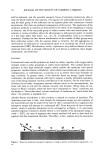
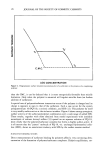
46 JOURNAL OF THE SOCIETY OF COSMETIC CHEMISTS Figure 16. Depiction of association structures of hydrophobically substituted polymers: (a) end-substitu- tion. (b) "comb" structure (Courtesy D. R. Bassett). reference 66. Other consequences of the associative tendency of molecules with this type of structure are the development of solubilizing properties for water-insoluble materials, including dyes, and also a strong tendency to produce foams, especially foams of un- usual stability: Goddard and Braun, in fact, showed that a hydrophobically modified cationic cellulosic polymer, polyquaternium 24, itself could form the basis of an aerosol mousse (67). On a historical note, it should be pointed out that the structure of the above-mentioned associative thickeners bears a strong resemblance to the so-called "polysoaps" that were investigated in detail in the 1960s.

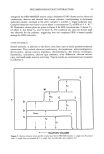
POLYMER/SURFACTANT INTERACTION 47 Figure 17. Depiction of associating polymer structure with surfactant miceliar bridge (Courtesy D. R. Bassett). The effects noted above can be magnified (or at least substantially altered) if a surfactant is also present in the system, since the presence of additional hydrophobic groups vir- tually guarantees that association between the two species will occur. (See Figure 17, which depicts a possible association structure.) In this vein, Ananthapadmanabhan et al. (68) showed that the addition of a very small amount of SDS was able to substantially increase the solubilizing power of the polymer polyquaternium 24 for a fluorescent dye. Changes in other properties of the association polymer can be expected, and obviously the number of variations possible on this basic theme is very large. While current interest in this area is largely confined to the paint and petroleum industries, its wider implications and opportunities for exploitation are substantial and certainly include the cosmetics industry. REFERENCES (1) M. M. Breuer and I.D. Robb, Chem. Ind., 530 (1972). (2) I.D. Robb, in Anionic Surfactants in Physical Chemistry of Surfactant Action, E. H. Lucassen-Reynders, Ed. (Dekker, New York, 1981), p. 109. (3) E. D. Goddard, Colloids andSurfaces, 19, 255, 301 (1986). (4) Lipo-Proteins, Discuss. Faraday Soc., 6 (1949). See article by D. G. Dervichian. (5) P. J. Flory, Principles of Polymer Chemistry (Cornell University Press, Ithaca, NY, 1953). (6) M. N. Jones, J. Colloid Interface Sci., 23, 36 (1967). (7) M. J. Schwuger, J. Colloid Interface Sci., 43, 491 (1973). (8) H. Lange, KolloidZ. Z. Polym., 243, 10! (1971).
Purchased for the exclusive use of nofirst nolast (unknown)
From: SCC Media Library & Resource Center (library.scconline.org)