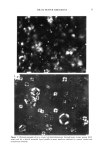
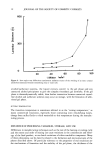
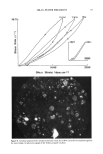
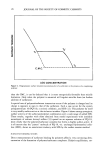
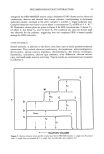
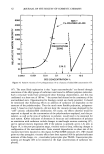
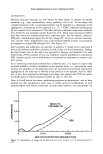
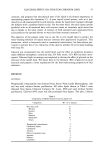
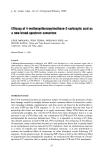
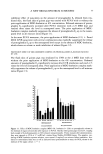
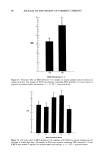
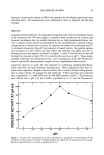
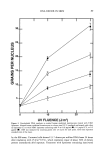
GLYCEROL EFFECT ON STRATUM CORNEUM LIPID 59 containing samples, although the solid crystallization proceeds more slowly than in low humidity. At 6 hr. the control displays considerable liquid crystal nature but also the beginnings of solid crystal formation. At 24 hr. solid crystals are more prominent, and at 96 hr. an extensive solid crystal network replaces the liquid crystal. On the other hand, the glycerol-containing sample is virtually unchanged over the period from the initial examination to 24 hr. Even at 96 hr. the glycerol-containing structure is pre- dominantly liquid crystal, with solid crystals in an early stage of growth. These data indicate clearly that the stratum corneum model lipid is largely a liquid crystal, as prepared with 33% H20, and that this structure gives way to a solid crystal state upon loss of water. Glycerol is capable of maintaining the liquid crystalline state of the lipids even under conditions of very low humidity, where extensive water loss has occurred. DISCUSSION The stratum corneum is the essential barrier against both water loss from the body and the entry of toxic or irritating chemicals into the body. It has long been recognized that the condition of the stratum corneum influences its barrier function. The condition is affected fundamentally by the diet and age of the individual. Environmental conditions also greatly alter skin condition and barrier function. However, changes in the stratum corneum barrier function seem to occur readily in response to changes in temperature and humidity (11). This is a key observation that provides a clue as to the nature of A Figure 5. Model lipid with 0% glycerol (A) and 10% glycerol (B) viewed under polarized light at 400 X magnification at the initial time.

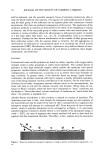
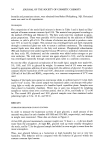
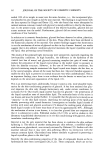
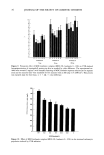
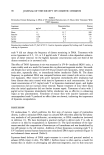
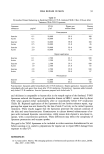
60 JOURNAL OF THE SOCIETY OF COSMETIC CHEMISTS 6h 24 96 hr. Figure 6. Model lipid with 0% glycerol (A) and 10% glycerol (B), after 6 hours, 24 hours, and 96 hours of exposure to 6% RH, viewed under polarized light at 400 X magnification (for the 6-hr timepoint) or 100 X magnification (for the 24-hr and 96-hr timepoints). environmentally induced changes in the skin. Because such responses are rapid, they probably involve physical changes in the stratum corneum structure as opposed to bio- chemical changes in cell growth and differentiation or lipid metabolism. One of our objectives was to understand the structural basis for the moisture barrier of the stratum corneum. Because the intercellular lipid of stratum corneum is strongly implicated in hydration of the skin, we have adopted an in vitro model of stratum corneum lipid to study water binding in skin and the concomitant structural changes. We have found that the mixture of partially neutralized fatty acid and neutral lipids, with 33% water, forms a structure with considerable liquid crystalline character. Al- though polarized light microscopy did not reveal solid crystals in freshly prepared
Purchased for the exclusive use of nofirst nolast (unknown)
From: SCC Media Library & Resource Center (library.scconline.org)