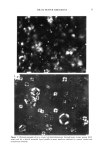
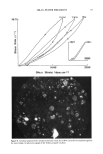
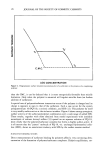
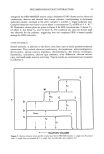
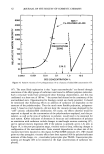
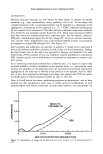
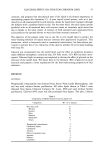
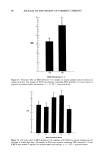
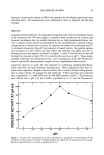
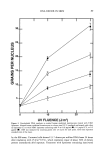
GLYCEROL EFFECT ON STRATUM CORNEUM LIPID 61 B 96 hr. Figure 7. Model lipid with 0% glycerol (A) and 10% glycerol (B) after 6 hours, 24 hours, and 96 hours of exposure to 92% RH, viewed under polarized light at 400 x magnification (for the 6-hr and 24-hr time- points) or 100 x magnification (for the 96-hr timepoint). model lipid, this does not prove the absence of a solid phase. Very find solid crystals dispersed in a liquid crystal are not detectable using this technique. Friberg (unpub- lished data) has demonstrated that the model lipid is a mixture of solid crystal and liquid crystalline phases. We have studied the effect of incorporating glycerol into the stratum corneum model lipid mixture. Glycerol is a well-known humectant. Incorporation of 5-15% glycerol (by weight) into the model promotes the uptake of water under conditions of high humidity. The extent of humectant action of glycerol within the lipid matrix in high humidity is consistent with the behavior of neat glycerol. Neat glycerol absorbed its own weight in water over three days. The model lipid containing 10% glycerol ab-

62 JOURNAL OF THE SOCIETY OF COSMETIC CHEMISTS sorbed 10% of its weight in water over the same duration, i.e., the incorporated glyc- erol absorbed its own weight as did the neat material. This finding is in agreement with the data reported by Rieger and Deem (12), who also found that water absorption by isolated stratum corneum treated with glycerol is merely additive to that by the humec- tant. In the present study, under conditions of low relative humidity, glycerol did not attract moisture into the model. Furthermore, glycerol did not retard water loss under conditions of low humidity. In solution or in cosmetic formulations, glycerol has been observed to soften, plasticize, and generally improve the condition of the skin. These effects have been attributed to the humectant property of the material. Our present findings suggest that humectancy is not the mechanism of action of glycerol on skin in dry climates. Instead, our results suggest that in dry ambient conditions glycerol maintains the liquid crystalline state of the lipid, thus preventing crystal formation. The results of the polarized light microscopy were unexpected, especially regarding the low-humidity conditions. In high humidity, the difference in the hydration of the control (net loss of water) and glycerol-containing samples (net gain of water) may explain the persistence of the liquid crystal phase in the model: water is necessary to form the lameliar structure. However, in the case of low-humidity conditions, the glycerol-containing samples maintained the liquid crystal state despite the fact that, as in the control samples, almost all the water had been lost. Glycerol therefore appears to enable the skin lipid to preserve its normal structure even when underhydrated. This is an important finding, since there is now evidence that the barrier to water loss in vivo depends on the structural organization of the lipids (13). This is an interesting result, additionally, because it posits a new, more plausible expla- nation for the skin-conditioning properties of glycerol. It has been assumed that glyc- erol improves the skin only through humectancy and, under certain conditions, by occlusion (8,14). Our results imply another function for glycerol--the preservation of the liquid crystalline state of intercellular lipid. The molecular basis of this action is not known and must be probed further. It is possible that the glycerol acts merely as an "impurity" in the skin lipid mixture, depressing the melting point of the lipids and thereby preventing solid crystal formation. Investigation on lameliar liquid crystals of lecithin with water and glycerol as solvents (15) showed the melting point of glycerol- based liquid crystals to be lower than those of water by approximately 30øC. Although the mechanism of action is not known, it is clear that glycerol does not evaporate and that it is substantive to skin. Published studies (16,17,18), as well as studies in this laboratory (unpublished observations) on in vivo skin conditioning with glycerol, show a cumulative conditioning effect. Glycerol is not the only material that has been shown to condition the skin without hydrating it. The effects of another nonhygroscopic skin softener, a modified triglyc- eride known as glyceridacid, were recently reviewed by Osborne (19). Studies with this material indicate that it may exert skin-softening effects via interaction with the stratum corneum lipids. Glyceridacid may behave similarly to glycerol in preserving a liquid crystalline phase in the skin lipid. Recently the skin-conditioning properties of the class of compounds known as the ot- hydroxyacids have been investigated (20,21,22). These compunds, which are not hu-
Purchased for the exclusive use of nofirst nolast (unknown)
From: SCC Media Library & Resource Center (library.scconline.org)