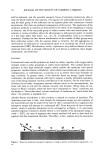
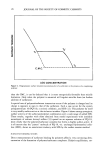
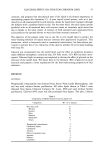
8 JOURNAL OF THE SOCIETY OF COSMETIC CHEMISTS Figure 3. Schematic diagram of an emulsion droplet stabilised by multilayers of lamellar liquid crystals. phases form when the fatty amphiphile and surfactant, in excess of that required to form a mixed monomolecular film at the oil-water interface, interact with water. Thus the properties and phase behaviour of mixed emulsifiers and their component surfactants in water both above and below T o as well as the corresponding emulsions, are often investigated in parallel. Equilibrated emulsifier/water ternary systems containing con- centrations of mixed emulsifier similar to those used to stabilise emulsions have proved useful as structural "models" for the continuous phases of the emulsions (Table II). Data used to develop the gel network theory, including evaluation of the viscoelastic proper- ties of ternary systems and emulsions, are summarised in reviews (1,2). MICROSTRUCTURE OF THE GEL NETWORK PHASE The fine structure of the ternary viscoelastic continuous phase is complex. Recent high- and low-angle x-ray diffraction studies (sometimes using a powerful synchrotron radia- tion source), together with light and electron microscopy, have confirmed unequivo-

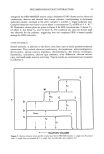
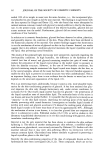
OIL-IN-WATER EMULSIONS 9 Table II Composition of Emulsions and Corresponding Ternary Systems Emulsion Ternary system Liquid paraffin 100 -- g Water 300 300 g Fatty amphiphile (cetearyl alcohol) Varied 7-57 Varied 7-57 g Surfactant (ionic or nonionic) Varied 0.8-6.4 Varied 0.8-6.4 g cably that complex crystalline gel phases are a major component of emulsions stabilised by combinations of fatty alcohols and ionic or nonionic surfactants (19-21). Figure 4 shows a schematic diagram of a typical o/w emulsion stabilised in this manner. At least four phases can be identified: 1. Dispersed oil phase 2. Crystalline gel phase composed of bilayers of surfactant and amphiphile separated by "thick" layers of water 3. Crystalline hydrates of amphiphile 4. Pockets of bulk "free water" The oil droplets are surrounded by multilayers of gel phase that become more randomly oriented as they progress further into the continuous phase. The gel phase can exist in equilibrium with crystalline regions and pockets of bulk water. The oil droplets are Surface of Oil Droplet Interlamellar Water GEL PHASE Figure 4. Schematic diagram of a typical multiple-phase oil-in-water cream to illustrate the composition of the viscoelastic continuous phase (redrawn from ref. 19).
Purchased for the exclusive use of nofirst nolast (unknown)
From: SCC Media Library & Resource Center (library.scconline.org)