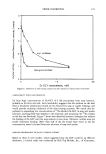
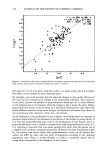
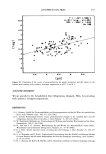
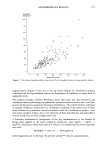
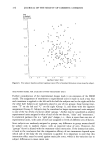
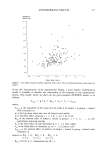
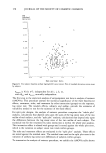
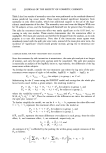
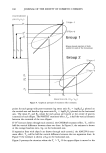
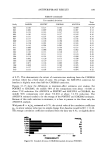
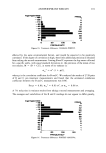
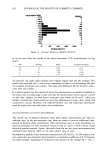
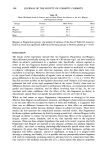
pH EFFECTS ON SKIN 157 5,5 4.5 3.5 2.5 2 1.5 1 .5 Y ' -.421 +.59B X r-.St! (slg., 95•. : .348 r ,645 N- Figure 10. Correlation of the counts of propionibacteria per square centimeter and pH values on the forearm from washing with synthetic detergent preparations at pH 5.5 and 8.5. ACKNOWLEDGMENT We are grateful to Dr. Schadenb6ck from Sebapharma, Boppard, FRG, for providing both synthetic detergent preparations. REFERENCES (1) L. Peukert, EinfluB der Titrationsalkalitiit yon Reinigungsmitteln auf den pH-Wert der menschlichen Haut, Arch. Domatol. Syph., 181, 417•424 (1941). (2) L. Arnold, Relationship between certain physicochemical changes in the cornified layer and the endogeneous bacterial flora of the skin, J. Invest Dermatol., 5, 207-223 (1942). (3) W. Burckhardt, Methoden zur Untersuchung der Wirkung synthetischer Waschmittel auf die Haut, Dermatologica, 129, 37-46 (1964). (4) H. P6sl and C. G. Schirren, Beeinflussung des pH-Wertes der Hautoberfiiiche durch Seifen, Waschmittel und synthetische Detergentien, Hautarzt, 17, 37•40 (1966). (5) R. J. Holt, Aerobic bacterial counts on human skin after bathing, J. Md. /Vlicrobiol., 4, 319-327 (1971). (6) A. A. Hartmann and H. R6ckl, Vergleichende Untersuchung fiber den EinfluB yon Balneum Herreal Gel zum Duschen auf die aerobe Residentflora der Haut bei einmaliger Anwendung, •rztl. Kosmetol., 9, 16-25 (1979). (7) H. C. Korting, M. Kober, M. Mueller, and O. Braun-Falco, Influence of repeated washings with soap

158 JOURNAL OF THE SOCIETY OF COSMETIC CHEMISTS and synthetic detergents on pH and resident flora of the skin of forehead and forearm. Results of a cross-over trial in healthy probitioners, Acta Derre. Venereol. (Stockh.), 67, 41-47 (1987). (8) H. C. Korting, A. Bau, and P. Baldauf, pH-Abhiingigkeit des Wachstumsverhaltens von Staphylo- coccus aureus und Propionibacterium acnes, ,4rztl. Kosmetol., 17, 41-53 (1987). (9) A. Marchionini and W. Hausknecht, Siiuremantel der Haut und Bakterienabwehr, Klin. Wochenschr., 17, 663-666 (1938). (10) H. Rfckl, Probleme der Bakterienfkologie der Haut, Hautarzt, 28, 155-159 (1977). (11) C. G. Schirren, Does the glass-electrode determine the same pH values on the skin surface as a quinhydrone electrode?J. Invest. Derm•tol., 24, 485-488 (1955). (12) H. Arbenz, Untersuchungen fiber die pH-Werte der normalen Hautoberfli/che, Dermatologica, 105, 133-153 (1952). (13) P. Williamson and A.M. Kligman, A new method for the quantitative investigation of cutaneous bacteria, J. Invest. Derm•tol., 45, 498-503 (1965). (14) A. A. Hartmann, A comparative investigation of methods for sampling skin flora, Arch. Derm•tol. Res., 274, 381-385 (1982). (15) W. E. Kloos and K. H. Schleifer, Simplified scheme for routine identification of human staphylo- coccus species,J. Clin. Microbiol., 1, 82-88 (1975). (16) C. E. North, A. Dalbiick, and T. Vatstrfm, Evaluation of a test kit for identification of anaerobic bacteria, Med. Microbiol. Immunol., 161, 231-242 (1973). (17) L. Essers and Haralambie, Experiences with a API 20A system in routine species identification of anaerobes, Zbl. Bakt. Hyg. I. Abt. Orig. A, 238, 394-401 (1974). (18) L. Sachs, Angewandte Statistik, 5th Ed. (Springer-Verlag, Berlin, 1978). (19) O. Braun-Falco and H. C. Korting, Der normale pH-Wert der menschlichen Haut, Hautarzt, 37, 126-129 (1986). (20) G. Piewig and A.M. Kligman, Acne: Morphogenesis and Treatment (Springer-Verlag, Berlin, Heidel- berg, New York, 1975). (21) J. J. Leyden, K. J. McGinley, O. H. Mills, and A.M. Kligman, Propionibacterium levels in pa- tients with and without acne vulgaris, J. Invest. Der matol., 65, 382-384 (1975).
Purchased for the exclusive use of nofirst nolast (unknown)
From: SCC Media Library & Resource Center (library.scconline.org)