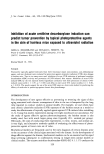
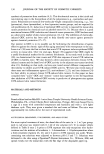
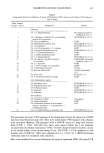
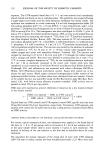
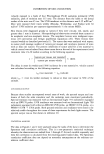
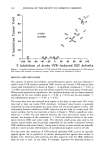
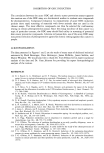
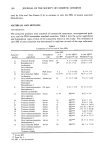
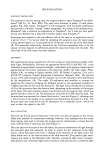
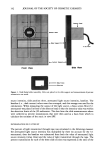
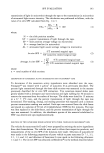
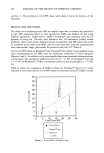
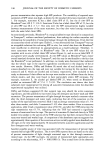
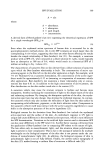
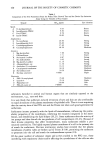
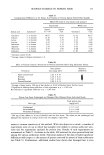
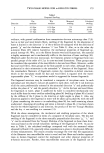
160 JOURNAL OF THE SOCIETY OF COSMETIC CHEMISTS Table I Comparison of the Test Parameters From the Pollen Tube Growth Test and the Draize Eye Irritation Assay Using 22 Tensides of Four Classes Tenside ED5o (ppm) Eye irritation Quats A Cl-laurylpyridinum 5.05 Severe B Laurylbenzene-DMAC 9.30 Severe C Cetyl-TMAC 9.78 Severe D Lauryl-TMAC 10.00 Strong Amphoterics E N-cocoylbetain 20.30 Strong F Lauryldimethyl-N-O 26.60 Strong G Cocamidpropylbetain 27.40 Strong H Cocoamphoglycinate 48.20 Moderate Anionics I Mg-laurylsulfate 7.00 Strong J Olefinsulfonate 7.71 Severe K Na-laureth-2-sulfate 8.87 Strong L Na dodecylsulfate 9.65 Strong M Mg-laureth-2-sulfate 11.16 Strong N Alkanesulfonate, sec. 11.30 Strong O Amidether (2)-condensate 16.12 Moderate P Cocoylprotein-condensate 18.10 Moderate Q Na-sulfosuccinate 24.59 Moderate R Na-Soap unscented 5000 Slight Nonionics S PEG- 10-nonylphenol 15.60 Moderate T Laureth-4 25.10 Slight U Polysorbate-20 310.00 Non V PEG-40-castor oil 40000 Non substances harmful to animal and human organs that are similarly exposed to the environment, e.g., eyes and skin. It is very likely that surfactant-induced irritations of eyes and skin are also attributable to major alterations of the plasma membranes of epithelial cells. Thus it is not surprising that the toxicity data of the PTG test and the Draize test show such good agreement for surfactants. Surfactants interact primarily with the lipids of biomembranes, influencing the perme- ability properties of the membranes, inhibiting the enzymes integrated in the mem- branes, and destabilizing the lipid bilayer (20,21). Some surfactants alter the activity of ion pumps and thus disturb the ion gradients of cell compartments (22,23). Because of their diverse properties that affect biomembranes, many surfactants exhibit a pro- nounced cytotoxicity. The highly exposed plasma membrane of a cell is the primary site of attack for surfactants. Electron microscopic studies have revealed that the plasma membranes of pollen tubes are broken up by Triton X-100, permitting the surfactant to penetrate into the cell and attack the endomembrane system (24). Of the great number of substance classes and actives studied in the PTG test, those interfering with respiratory chains and/or affecting the cytoskeleton of the cells are also

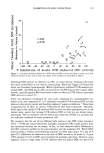
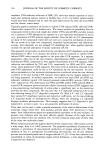
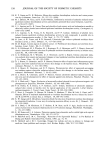
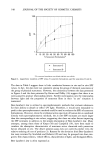
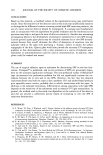
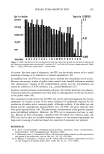
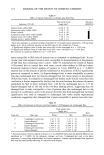
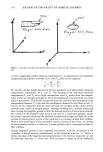
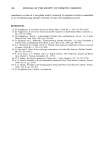
POLLEN TUBE GROWTH TEST 161 Eye Irritotion Toxicity [1lED50] severe 0.2 strong moderote 0.02 slight non 0.002 Tensides A B C D E F G H ] J K L M N 0 P IZ R S T U V Figure 4. Rank correlations of the test parameters from the pollen tube growth test (reciprocal values) and the Draize eye irritation assay considering 22 tensides (A-V, see Table I) of the four classes examined. Black bars = 1/ED5o (PTG-test) striped bars = Draize assay. of interest. For these types of substances, the PTG test has already proven to be a useful screening technique as an alternative to animal experiments (16). In modified form, the PTG test was also used to identify the intracellular site of action. Electron microscopic studies of pollen tubes treated with harmful substances revealed that characteristic changes of the endomembrane system and the mitochondria are caused by inhibition of ATP synthesis, e.g., pentachlorophenol (25). Another currently relevant environmental pollutant, the triethyl lead from car exhausts, evidently attacks the cytoskeleton and thus leads to a dysregulation of cell wall secretion in the pollen tubes (26). Our comparative study shows that the PTG test can be used advantageously for routine assessment of irritancy as part of the safety evaluation of surfactants required for the production of surface-active consumer goods. Although unlikely, if the rabbit eye test should provide unsatisfactory reproducibility (27), the PTG test gives objective data with good reproducibility (10). The photometric determination of the growth response gives well-defined endpoints. Moreover, the PTG test is inexpensive and easy to carry out. Because of these advantages, compared with the Draize eye irritation assay, the PTG test can be used as a suitable alternative assay to in vivo animal experiments for large-scale screening of surfactant-based raw materials of personnel care products. REFERENCES (1) R. Koch, Umwelttechniken--physikaliah-chemische Daten, Toxizitiiten, Grenz- und Richtwerte, Umweltverhalten. VCH-Verlagsgesellschaft, Weinheim (1989). (2) L. Mejnartowicz and A. Lewandowski, Effects of fluorides and sulphur dioxide on pollen germination and growth of the pollen tube, Acta Soc. Bot. Pol., 54, 125-129 (1985). (3) N. Masarau, F. Katsuhisa, T. Sankichi, and W. Yukata, Effects of inorganic components in acid rain on tube elongation of Camellia pollen, Envir. Pollut. (Ser. A), 21, 51-57 (1980).
Purchased for the exclusive use of nofirst nolast (unknown)
From: SCC Media Library & Resource Center (library.scconline.org)