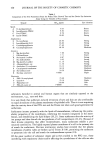
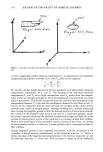
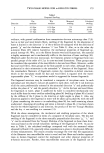
TWO-PHASE MODEL FOR ot-KERATIN FIBERS 179 Table I Fingernail Swelling Dry Wet Measured Calculated Direction modulus modulus swelling swelling g 4.0 Gpa 0.30 Gpa 7% 8.8% r 3.5 Gpa 0.13 Gpa 22% 20.4% a 4.5 Gpa 0.70 Gpa 4% 3.8% evidence, with general confirmation from transmission electron microscopy data (7,8). Just as in hair and wool keratin fibers, swelling of the fingernail by the absorption of water is limited in the direction "a" of the ot-helices (8) compared with the direction of growth "g" and the thickness direction "r" (see Table I). Also, as in the other dry ot-keratin fibers (0% relative humidity), the mechanical properties of fingernail ap- proach isotropy (9). Wet, as in the fibrous keratins wool and human hair, the material is highly anisotropic and is mechanically stiffer in the direction of lesser swelling (10). Observed under the electron microscope, the filaments present in fingernail form into parallel groups of the order of 0.2 Ix in cross-sectional dimensions. These groups may be considered the equivalent of the macrofibrils in hair and wool fibers. However, unlike hair and wool fibers, these groups are far from parallel to each other, although they are preferential in their orientation in the azimuthal "a" direction of the fingernail. Since the intermediate filaments of fingernails contain the crystalline a-helical structure, which in the two-phase model for hair and wool fibers is equated with the water- impenetrable phase "C," an equivalent model is suggested for human fingernails. The fingernail structure may be considered a composite of two-phase units. In each individual unit the phase C rods are all parallel to each other, with the C rod direction of all the units preferentially oriented in the azimuthal direction "a" and preferentially within the plane of "a" and the growth direction "g." As for the hair and wool fibers, for fingernails in water, phase C unaffected by water is considered mechanically very much stiffer than the water-swollen embedding phase M. Swelling of phase M is limited by the stiffness of the C phase to the direction at right angles to phase C. Also, any distortion applied to the fingernail in water will be taken up by phase M, with the stiff C phase transferring the stress to its embedding phase M, but itself remaining almost undistorted. Assuming all swelling and strain is limited to phase M, it has been shown that for the whole fingernail in any direction, the product of the wet Young's Modulus and the dry --) wet swelling is a constant (! 1). With the above assumptions, the mechanical and swelling properties of the whole fingernail may be considered in terms of a composite of two-phase units. The dry-wet swelling of the fingernail in the three mutually perpendicular directions "g," "r," and "a" can be estimated from the Young's Modulus of the fingernail in those three direc- tions and based on the overall volumetric swelling of the fingernail of 35%. As can be seen in Table I, the calculated swellings correspond well with the measured values obtained by Bendit (10), especially when consideration is given to the physical difficulty of these measurements. The results certainly encourage the view that the organization of the filaments into macrofibrillar units in wool and hair fibers and similar organiza- tions in human fingernail control the mechanical and other physical properties of ot-keratin structures. Further, these macrofibrillar structures in the fingernail can be

180 JOURNAL OF THE SOCIETY OF COSMETIC CHEMISTS considered in terms of a two-phase model consisting of organized ot-helices embedded in an interpenetrating polymer network of water and amorphous protein. REFERENCES (1) (2) (3) (4) (5) (6) (7) (8) (9) (10) (11) M. Feughelman, A two-phase structure of keratin fibres, Textile Res. J., 29, 223-228 (1959). M. Feughelman, A note on the water impenetrable component of alpha-keratin fibers, Textile Res. J., 59, 739-742 (1989). M. Feughelman, "Keratin," in Encyclopedia of Polymer Science and Engineering, 2nd ed., Vol. 8 (John Wiley & Sons, New York, 1987), pp. 566-600. D. Klempner and L. Berkowski, "Interpenetrating Polymer Networks," in Concise Encyclopedia of Polymer Sdence and Engineering (John Wiley & Sons, New York, 1990), pp. 489-492. F.-J. Wortmann, B. J. Rigby, and D. G. Phillips, Glass transition temperature of wool as a function of regain, Textile Res. J., 54, 6-8 (1984). M. Spei and H. Zahn, X-ray small-angle examination of swollen fiber keratins, Melliand Textilber., 60, 523-525 (1979). R. D. B. Fraser, T. P. MacRae, and G. E. Rogers, Keratins, Their Composition, Structure and Biosyn- thesis (Charles C. Thomas, Springfield, II1., 1972). H. P. Baden, The physical properties of finger nail, J. Invest. Dermatol., 55, 115-122 (1970). E. G. Bendit, Proceedings of the 6th Quinquennial International Wool Textile Research Conference, Pretoria, 1980, Vol. II, pp. 55-66. E. G. Bendit, Proceedings of the 6th Quinquennial International Wool Textile Research Conference, Pretoria, 1980, Vol. II, pp. 247-262. M. Feughelman and I. Kaplin, in preparation.
Purchased for the exclusive use of nofirst nolast (unknown)
From: SCC Media Library & Resource Center (library.scconline.org)