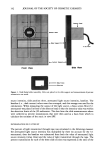
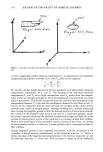
j. Soc. Cosmet. Chem., 44, 177-180 (May/June 1993) A note on the application of the two-phase model of -keratin fibers to the mature human fingernail M. FEUGHELMAN, University of New South Wales, Kensington, New South Wales, Australia 2033. Received October 30, 1992. Synopsis The two-phase model (1) of a water-impenetrable phase C embedded in a water-penetrable phase M has been successfully applied to explain many of the mechanical and water sorption properties of fibrous o•-keratin such as hairs, wool, quills, horns, etc. A simple extension of this model in which the C phase consisting of rods parallel to the fiber axis in wool is modified to consist of groups of C phase rods parallel to each other within the group, but with each group only roughly oriented in a given direction, has been applied to the mature human fingernail. Using this model, the anisotropic swelling of the human fingernail can be calculated in terms of the Young's modulus of the fingernail in the three mutually perpendicular directions of nail growth (g), thickness (r), and the direction perpendicular to growth in the plane of the nail, the azimuthal direction (a) (see Figure 1). The calculations correspond, within expected experimental error, to the measured data for swelling, strongly suggesting the validity of the application of this extended two-phase model to the human nail. A simple two-phase model has been successfully applied to describe the physical be- havior, in particular the change of mechanical properties, of fibrous ot-keratins such as hairs, wool, quills, and horns, with change in moisture content from dry to saturation in water (1,2). The model consists of water-impenetrable cylindrical rods (phase C) set parallel to the axis of the fiber and embedded in a water-penetrable medium (phase M) that is pro- gressively mechanically weakened by increasing swelling with uptake of water. A range of physical measurements (2) have confirmed that phase C represents between 25-30% of wool and hair fibers and has been identified with the crystalline a-helical material that forms a major component of the intermediate filaments (microfibrils) present in the cortex of ot-keratin fibers. Phase M, the embedding phase, is identified with the amorphous protein, primarily the globular high-sulphur protein of the corticular matrix, plus the non-crystalline protein of the filaments, together with the three-dimensional continuous water network present in the fiber cortex (3). The water network forms a separate polymer, which interfaces with the protein polymer network, forming two totally compatible interpenetrating polymer networks. The whole fiber has been shown 177

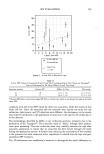
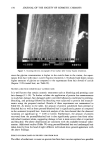
178 JOURNAL OF THE SOCIETY OF COSMETIC CHEMISTS // Figure 1. The three mutually perpendicular directions g, a, and r (see text) relative to a human finger and nail. to have a single glass-rubber transition temperature Tg, as expected for two compatible interpenetrating polymer networks (4,5), with Tg given by the equation I W1 W2 - + Tg T1 T 2 W1 and W2 are the weight fractions of the two polymers, with glass-rubber transition temperatures, respectively, of T 1 and T 2. The merging of the individual transition temperatures T1 and T 2 into a single intermediate value Tg results from the compati- bility of the two polymer networks in which the dimensions of each network are of the order of nanometers. This would be expected from the cross-sectional dimensions of the intermediate filaments (7.5 nm) and the interfilament distance for wet fibers of circa ! 1 nm (6). To be compatible with the water network, the interface surface of the protein network must consist of charged groups, hydrogen bonding sites, or polar interacting sites, leaving the lipophilic groups to form the internal structure of the protein network. The concept of the absorbed water being in the form of a continuous polymer outside the protein network eliminates the observed contradiction by Spei and Zahn (6) of the increase of matrix protein within a fiber resulting in an increase in total fiber stiffness. Within the limited space of the microfibril-matrix structure of the cortex, an increase of matrix protein results in a reduction of water polymer with a consequent increase in fiber stiffness. Human fingernail protein is also composed of ot-keratin, with the orientation of the crystalline u-helical material predominantly in the azimuthal direction "a," which is within the plane of the fingernail and perpendicular to the direction of growth "g" and the thickness direction "r" of the nail. This conclusion is based on X-ray diffraction
Purchased for the exclusive use of nofirst nolast (unknown)
From: SCC Media Library & Resource Center (library.scconline.org)