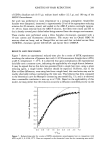
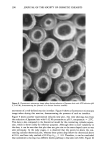
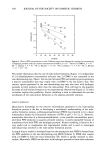
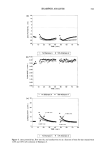
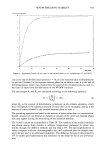
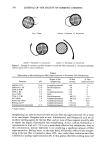
292 JOURNAL OF THE SOCIETY OF COSMETIC CHEMISTS Figure 10. Fluorescence microscopy image taken during reduction of Japanese hair with cysteamine solution (pH 9, 0.42 M), showing a more uniform reduction and no reaction interface. different results. Japanese hair has been used in this study as a model for a type of hair that is generally regarded to be "easy to perm," whereas fine Caucasian hair (diameter ( -- 75 I-•m) is generally considered to be "difficult to perm." Although the underlying reason for these two types of behavior is not known, it is observed that both hair types may react very differently with a given reducing agent. Figure 13 shows the result of treating fine Caucasian hair with the same 0.42 M, pH 9, ATG solution, and demon- strates that a highly sigmoidal reduced-time curve can now be produced. It is empha- sized that the only difference between this experiment and the one that was summarized in Figure 7 is the hair type. This change in the kinetic behavior has been found to be most pronounced when particularly fine hair is used.

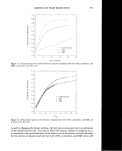
KINETICS OF HAIR REDUCTION 293 1.0 ..o 0.7 - / • 0.6 - • 0.5 - = / _o 0.4 / / ......•...•--"--"-- - • 0.5 - 0.2 -- cystearn•ne - ./ / -- - ATG 0.1 - ----- GMT - 0 5 10 15 20 25 time (mins) Figure 11. Fraction of reaction-vs-time data for the reduction of Japanese hair with ATG, cysteamine, and GMT, all at pH 9, 0.42 M, 25øC. 0.9 0.8 • v•v-v-v-- _ o :• 0.7 o o 0.6 - '• 0.5 • 0.4 • ff o Cysteamine • 0.3 • v ATG _ 0.2 • n GMT _ 0.1 0.0 0.0 0.5 1.0 1.5 2.0 2.5 3.0 5.5 4.0 t/to Figure 12. Reduced-time plots for the reduction of Japanese hair with ATG, cysteamine, and GMT, all at pH 9, 0.42 M, 25øC. As well as changing the kinetic pathway, the hair type can also give rise to an alteration in the overall reaction rate. The time at which the reaction reaches its midpoint (to. 5) is considered to be a good indication of the relative rate of the process, and the half times for the reaction of Japanese and fine hair with ATG, cysteamine, and GMT (all at pH
Purchased for the exclusive use of nofirst nolast (unknown)
From: SCC Media Library & Resource Center (library.scconline.org)