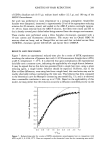
280 JOURNAL OF THE SOCIETY OF COSMETIC CHEMISTS and then monitoring the relaxation in stress that occurs as a result of the reducing agent breaking the disulfide bonds within the hair. Thus, by assuming that (i) each disulfide bond in the hair contributes equally to the overall tensile strength, and (ii) the 2% strain is within the linear region of the stress-strain curve, the stress decay data is used as an indication of the reaction progression. First, there may be some reservations about this initial claim regarding the contribution of each disulfide bond to the overall tensile properties. This is obviously the underlying assumption on which the success of the whole method depends however, there appears to be no evidence in the literature to either prove or disprove this presumption. Nevertheless, it is observed that the tech- nique has been sporadically used in the literature (3,4), with what appears to be a certain degree of success. Therefore, although the concerns are noted, it is still considered viable to use this method. Second, it should be pointed out that there is some question in the literature regarding the position of the Hookean region. Various reports have the Hookean region extending anywhere between approximately 1% to 2% strain, with some of this variability possibly being accounted for by the effect of the strain rate (5). In addition, Bendit (6) has claimed that because of the viscoelastic properties of keratin, hair fibers will not possess a Hookean region and that the linear region in the stress- strain curve is actually an inflection point caused by the viscoelastic curvature and experimental factors. The progression of the hair reduction process can have two limiting factors: the rate of the chemical reaction between the reducing agent and the disulfide bonds, and the ability of the reducing agent to diffuse into the fibers. Therefore, if diffusion is fast compared to the chemistry, then the overall rate is dictated by the chemical reaction (i.e., reaction-controlled). If diffusion is slow compared to the reaction rate, then the diffusion becomes the limiting step (diffusion-controlled) and the reaction progresses via the propagation of a well-defined reaction interface into the fibers. Mathematical expressions have been put forward to describe these two limiting cases in terms of the tensile properties. Reese and Eyring (2) postulated a first order expression to describe reaction-controlled processes: F(t) = F(0)exp(- kCot) (1) while Wickett (1) has derived a moving boundary model to describe diffusion-controlled processes: F(t)= F(0)exp[- (2• ka •ø)t 3/2] (2) where F(t) is the force at time t, F(0) is the initial force, C O is the initial concentration, k is the specific reaction rate constant, A is the cross-sectional area, and T is the temperature. It would seem then, that the single fiber tensile technique can quantitatively follow the reduction of hair fibers and that theoretical models already exist to which our data can be compared. However, it would be desirable to have a uniform data transformation technique that would allow for the comparison of experiments carried out under a variety of different conditions. To accomplish this, it appears possible that we can borrow some ideas from the analogous field of heterogeneous reaction kinetics.

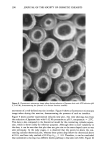
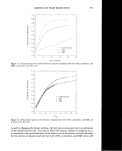
KINETICS OF HAIR REDUCTION 281 Heterogeneous reaction kinetics is usually associated with reactions in the solid state, particularly those involving the heat treatment of solids (e.g., decomposition reactions, volatile evaporation, or phase transformations). Here, again, the relative reaction and diffusion rates have to be considered. Reactions in the solid state begin at localized sites (nuclei) that correspond to imperfections on the surface, or corners and edges. If the reaction rate is fast compared to diffusion, then these nuclei spread across the surface and coalesce to form a reaction interface. This interface then advances into the solid, pro- ducing a reaction "front" with reactant ahead and product behind. Meanwhile, if the diffusion rate is faster than the reaction rate, the overall reaction proceeds via "branching chains," with no well-defined interface. It can be seen that this situation is very similar to that occurring between the reducing agent and the hair. Here the nucleation step between reducing agent and the hair can be considered to be instantaneous, as a result of the contact between the fiber and the solution. Therefore, a reaction "front" is produced by the diffusion of the reducing agent into the hair, with unbroken disulfide bonds ahead of the front and reduced cystine behind. Reaction-controlled processes do not produce this interface, as diffusion is fast compared to the reaction rate. This paper will attempt to demonstrate the usefulness of utilizing some of the data analysis techniques, which are associated with heterogeneous reaction kinetics, in treat- ing the data obtained from the SFTK experiments. In addition, there are a number of theoretical kinetic models that have been derived for solid-state reactions which have been investigated for their applicability in hair/reducing agent interactions. These mod- els have been based not only upon diffusion and reaction order, but also upon factors such as geometry. The work will show that although none of these models adequately describe the experimental data, there are distinctively different reaction behaviors that can be identified using the analysis described. THEORY In heterogeneous reactions the term ot is used to symbolize the fraction of the reaction. Therefore, the reaction rate is expressed as dot - kf (ot) (3) dt where t is time, k is the specific reaction rate constant, and f(ot) is the mathematical expression in ot that describes the reaction (i.e., the kinetic model). The simplest example is the first order relationship: dot - k(1 - ot) (4) dt It is desirable to eliminate the derivative term. Therefore, upon integration: we obtain o•=o• • t=t ' or=0 t=0 at (5) -ln(1 - ot) = kt (6)
Purchased for the exclusive use of nofirst nolast (unknown)
From: SCC Media Library & Resource Center (library.scconline.org)