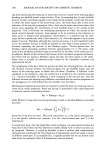
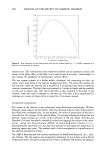
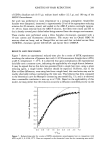
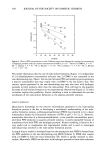
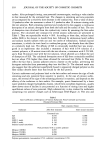
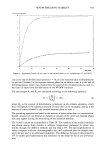
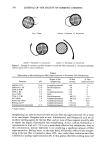
318 JOURNAL OF THE SOCIETY OF COSMETIC CHEMISTS surface. After prolonged rinsing, zeta potential increases again, reaching a value similar to that measured for the untreated hair. The changes in streaming and zeta potentials are accompanied by a relatively slow decrease in the conductivity, from a value of about 10 !xmho/cm after the treatment to about 4.5 !xmho/cm after 30 minutes rinsing with the test solution. Both streaming potential and conductivity data suggest a continuous desorption of an anionic detergent from both the bulk and the surface of hair. The rate of desorption was calculated from the conductivity curves by assuming the first-order kinetics. The calculated rate constants for several anionic surfactants are presented in Table I. They are reproducible within -10%. According to these data, sodium lauryl sulfate (SLS) is the slowest to desorb from hair, followed by ammonium lauryl sulfate and sodium laureth sulfates with one and two moles of ethoxylation. Sodium lauroyl sarcosinate, in which the ionic head is a carboxylate group, also desorbs from the fibers at a relatively high rate. The affinity of SLS to cationically modified hair was investi- gated in an experiment that included a treatment of hair with 0.5% solution of a cationic polymer, a 30-minute rinse with the test solution, a treatment with 0.5% SLS, and a final 30-minute rinse with the test solution, which allowed us to follow the rate of desorption of SLS. The calculated desorption rates of SLS from cationically modified hair are about 25% higher than those obtained for untreated hair (Table I). This may reflect the fact that a cationic polymer creates a barrier on the surface, preventing the detergent molecules from penetrating deep into the fiber (5). The obtained result may also suggest that the surfactant superficially bound to oppositely charged polymer on the fiber surface desorbs faster than that bound by the hair protein. Cationic surfactants and polymers bind to the hair surface and reverse the sign of both streaming and zeta potential from negative to positive. In the case of cationic surfac- rants, the reversal of the sign of the streaming potential is transient, and depends on the affinity of the surfactant to hair surface. For example, quats characterized by a lower water solubility (longer hydrophobic chains), which form crystalline dispersions, usually show slower rates of decline in zeta potential as a function of rinsing time and higher equilibrium values of zeta potential. High substantivity is also evident for surfactants comprising two positive charges such as Schercoquat DAS (Figure 2). The zeta and Table I Rate Coefficients of Desorption of Various Surfactants From Untreated and Cationic Polymer-Pretreated Hair Rate constants (1/min) Surfactant After first treatment After second treatment Untreated hair SLS 0.076 ALS 0.093 SLES (1 mole) 0. 104 SLES (2 mole) 0.116 Sodium lauroyl sarcosinate 0.100 Hair pretreated with a cationic polymer Merquat 100/SLS 0.097 Merquat 550/SLS 0.099 Merquat 280/SLS 0.096 0.088 0.130 0. 109 0.155 0. 127 Polymer pretreatment concentration 0.5 %, surfactant concentration 0.5%.

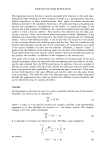
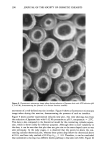
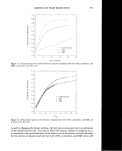
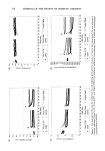
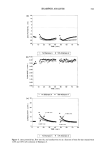
SHAMPOO ANALYSIS 319 streaming potential potential traces obtained for this material show both high maximum and equilibrium values as compared to single-charge quartenary ammonium surfactants such as, for example, cetyltrimethylammonium chloride (3). Similarly to other cationic surfactants, Schercoquat DAS reduced the conductivity of the plug to below baseline value within a few rinsing cycles after the treatment. As suggested before, this shows that the fibers do not release appreciable amounts of ad(b)sorbed surfactant into the test solution, and may be indicative of the penetration or rearrangement of the initially adsorbed cationic surfactant molecules inside the bulk of the fiber (3). The flow rate data presented in Figure 2b also suggest a 6% decrease in permeability of quat-treated plug in comparison with hair after exposure to SLES-2, the difference being slightly higher than the limits of the experimental error. In contrast to cationic surfactants, cationic polymers adsorb at the hair surface in a nearly irreversible fashion (6). In the case of Jaguar C17, which is a guar gum modified by the reaction with glycidyltrimethylammonium chloride, the signs of the streaming and zeta potentials are reversed after the treatment and remain constant throughout the whole rinsing cycle. The polymer, which forms turbid dispersions rather than clear solutions in water, significantly reduces the permeability of the plug by evidently forming thick deposits on the fiber surface. Such a behavior is similar to that observed for other cationically modified guar gums, but contrasts with that noted for synthetic, water- soluble cationic polymers, which even at a considerably higher concentration (0.5%) adsorb in the form of thin layers on the fiber surface (3). Figure 3a-d presents the data obtained for amphoteric and nonionic detergents, which are frequently included in commercial cleansing products. The dynamics of the inter- action of hair with such surfactants cannot be unambiguously probed by the use of DEPA because of their uncharged nature. One can only draw conclusions from the relative variation in streaming potential and conductivity. In general, for two ampho- teric surfactants, cocamidopropyl betaine (CAPB) and cocamidopropyl hydroxysultaine (CAPHS), and three nonionic surfactants, Triton X-100, Triton X-405, and Tergitol TMN-6, the changes in electrokinetic parameters and permeability before and after the treatment are relatively small. Both amphoteric surfactants contain salt as a contami- nant, which might be responsible for an increase in plug conductivity observed imme- diately after the treatment cycles. As a result of washing with Triton X-405 and CAPHS, a small decrease in zeta potential is evident, especially after the second treat- ment cycle. Although both surfactants possess no excess charge, and thus cannot modify the surface potential by neutralization, if it plausible that they can screen the intrinsic surface charge by adsorption. This could be responsible for the observed transient reduction in zeta potential immediately after the treatment. It should also be noted that the application of the surfactant solutions results in a significant lowering of the plug conductivity, and in the case of betaine, Triton X-100, and Tergitol TMN6, an increase in the value of the streaming potential. Both phenomena may reflect the removal of loosely bound electrolytic species (including hair lipids) from the fiber by a dilute surfactant solution. NONCONDITIONING SHAMPOOS BASED ON ANIONIC SURFACTANT Figure 4a-c presents the electrokinetic and permeability traces obtained for hair treated with 1% and 10% solutions of shampoo A based on sodium C14-C16 olefin sulphonate,
Purchased for the exclusive use of nofirst nolast (unknown)
From: SCC Media Library & Resource Center (library.scconline.org)