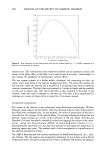
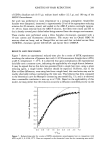
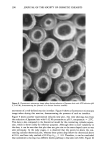
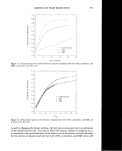
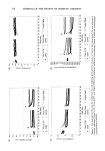
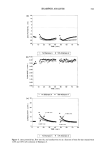
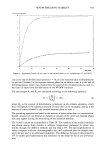
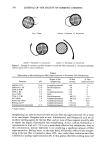
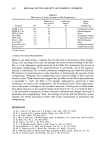
316 JOURNAL OF THE SOCIETY OF COSMETIC CHEMISTS Shampoo M. The formulation is based on the complex of cationic (stearyltrimethylam- monium chloride) and anionionic (sodium N-lauroyl-N-methyl-beta-alanine) surfac- tants, amphoteric detergent, cocamide DEA, and water (9). RESULTS AND DISCUSSION UNTREATED HAIR Five datapoints in the first measurement period allow the estimation of electrokinetic and permeability characteristics of untreated hair fibers. As pointed out previously (3), there is a considerable plug-to-plug variation in the measured parameters, with the streaming potential and conductivity ranging from - 180 mV to - 280 mV, and from 7.5 to 4.8 mho/cm, respectively. Consequently, zeta potentials calculated from the Smoluchowski equation varied from -8 to - 15 mV. The flow rates through a newly formed plug, at 12 cm Hg, were in the range of 3.25 to 3.75 cm3/sec, drifting toward higher values within the first 5-10 minutes of the experiment, probably as a result of the flow-induced rearrangement of the fibers in the plug. In order to facilitate com- parisons between the data obtained in different experimental runs, the fifth datapoint on zeta potential, streaming potential, and flow rate curves were normalized to - 15 mV, -250 mV, and 3.5 cm3/sec, respectively. The normalization factor, ranging from 1.02 to 1.4, was the same for streaming and zeta potential data, since these two parameters are connected through the Smoluchowski equation, and zeta potential was calculated from the adjusted streaming potential and unadjusted conductivity values. The nor- malization factor was different for the flow rates, and varied from 1.02 to 1.15. The parameters characterizing the interactions of shampoos with hair, such as the thickness of deposited layers and buildup coefficients, were calculated from the actual, unadjusted data. The analysis of the reproducibility of electrokinetic and permeability parameters is discussed in reference (3). The reproducibility of the values obtained for the same treatments but using different plugs is estimated to be within -+5%. MODEL, SINGLE-COMPONENT SURFACTANT AND POLYMER SOLUTIONS DEPA traces for the pure components of shampoo formulations, such as anionic and cationic detergents, as well as cationic polymers, were discussed in our previous pub- lication (3). Figure 2 presents typical curves obtained for an anionic detergent, SLES-2, a cationic surfactant, Schercoquat, and a cationic polymer, Jaguar C17, which are frequently used in shampoo compositions. The binding of an anionic surfactant to hair depends on the type of its ionic head, counterion, degree of ethoxylation, etc. For example, the rates of desorption of laurylsulfates are affected by a counterion and were found to decrease in the following sequence: TEA lauryl sulfate DEA lauryl sulfate ammonium lauryl sulfate sodium lauryl sulfate (3). Similarly, lauryl sulfates with a higher degree of ethoxylation have lower affinity to keratin fibers, and are easier to remove by rinsing with water. Figure 2 presents the DEPA traces obtained for an anionic surfactant, SLES-2, which shows some extent of binding to hair surface. Following the treatment, zeta potential of hair decreases below levels characteristic for untreated hair, suggesting the presence of negatively charged surfactant on the fiber

SHAMPOO ANALYSIS 317 ,• ( oqtun ) ,,d. lAIJ. OrlaNOO = 6 • 6 • 6 • 6 • 6 = •,• ( ALU ) -IVlJ. N=lJ. Od VñEtZ ++ + +$+ oooo • 6 g • o • g õ o ø g ( ALU ) -IVlJ. N=lJ. Od DNII•V=IEIJ. S 6 6 6 õ • g •, ( oas/oo ) =1/VEI MO-I-I
Purchased for the exclusive use of nofirst nolast (unknown)
From: SCC Media Library & Resource Center (library.scconline.org)