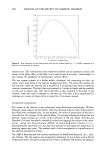
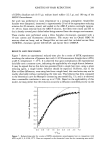
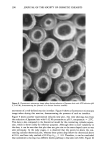
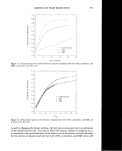
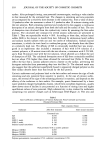
344 JOURNAL OF THE SOCIETY OF COSMETIC CHEMISTS Table III Parameters of Eq. 2 Calculated for Two Temperatures of Storage (Average Values of Three Measures on Two Batches: n = 6) Standard UV Visible Temperature Parameter deviation spectrometry spectrometry HPLC 25øC A 2.19 2.34 2.18 tr^ 0.05 0.08 0.02 k 0.084 0.067 0.082 trk 0.005 0.007 0.002 40øC A 7.72 7.82 7.79 or^ O. 08 O. 08 O. 01 k 0.229 0.217 0.220 O' k O. 007 O. 007 O. O01 Both A and k values increase with temperature. The breakdown of the emulsion was both amplified (increase in A value) and accelerated (increase in k value). Thus, accel- erated stability study at 40øC can be considered as a valuable means to predict the long-dated behavior of the emulsion. However, to be valid, the accelerated study must proceed from the same phenomenon of instability as the ambient temperature stability. Consequently, the experimenter must perform a careful search of which temperature should lead to the more valuable results. In our example, the total oil film disruption was not observed at 40øC, due to the greater stability of the primary emulsion. The increase of the multiple emulsion breakdown between ambient temperature and 40øC can be attributed to the weakening of the oil barrier with temperature. Due to temperature, the oil film loosens and becomes more subject to disruption. This explains the simultaneous amplification and acceleration of the instability phenomenon. At higher temperatures, the breakdown may proceed from the stability of the oil film itself. Visual inspection of multiple emulsion stored a few weeks at 70øC shows a total breakdown. However, the phase, corresponding to the primary emulsion, appears to be solidified, which prevents the total disruption of the internal aqueous droplets. Conse- quently, even if higher values of parameters A and k can be observed at those temper- atures (70øC), the instability phenomenon is not the same as at 25 or 40øC and cannot be used for predictive means. CONCLUSION Dihydralazine was proven to be a convenient indicator for W/O/W multiple-emulsion breakdown studies. It met the well-accepted criteria of non-diffusibility, stability, and detectability. Also, the low amount of dihydralazine included in the internal phase ensures that the tracer does not compromise the emulsion stability. Indeed, it is possible to include it as tracer, jointly with active substances in the early development steps of a new formulation. Dihydralazine can be used whatever the emulsion formula is if the preliminary determination of partitioning coefficient is measured in liquid media con- taining lipophilic or hydrophilic surfactant as concentration in the emulsion formula. (A forthcoming study on this subject is in progress in our laboratory.) The consistency of

W/O/W EMULSION STABILITY 345 the results obtained with different analytical methods should also facilitate this step by allowing inter-laboratory comparisons. Its thermal stability allows the performance of accelerated stability studies at subambient temperatures, but, more advisably, with an additional macroscopic observation of the W/O/W multiple-emulsion stability. REFERENCES (1) W. Seifriz, Studies in emulsion, J. Phys. Chem., 29, 738-749 (1925). (2) A. T. Florence and D. Whitehill, Some features of breakdown in water-in-oil-in-water multiple emulsions, J. Colloid Interface Sci., 79, 243-256 (1981). (3) A. T. Florence and D. Whitehill, The formulation and stability of multiple emulsions, Int. J. Pharm., 11, 277-308 (1985). (4) D. Whitehill and A. T. Florence, Mechanisms of instability in W/O/W multiple emulsions, J. Pharm. Pharmacol., 31, 3P (1979). (5) S.S. Davis and A. S. Burbage, Electron micrography of water-in-oil-in-water emulsions, J. Colloid Interface Sci., 62, 361-363 (1977). (6) Y. Kita, S. Matsumoto, and D. Yonezawa, Viscosimetric method for estimating the stability of W/O/W-type multiple-phase emulsions, J. Colloid Interface Sci., 62, 87-94 (1977). (7) M. Tomita, Y. Abe, and T. Kondo, Viscosity change after dilution with solutions solute permeability through the oil layer, J. Pharm. Sci. 71, 332-334 (1982). (8) S. Matsumoto, Y. Kita, and D. Yonezawa, An attempt at preparing water-in-oil-in-water multiple phase emulsions, J. Colloid Interface Sci., 57, 353-361 (1976). (9) S. Magdassi, M. Frenkel, and N. Garti, On the factors affecting the yield of preparation and stability of multiple emulsions, J. Dispers. Sci. Technol., 5, 49-59 (1984). (10) J. A. Omotosho, T. K. Law, T. L. Whateley, and A. T. Florence, The stabilization of W/O/W emulsions by interfacial interaction between albumin and non-ionic surfactants, Colloids and Surfaces, 20, 133-144 (1986). (11) A. Burbage and S. Davis, The characterization of multiple (W/O/W) emulsions using a radiotracer technique, J. Pharm. Pharmacol., 31, 6P (1979). (12) S.S. Davis and I. Walker, Measurement of the yield of multiple emulsion droplets by a fluorescence tracer technique, Int. J. Pharm., 17, 203-213 (1983). (13) J. Zatz and G. Cueman, Assessment of stability in water-in-oil-in-water multiple emulsions, J. Soc. Cosmet. Chem., 39, 211-222 (1988). (14) M. De Luca, P. Rocha-Filho, J. L. Grossiord, A. Rabaron, C. Vaution, and M. Seiller, Les •mulsions multiples, Int. J. Cosmet. Sci., 13, 1-21 (1991). (15) C. Laugel, P. Chaminade, A. Baillet, and D. Ferrier, Ion-pairing reversed phase liquid chromato- graphic determination of dihydralazine, J. Chromatogr. (in press).
Purchased for the exclusive use of nofirst nolast (unknown)
From: SCC Media Library & Resource Center (library.scconline.org)