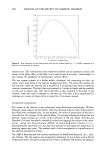
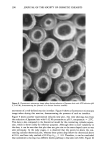
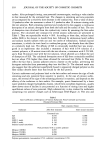
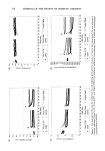
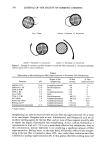
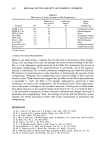
HAIR STRAIGHTENING 349 treated with a commercial thioglycolate waving lotion for 30-40 minutes, followed by a neutralization step, the hair fiber will acquire a curly configuration that will survive subsequent washing. On the other hand, if a curly Afro hair fiber is set in a straight configuration (the fiber is held straight under a small strain, for example), and treated with a similar thioglycolate waving lotion and neutralization step, the hair fiber will acquire a temporary straight configuration. However, the hair fiber will revert to most of its original curliness on even one subsequent washing. The failure of this reduction/ re-oxidation scheme to impart a more permanent straightness to the hair fiber suggests that a molecular model comparable to hair waving may not be entirely applicable. THE PHENOMENON OF SPONTANEOUS HAIR UNCOILING Another unique aspect of hair straightening is the spontaneous uncoiling of the hair fiber. Placed in a solution of appropriate reagent, a curly hair will uncoil itself without the help of an external force. This phenomenon can be demonstrated by the following experiment: A curly hair fiber is immersed in a 1 N sodium hydroxide solution. The curvature of the hair is observed and can be seen to increase slowly, and in about 10 to 15 minutes, the hair fiber becomes practically straight. In other words, unlike hair waving, hair straightening can be achieved without the application of an external force to strain the hair fiber. The question arises as to what causes the curly hair fiber to uncoil and allow hair straightening to proceed. We thought of two possibilities: One explanation could be the swelling action of the reagent, since sodium hydroxide is an excellent swelling agent for keratin fiber. In fact, it has been pointed out in the literature (5,6) that, based entirely on geometrical consideration, any radial swelling of a curved segment of a fiber should result in an increase in the radius of curvature of the fiber. Another explanation could be the result of fiber supercontraction (7). In fact, under closer examination, as shown in Figure 1, it can be seen that in a 1 N sodium hydroxide solution, the uncoiling of the hair fiber is accompanied by some changes in fiber geometry. HAIR SWELLING AND HAIR SUPERCONTRACTION To assess the relative importance of these two factors to permanent hair straightening, we proceeded to examine the swelling and supercontraction behavior of hair fibers in a variety of reagents and to establish how they would impact on hair straightening. In this set of experiments, curly Afro hair fibers were treated with various reagents, some of which are known to be good keratin swelling agents, while others are also known to cause supercontraction in keratin fibers. These reagents included sodium hydroxide, resorcinol, lithium chloride, urea, dithiothreitol (DTT), thioglycolic acid (TGA), tris (hydroxymethyl)phosphine (THP), boiling water, and cuprammonium hydroxide. The degree of hair swelling and the amount of fiber supercontraction were measured and correlated with the corresponding degree of permanent hair straightening. Results are shown in Table I below. It is interesting that while all the reagents in the study are effective hair swelling media, permanent hair straightening is achieved only by those that are also able to induce hair supercontraction. From the data shown in Table I, it is obvious that effective hair

350 JOURNAL OF THE SOCIETY OF COSMETIC CHEMISTS Dry Fiber After 2 Minute in Solution After 5 Minutes in Solution After 16 Minutes in Solution Figure 1. Changes in curvature and fiber diameter of curly hair fiber immersed in 1 N sodium hydroxide solution (grid circle is used as reference). Table I Relationship of Hair Swelling and Fiber Supercontraction to Permanent Hair Straightening Degree of hair % Hair % Hair Reagents pH straightening swelling supercontraction NaOH (1 N) 14.0 Complete/permanent 40 5.7 NaOH (0.1 N) 13.0 Partial/temporary 40 0 DTT (0.8 M) 3.5 None 50 0 THP (1 M) 8.5 Complete/permanent 50 6 Urea (50%) 7.0 None 30 0 TGA ( 1.2 M) 9.6 Partial/temporary 80 [ 11] 2.0 LiCl (40%) 7.0 Complete/permanent 60 [ 12] 11.5 Resorcinol (40%) 7.0 Complete/permanent 50 10.0 Boiling water* Complete/permanent 15 [ 13] 6.0 Cuprammonium hydroxide 12.0 Complete/permanent 50 [ 14] 9.4 * Under tension. straightening can only be achieved when the hair fiber has supercontracted 5 % or more of its own length. Reagents such as urea, dithiothreitol, and thioglycolic acid are all excellent swelling agents for the hair fiber, and yet none of these reagents would be able to impart any degree of permanent hair straightening. In fact, sodium hydroxide at a concentration as high as 0.1 N is not a particularly effective hair straightener, since at this concentration, sodium hydroxide is not producing a significant amount of fiber supercontraction. Boiling water, on the other hand, will produce effective hair straight- ening if the hair fiber is strained to about 20%, since under these conditions hair fiber is believed to undergo supercontraction (8). It thus appears that fiber swelling alone will
Purchased for the exclusive use of nofirst nolast (unknown)
From: SCC Media Library & Resource Center (library.scconline.org)