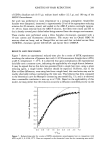
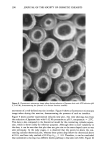
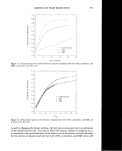
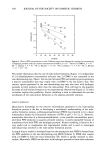
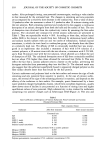
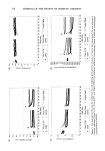
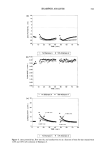
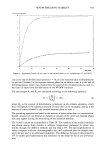
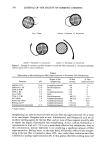
HAIR STRAIGHTENING 351 not be sufficient without also the presence of fiber supercontraction. Indeed, hair fiber supercontraction is perhaps the dominant requirement. The importance of fiber supercontraction is further demonstrated by the observations that the time required to achieve permanent hair straightening tends to coincide with the onset of supercontraction, as data in Table II clearly indicate. For example, in the case of 1 N sodium hydroxide, it takes about 15-20 minutes to achieve effective hair straightening. On the other hand, it takes as long as 45 minutes for THP. Closer examinations of the rate of supercontraction show that in sodium hydroxide solution, hair fiber will start to supercontract in 10 minutes, and supercontract completely in about 20 minutes. For THP, it takes much longer for fiber supercontraction to start, and it takes about 40-45 minutes for completion. What this seems to suggest is that radial swelling of the hair fiber is only the initiation step that helps to achieve the necessary uncoiling of the curly fiber into a straight configuration. The primary driving force to impart permanent straightening to the hair is the subsequent supercontraction of the fiber. THE ROLE OF CYSTINE AND LANTHIONINE The formation of a new crosslink such as lanthionine is generally believed to be required in hair straightening to stabilize the fiber in the new straight configuration. However, the observations described in Table I would suggest that the formation of lanthionine may not be as critical. Lithium chloride, for example, is not expected to produce any significant amount of lanthionine in the hair, and yet it is able to achieve effective hair straightening under appropriate conditions. On the other hand, 0.1 N sodium hydrox- ide produces only partial hair straightening, but its action on hair is expected to produce a substantial amount of lanthionine. On analyzing the treated hair samples described in Table I for cystine and lanthionine contents, we were indeed able to show that neither the formation of lanthionine nor the reduction of cystine will always correspond to the efficacy in hair straightening. In addition to lithium chloride, for example, other reagents such as resorcinol, tris(hydroxymethyl)phosphine, and boiling water are all found to be able to achieve effective hair straightening without any evidence of lan- thionine formation, as shown in Table III below. Also, a reagent such as dithiothreitol is found to be totally ineffective even though it would cause substantial breakdown of cystine in hair. The assumption that permanent hair straightening requires the cleavage of cystine and the subsequent formation of lanthionine does not appear to be entirely valid. Table II Treatment Time Required for Fiber Supercontraction and for Hair Straightening Fiber Permanent hair Reagents supercontraction straightening Sodium hydroxide, 1 N 15-20 min 20 min THP 40-50 min 50 min LiC1 120 min Over 120 min Cuprammonium hydroxide 70-80 min 90 min

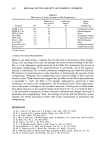
352 JOURNAL OF THE SOCIETY OF COSMETIC CHEMISTS Table III Effectiveness of Various Reagents on Hair Straightening Reagents pH Reduction in Lanthionine Degree hair cysteine formed of hair (%) (%) straightening NaOH (1 N) 14.0 35 24 Complete/permanent NaOH (0. t N) 13.0 30 17 Partial/temporary DTT (0.8 M) 3.5 90 0 None LiC1 (40%) 7.0 3 0 Complete/permanent THP (1 M) 8.5 45 0 Complete/permanent TGA ( 1.2 M) 9.6 54 0 Partial/temporary Urea (50%) 7.0 -- 0 None Resorcinol (40%) 7.0 -- 0 Complete/permanent Boiling water* 5 0 Complete/permanent * Under tension. A MODEL FOR HAIR STRAIGHTENING Based on our observations, it appears that the first step in the process of hair straight- ening is the uncoiling of the hair curl through the action of radial swelling of the fiber. But it is the subsequent supercontraction of the fiber that determines the success of permanent straightening. If the supercontraction is irreversible, and if the supercon- traction is substantial (5% or more), permanent straightening can indeed be achieved. The kinetics of supercontraction is also important in determining the outcome of hair straightening. Permanent hair straightening can be achieved rapidly if fiber supercon- traction is fast. These observations suggest that the effect of the fiber supercontraction is essentially to "lock" the fiber in the straight configuration, preventing it from reverting to its native curly configuration. On the molecular level, fiber supercontrac- tion is the result of changes in the secondary structure, involving the so-called alpha- beta phase transition in the organized phase of the keratin (9-11). It is believed that it is the irreversible consequence of these molecular conformational changes that leads to permanent hair straightening. Thus, the c.leavage of cystine and the formation of lan- thionine are merely by-products rather than prime requirements of permanent hair straightening. REFERENCES (1) M. J. Horn, B. D. Jones, and S. J. Ringel, J. Bio. Chem., 138, 141 (1941). (2) R. S. Asquith and P. Carthew, Biochim. Biophys. Acta, 278, 8 (1972). (3) J. M. Swan, Nature, 179, 965 (1957). (4) J. Chao, E. Newsome, I. M. Wainwright, and R. A. Mathews,J. Soc. Cosmet. ½hem., 30, 401 (1979). (5) K. Baird, Text. Res. J., 33, 866 (1963). (6) M. Cednes, Text. Res. J., 52, T25t (1961). (7) F. J. Worthmann and H. Heutz, J. Appl. Polym. Sci., 48, 137 (1993). (8) M. Feughelman, A. R. Haly, and W. Snaith, Text. Res. J., 32, 913 (1962). (9) W. T. Astbury and H. T. Wood, Phil. Trans Roy. Soc., A232, 333 (1933). (t0) P. Alexander, Wool: Its Chemistry and Physics (Chapman & Hall, London, 1954), pp. 76, 374. (lt) W. G. Crewther and L. M. Dowling, Text. Res. J., 29, 541 (1951).
Purchased for the exclusive use of nofirst nolast (unknown)
From: SCC Media Library & Resource Center (library.scconline.org)