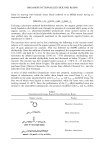
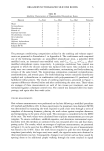
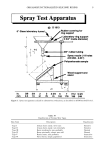
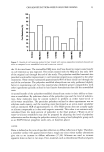
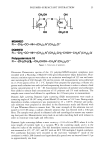
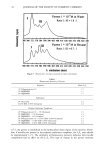
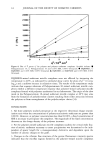
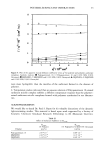
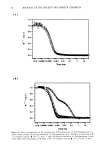
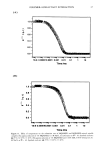
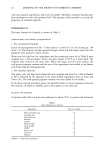
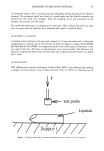
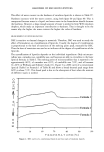
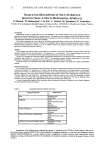
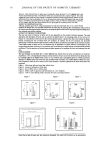
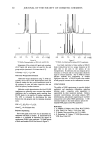
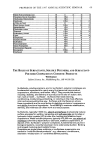
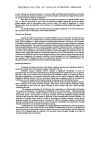
POLYMER-SURFACTANT INTERACTION 25 CH2OH OH o I I OH CH=O R MQNNED R = -CH2-CO-NH-(CH2) 2 N + (CH3) 3 CI- DQNNED R = -CH2-CO-NH-(CH2) 2 N + (OR3) 2 CH2-CHOH-CH2 N+ (CH 3)3 Cl' Polyquaternium 10 R = -(CH2CH2q•(-CH2CHOH-CH2 N+ (CH3) 3 CI- Figure 1. Structures of polymers. Fluorescence. Fluorescence spectra of the 1% polymer/SDS/Octoxynol complexes were recorded with a Fluorolog 2 Model F112X spectrofluorometer (Spex Industries). Fluo- rescence emission spectra were taken at an excitation wavelength of 335 nm and emis- sion wavelengths of 360 through 450 nm for pyrene. All measurements were performed in a 1.0-cm quartz cell at 25 + iøC. Samples were prepared by piperring a volume of a pyrene stock solution into each vial and evaporating the solvent in order to obtain a final pyrene concentration of 1 ß 10 7 M. Concentrated solutions of polymer and surfactants were added to obtain final concentrations of 1% polymer and 1% total surfactant. The samples were stirred and allowed to equilibrate for 24 hours prior to measurement. Dynamic light scattering. Dynamic light scattering (DLS) measurements were made at scattering angles of 30-90 ø using a Lexel Model 95 ion laser at 514.5 nm. During angle dependence studies, temperature was maintained at 25 + 0.05øC. Polymer and surfac- tant solutions were prepared as described in the fluorescence study and filtered with 0.2-pm Whatman filters to remove dust. The ionic strength of the solutions was ad- justed to 0.10 M using a sodium chloride solution that was filtered with a 0.02-pm filter. The samples were placed in silanated cells and centrifuged to remove any remain- ing dust particles. Measurements were made in an index matching bath with toluene in order to minimize stray light and reflections. Dynamic light scattering defines a wave vector q = (4 'r n/k) sin ((}/2) where X is the wave length of incident light in a vacuum, (} is the scattering angle, and n is the refractive index of the medium. The full homodyne intensity autocorrelation function was measured at 30 ø, 45 ø, 60 ø, and 90 ø with an ALV 500 multiple-'r digital correlator. The correlation functions were recorded in the real time "multiple-'r" mode of the correlator in which 288 channels are logarithmically spaced over an interval from 0.2 ps to approximately one hour.

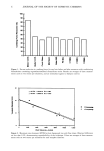
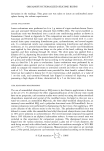
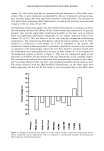
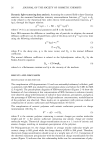
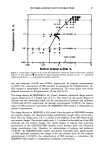
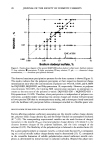
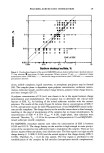
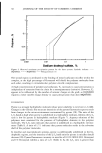
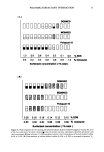
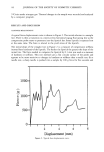
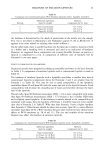
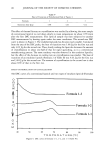
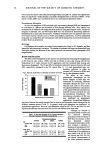
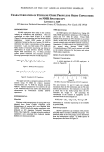
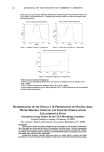
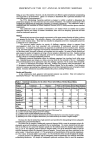
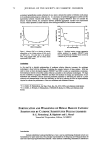
26 JOURNAL OF THE SOCIETY OF COSMETIC CHEMISTS Dynamic light-scattering data analysis. Assuming the scattered field to have Gaussian statistics, the measured homodyne intensity autocorrelation function, g(2) (q,t), is di- rectly related to the theoretical first order electric field autocorrelation function, (q,t), through the Siegert relation: g(2) (q,t) = 1 + B(1 + flgO) (q,t)[2) (1) where f (•1) is an instrumental parameter and B is the baseline. Since DLS measures the diffusion or tumbling rate of particles in solution, the mutual diffusion coefficient can be obtained from a plot of the decay rate of g(•) (q,t) versus time using the following relationships: g0) (q,t) = e -rt (2) I • = q2D m (3) where F is the decay rate, q is the wave vector, and D m is the mutual diffusion coefficient. The mutual diffusion coefficient is related to the hydrodynamic radius, Rh, by the Stokes-Einstein equation: D m = kT/6•rwlR h (4) where k is a Boltzmann constant and x I is the viscosity of the medium. RESULTS AND DISCUSSION PRECIPITATION STUDIES WITH SDS The complexation of Polyquaternium 10 and two aminoalkylcarbamoyl ceIlulosic graft co-polymers with SDS was studied by precipitation above and below the CMC for SDS (2.4 mg/ml). The pseudo-phase diagrams of SDS/water/polymer (Figures 2•4) show the formation of clear solutions at low concentrations of SDS. Increases in solution viscosity were observed along with formation of turbid or hazy solutions, precipitates, and gels as the percentage of SDS was increased. At high surfactant concentrations, resolubilization of the polymers was observed. These results are in agreement with previous studies of complexation of anionic surfactants and Polyquaternium 10 (8,10). The complexation of cationic polymers with anionic surfactants proceeds via charge neutralization (10) (Eq. 5). pn+ +nD • PDn (5) where P is the cationic polymer containing n cationic charges per residue molecular weight and D- is the anionic surfactant containing one anionic charge per residue molecular weight. Theoretical charge neutralization occurs at a 1:1 ratio of cationic and anionic charges, resulting in maximum precipitation of the polymer. For Polyquaternium 10, the charge density or average residue molecular weight per cationic charge is 689 g/mol while the charge density of SDS is 288 g/mol. Therefore, theoretical charge neutralization should occur at a weight ratio of 2.3:1. Comparison of the observed maximum precipitation with the theoretical charge neutralization for this system (Figure 2) indicates that this relationship holds true for concentrations of poly-
Purchased for the exclusive use of nofirst nolast (unknown)
From: SCC Media Library & Resource Center (library.scconline.org)