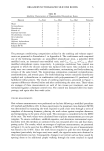
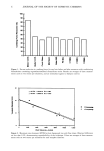
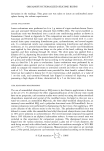
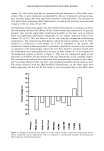
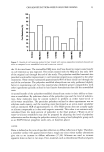
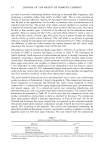
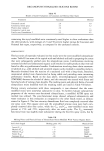
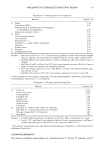
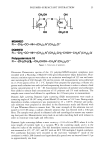
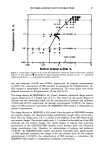
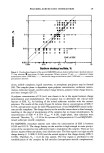
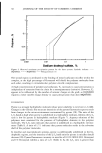
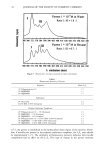
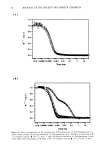
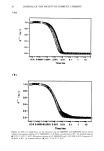
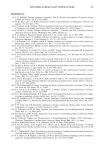
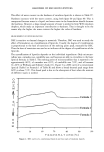
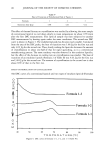
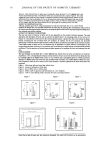
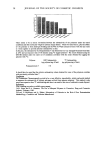
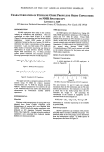
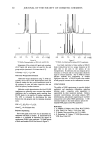
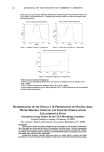
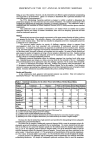
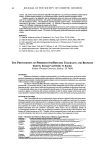
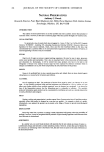
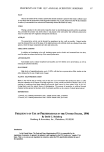
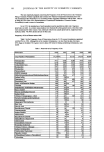
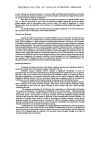
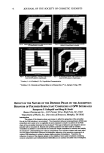
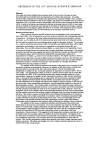
HARDNESS OF EMULSION LIPSTICKS 47 The effect of water content on the hardness of emulsion lipsticks is shown in Table IV. Hardness increases with the water content, using both Span 60 and Span 80. This is unexpected because water is a liquid, and more water in the formulation should decrease the hardness. However, a large enough amount of water is needed to form W/O emulsion droplets, which make an important contribution to hardness. That is thought to be the reason why the higher the water content the higher the value of hardness. MEASUREMENT OF CRYSTALLIZATION DSC is sensitive to thermal changes in materials. Therefore, DSC was used to study the effect of formulation on crystallization of lipsticks. Usually the degree of crystallization is proportional to the heat of transition of the melting point peak, measured by DSC. Thus the heat of transition was used as an indicator of the degree of crystallization of the lipsticks. The crystallization of lipsticks depends on the individual ingredients. Only microcrys- talline wax, carnauba wax, candelilla wax, and beeswax are able to crystallize in the basic lipstick formula in Table I. The melting point of microcrystalline wax is reported to be approximately 80øC, of carnauba wax 85øC, of candelilla wax 70øC, and of beeswax 61-66øC in Williams and Schmitt's book (! 1% Figure 3 is a DSC curve of a conventional lipstick (Table I or Formula ! of Table II) and shows a broad thermal peak range from 60øC to about 73øC. This broad peak is due to the absorption of heat when the mixture of different waxes is melted. I Formula 1 Formula 2 Formula 3 40 50 60 70 80 90 TFJvIp1= RATURF(øO) Figure 4. DSC curves of a conventional lipstick and two types of emulsion lipstick. 100

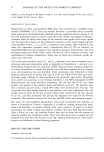
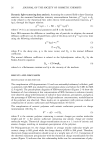
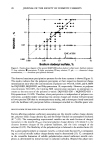
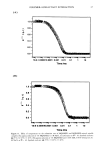
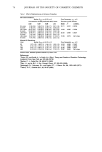
48 JOURNAL OF THE SOCIETY OF COSMETIC CHEMISTS Table V Heat of Transition of Endothermal Peak of Figure 4 Formula 1 2 3 Transition heat (J/g) 5.98 4.63 4.12 The effect of thermal history on crystallization was studied by allowing the same sample of conventional lipstick to cool down slowly to room temperature (at about 10øC/min) after the first DSC measurement. This lipstick sample was then subjected to another DSC measurement by heating again under the same conditions. The second-run DSC curve is shown in Figure 3. The endothermal peak has become much smaller. Calculated from the area of the DSC peaks, the heat of transition was 5.98 J/g for the first run and only 3.02 J/g for the second run. Thus, slowly cooling the lipsticks decreases the amount of crystallization to about one-half of that for rapid quenching, as in a conventional manufacturing process. The same tendency was also observed in the emulsion lipsticks, but the effect of the decrease in cooling rate on crystallization was smaller. The heat of transition of an emulsion lipstick (Formula 2 of Table II) was 4.63 J/g for the first run and 3.84 J/g for the second run. The amount of crystallization in the second run is thus about 83% of that in the first run. EFFECT OF FORMULATION ON CRYSTALLIZATION The DSC curves of a conventional lipstick and two types of emulsion lipstick (Formulae o :z I,.,d 40 Formula 1-3 Formula 1-2 Formula 1-1 f I i I 50 60 70 80 T F' •'• P F' RAT U R F' (øO) Figure 5. DSC curves of formulae 1-1, 1-2, and 1-3 (Table IV). 100
Purchased for the exclusive use of nofirst nolast (unknown)
From: SCC Media Library & Resource Center (library.scconline.org)