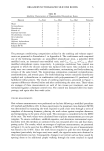
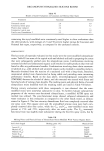
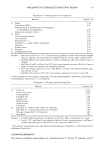
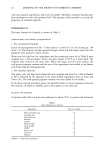
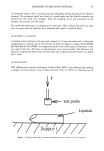
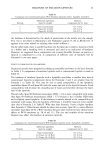
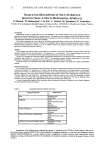
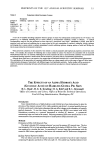
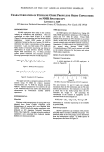
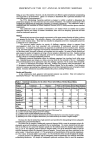
HARDNESS OF EMULSION LIPSTICKS 45 Table II Comparison of a Conventional Lipstick With Emulsion Lipsticks (with a lipophilic emulsifier) Additional ingredients Hardness Formula (parts by weight) (compression by 0.1 mm) 1 None (conventional) 313 q- 30 g 2 5 Span 60 10 H20 223 --- 22 g 3 5 Span 80 10 H20 263 q- 27 g the hardness is determined by the depth of penetration of the needle into the sample. This test is described in Maruyama's and Nakajima's papers (5,10) as JIS K2235. It appears to be more related to yielding than initial stiffness.) On the other hand, there is another hardness test for lipsticks in which a lipstick is fixed in a holder and a breaking force is measured and used as an indication of hardness. However, we suggested that a compression test is more favorable because, in practice, a lipstick is compressed to a lip. A comparison of different tests of hardness will be discussed in our next paper. EFFECT OF FORMULATION ON HARDNESS Emulsion lipsticks were prepared by adding an emulsifier and water to the basic formula in Table I. A comparison of emulsion lipsticks with a conventional lipstick is made in Table II. The hardness of emulsion lipsticks with a lipophilic emulsifier is smaller than that of conventional lipsticks (compression forces for Formulae 2 and 3 are smaller than for Formula 1 in Table II). This may be due to good compatibility of the lipophilic emulsifiers (Span 60 and Span 80) with the waxes and oils in the lipstick formula. Good compatibility will decrease the crystallization of waxes and therefore decrease the hard- ness of the lipsticks. Theoretically, Span 80 (Sorbitan monooleate HLB = 4.3) is more compatible with waxes than Span 60 (Sorbitan monostearate HLB = 4.7) because it has a smaller HLB value and is slightly more lipophilic. If the hardness is mainly related to the compatibility of emulsifier with waxes, then the hardness of Formula 3 would be expected to be smaller than that of Formula 2 in Table II. Why then does Formula 3 have a higher hardness than Formula 2? Other factors should be taken into account. Span 80 is a more effective emulsifier than Span 60 for a W/O emulsion because oleyl derivatives have shown better effects in W/O emulsions (p. 28 of ref. 11). The size and number of the emulsion droplets may affect the hardness of emulsion lipsticks. Table III Comparison of a Conventional Lipstick With Emulsion Lipsticks (with a hydrophilic emulsifier) Additional ingredients Hardness Formula (parts by weight) (compression by 0.1 mm) 1 None (conventional) 313 + 30 g 2 4.0 Tween 20 10 H20 237 + 24 g 3 4.5 Tween 20 10 820 247 --- 24 g

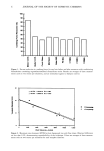
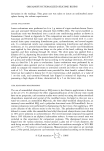
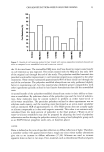
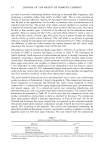
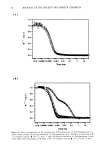
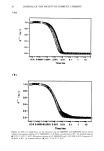
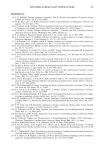
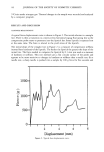
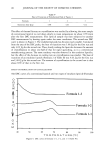
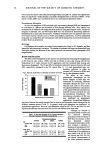
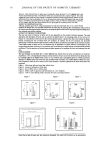
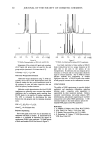
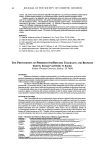
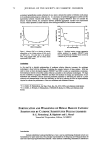
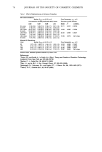
46 JOURNAL OF THE SOCIETY OF COSMETIC CHEMISTS Table IV Effect of Water Content on Hardness of Emulsion Lipsticks Additional ingredients Hardness Formula (parts by weight) (compression by 0.1 mm) 1-1 5 H20 5 Span 60 140 + 13 g 1-2 10 H20 5 Span 60 223 + 23 g 1-3 15 H20 5 Span 60 270 + 28 g 2-1 5 H20 5 Span 80 190 + 18 g 2-2 10 H20 5 Span 80 263 -+ 27 g 2-3 15 H•O 5 Span 80 273 + 26 g An emulsion lipstick is usually a W/O-type emulsion because of high oil and wax contents. A selection of lipophilic emulsifiers is therefore preferable. However, it is interesting to examine the effect of a hydrophilic emulsifier. Tween 20 with an HLB value of 16.7 was used to prepare an emulsion lipstick. Examples are given in Table III. The hardness of emulsion lipsticks prepared with a hydrophilic emulsifier also decreased when compared with a conventional lipstick. The hardness of Formulae 2 and 3 in Table III is similar to that of Formulae 2 and 3 in Table II, which shows that a hydrophilic emulsifier can also give a stable W/O emulsion lipstick. The reason is not understood. o o x 1.1.1 First run , Second run 4O i I I ' 60 70 80 90 TEMPE R-AT U R E(øG) Figure 3. DSC curves of a conventional lipstick. lOO
Purchased for the exclusive use of nofirst nolast (unknown)
From: SCC Media Library & Resource Center (library.scconline.org)