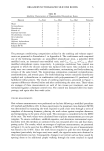
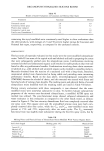
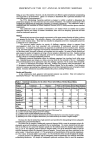
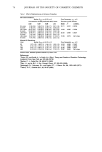
PREPRINTS OF THE 1997 ANNUAL SCIENTIFIC SEMINAR 69 Sodium Hydroxymethylglycinate 19 2 2 0 0 Polymethoxy Bicyclic Oxazolidine 18 0 NA 0 0 Chlorhexidine Dihydrochloride 16 0 NA 5 5 Dimethoxane 16 20 qA 19 23 p-Chloro-m-Cre,sol 1•5 0 C 0 0 Phenyl Mercuric Acetate 14 20 qA 35 35 Isopropylparaben IC 4 qA 9 12 Chlorhexidine Acetate 9 0 qA 3 C Thimerosal 9 11 qA 21 22 Dichlorobenzyl Alcohol 8 11 qA 12 4 Captan ? 11 NA 19 3C Chlorphenesin 7 0 NA 0 • Domiphen Bromide ? 0 NA 4 2 Dichlorphene 5 0 NA 3 3 Phenoxyisopropanol 5 0 NA 5 5 Sodium Propylparaben 5 0 NA 0 0 Polyaminopropyl Biguanide 4 0 0 0 • Benzylparaben 0 95 NA 9 9 Chlorbutanol 0 0 NA I I THE ROLES OF SURFACTANTS• SOLUBLE POLYMERS• AND SURFACTANT- POLYMER COMPLEXES IN COSMETIC PRODUCTS Wil Hemker Salient Science, Inc., Middleburg Hts., OH 44130 USA Surfactants, soluble polymers, and/or surfactant - polymer complexes are fundamental ingredients to nearly every fluid personal care product: suspensions, emulsions, and foams. Why? They provide the desired viscosity, stability, and delivery of a product to the site of action: skin hair nails or teeth ...'surfaces'. Surfaces that need cleaning, conditioning, moisturizing, protecting, or coloring in the most effective, mild, and sensory-attractive way. Surfaces and interfaces are where these ingredients are the most active to stabilize emulsions / suspensions and deliver functional ingredients. Formulating to maximize stabilization, delivery, and mildness can often work at cross purposes. Surfactants, typically lOO0 mw, adsorb at interfaces to physically reduce surface energies for wetting / spreading and self associate as micelies or lyotrophic liquid crystals (LC) to alter the rheology and stabilize liquid suspensions. Water soluble polymers, typically lO,000 mw, can adsorb at interfaces (chemistry dependent) to lubricate, stabilize suspensions, or deposit a film. Surfactant - polymer complexes, fundamental structures in biological systems, recently have been more extensively studied. Binding is strongest involving electrostatic forces. Complexes as single phase solutions or multiphase suspensions are central to "multi-functional products" e.g. cleansers / conditioners, cleansers / moisturizers or controlled delivery activity.

70 JOURNAL OF THE SOCIETY OF COSMETIC CHEMISTS Foaming cleansing products, e.g. shampoos or shower gels, success is dependent on the colloidal properties of the surfactants that affect detergency, foam stability, rheology, and mildness. Detergency requires the surface free energy, •G, to be __0 corresponding to minimum interfacial tensions, 7wo,+ 7sw, which occurs at surfactant concentrations 10 - 20X less than typically used. Foam stability is dependent on bubble film elasticity and resilience both requiring high surfactant concentration and viscosity within the film. Rheology or desired viscoelastic flow is the result of elongated, rod-like micelies of charge shielded ionic or amphoteric surfactant regular micelies. Soluble polymer - surfactant complexes can enhance foam stability and rheological properties while reducing concentrations of surfactants required also enhancing cleanser mildness. Skin irritating surfactants have been identified as those with compact ionic head groups that strongly bind stratum corneum proteins. Relative mildness is enhanced by surfactant or surfactant blends having bulky head groups, lower critical micelie concentrations (CMC), and formulated with solution polymers that complex with ionic surfactants. Emulsion products are macroscopic dispersions of two immiscible liquids into a physically stable suspension, to deliver functional attributes in a sensory attractive manner primarily to the surface of skin or hair. Their physical stability is dependant on forming small dispersed droplets maintained by 1) viscous closed lamella LC comprised of surfactants and polar lipids, 2) combination surfactant LC aggregates with branched or cross-linked soluble polymers in the continuous phase, or 3) amphipathic polymeric steric stabilizers. The functional attributes of an emulsion is centered around the manner it responds to the surface in which it is delivered. The rate the emulsion physically destabilizes and releases its phases via adsorption, evaporation, or dilution of the continuous phase, impacts sensory and performance qualities. GENERAL REFERENCES: Basic Principles of Colloid Science, D.H. Everett, ed., CRC Press, 1988. Colloid and Interface Chemistry, D. Void and M.J. Void, Addison-Wesley 1983. Foams: Encyclopedia of Chemical Technology, S. Ross, Vol.2, 3rd ed., Wiley, New York 1980 Structure and Flow in Surfactant Solutions, C. R. Herb and R. K. Prud'homme, ed., ACS Symposium Series 578 1994 Interactions of Surfactants and Polymers and Proteins, E.D. Goddard and K. P. Ananthapadmanabhan, ed. CRC Press, 1993 Interfacial Phenomena in Biological Systems, M. Bender, ed. Marcel Dekker, New York, 1991 Secondary Droplet Emulsion: Mechanism and Effects of Liquid Crystal Formation in O/W Emulsion, T. Suzuki, H. Tsutsumi, and A. Ishida J. Disp. Sci & Tech., vol 5(2) p.l19, 1984
Purchased for the exclusive use of nofirst nolast (unknown)
From: SCC Media Library & Resource Center (library.scconline.org)