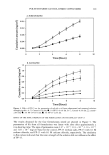
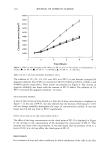
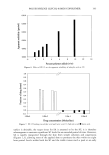
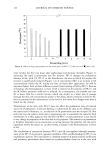
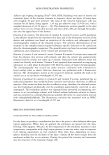
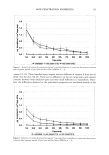
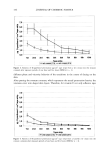
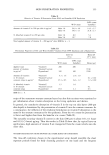
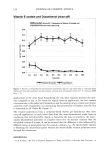
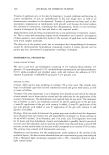
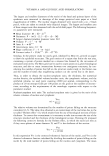
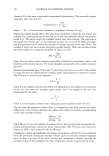
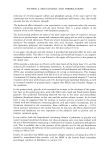
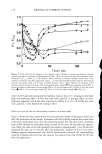
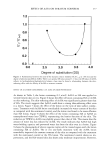
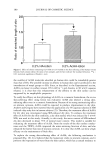
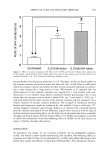
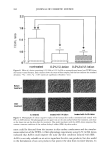
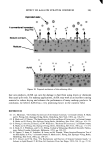
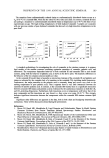
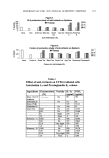
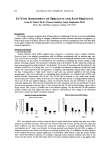
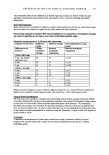
PREPRINTS OF THE 1999 ANNUAL SCIENTIFIC SEMINAR 193 the SDS or when mixed with it but had no anti-irritant effect when used as a pre-treatment (Fig 2). The latter data suggest that this extract may have augmented the SDS irritation by an unknown mechanism. B. Neurosensory Reactivity It is generally recognized that a sub-population of consumers exists who are particularly sensitive to irritation. They can be identified by their subjective response to a solution of lactic acid that is applied to the naso-labial fold. However, the response of such a panel to cosmetics and toiletry products is very low. To increase the likelihood of obtaining a reaction, exposure to a sauna has been used. This increases the irritant response but has the potential for the heat alone to be irritating. Alternatively, it has been suggested that the lactic acid be applied on a pad, which remains in place for the duration of the study. This provides a reservoir of irritant throughout the study period and maintains a hydrated stratum corneum, which will aid in penetration of the lactic acid. We have found that using this technique with a lcm 2 patch of non- woven fabric, soaked in 7.5% lactic acid, allows most people to respond. As a result, a population with "sensitive skin" is not required for these tests. A standard 5 point scale is used to evaluate the irritation, and an assessment is obtained every minute for 10 minutes. To determine the efficacy of anti-irritants, a comparison can be made between the results obtained from different materials applied to the two sides of the face. We confirmed the results of Hahn (1), who showed that addition of strontium nitrate to lactic acid reduced the level of irritation (Fig. 3). We also found that once the irritation had been established (after 5 minutes), replacement of the lactic acid with a non-irritating material reduced the irritant response. This occurred more rapidly if the lactic acid was replaced with a fresh piece of fabric soaked in an anti-irritant. In the example shown in Fig. 4, water or a base formula decreased irritation, but the inclusion of a botanical extract decreased it further. Effect of Strontium Nitrate on Lactic Acid Effect of Botanical Extract on Lactic Acid Irritation Irritation 0 1 2 3 4 5 e ? a s I 0 1 2 3 4 s T•me (m•ns) 0 T•me (m•ns) a•ter anUqrntant Fig. 3 Fig. 4 Conclusions Modifications to the standard assays for assessing dermal and sensory irritancy allow the general population to be used for testing, mild irritation to be assessed, and anti-irritants to be evaluated. References 1. U.S. Patent # 5,716,625-A. Hahn. G. Compositions containing divalent strontium cations for reducing irritant effects of chemical or environmental irritants

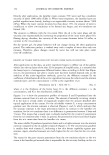
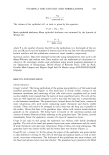
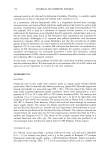
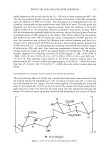
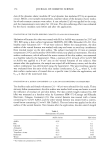
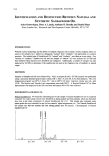
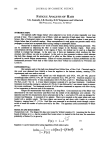
194 JOURNAL OF COSMETIC SCIENCE IDENTIFICATION AND DISTINCTION BETWEEN NATURAL AND SYNTHETIC SANDALWOOD OIL Asira Ostrovskaya, Peter A. Landa, Anthony D. Rosalia and Daniel Maes Estee Lauder Inc., Research and Development Center, Melville, NY 11747 INTRODUCTION: With the current technology and the ability of synthetic fragrance oils to mimic sensory response, there is a need in the industry for a method to distinguish "natural" from "synthetic" oils particularly in cosmetic products. The isolated case of Sandalwood Oil, "natural" and "synthetic", was taken as a case study. Five varieties of "synthetic" Sandalwood oils and one sample of "natural" oil were analyzed by GC/MS and their different Mass Spectra were identified and compared. Additionally, a sample of cologne was also analyzed by GC/MS to determine if the sandalwood oil used in the fragrance was of synthetic or natural origin. METHODS: Samples of Sandalwood oils were diluted 0.4g / 10mL in reagent alcohol. GC/MS analysis was performed using a non-polar dimethyl polysiloxane column, DB-1, 30m x 0.32cm ID, 0.25u film thickness. The oven temperature program was 60øC (5 ram), 4øC /mm to 280øC (20 ram). Injection volume was luL, split 1/100. The Injector and Transfer Line temperatures were both 280øC. A Hewlett Packard 5971A Mass Spectrometer was employed in the full scan mode and masses 40 to 550 were collected. EXPERI3,1YNTS AND RESULTS: Natural Sandalwood: We found the chromatogram for the sample of natural Sandalwood oil we analyzed contained two major peaks which were identified as alpha-santalol'and beta-santalol, which the literature also cites as the main constituents of natural Sandalwood Oil (1-3). This sample also contained some minor peaks that were identified as epi-cis-beta santalol, alpha bergamotene, etc. The Natural Sandalwood Oil sample also did not contain any late eluting peaks after 40 minutes. Chromatogram of Natural Sandalwood Oil: i i i 25.00 30.00 , 35.00 ' I ' 40.00
Purchased for the exclusive use of nofirst nolast (unknown)
From: SCC Media Library & Resource Center (library.scconline.org)