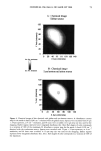
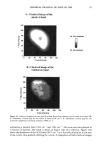
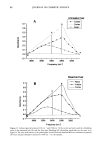
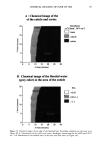
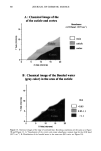
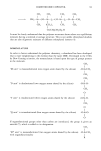
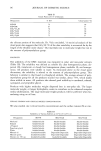
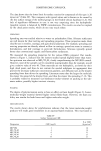
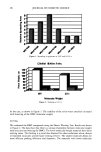
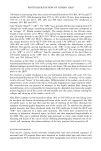
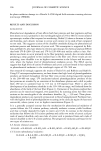
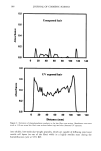
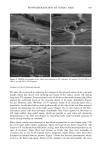
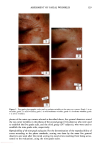
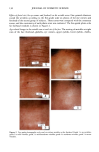
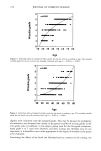
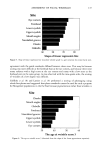
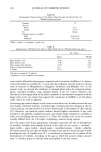
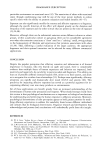
128 JOURNAL OF COSMETIC SCIENCE reported by dermatologists (8,9). However, these photo scales of wrinkling are standards for Caucasian people, and it is necessary to develop a photo scale for Japanese, because the principal manifestation of photodamage in Far East Asians, including Japanese, is based on pigmentary change rather than wrinkling (8,14). We therefore evaluated the statistical validity of the evaluation of facial wrinkles using photo scales, and we also examined age-related changes in wrinkles at eight facial sites in Japanese females. In addition, these photo scales were applied to an evaluation of a cosmetic agent for the improvement of wrinkles. MATERIALS AND METHODS SUBJECTS The subjects were 613 healthy Japanese females aged 17-83 years living in the Tokyo metropolitan area. Each subject washed her face using a liquid face-washing agent (Kao Corp., Tokyo) and water. The subjects were photographed in a room with a constant temperature of 20øC and a constant relative humidity of 40-50%. Ten minutes after washing her face, each subject was seated on a chair with her eyes lightly closed, and photos were taken as follows. A photo of the entire face was obtained for the scoring at eight sites on the face, and separate close-up photos of the outer eye corners and the forehead were also obtained. The photographs were taken using a Medical Nikkol camera (Nikon, Tokyo) with a diffused-light electric flash, which has a frame to ensure the standardization of lighting, angle, and distance. All film used (Fujichrome for color transparencies, Fuji Film, Tokyo) originated from the same batch. The first frames of each role of film included a standard gray scale and color charts from the film manu- facturer to facilitate color correction (10). The subjects were photographed in three groups (202 subjects = first group, 164 = second group, and the remaining 247 = third group). SELECTION OF PHOTOGRAPHIC SCALE PHOTOS AND ASSIGNMENT OF STANDARD GRADES Five-grade wrinkle scales for the outer eye corners and forehead. Using a five-point descriptive scale (defined as follows: 1 = none, 2 = mild, 3 = mild/moderate, 4 = moderate, 5 = severe), two specialists separately performed a scoring of wrinkles on photos of the second group (164 subjects) and gave consensus scores. A single photograph with an appropriate score was then chosen to depict each of the five grades. The photo scale for the eye corners is shown in Figure 1. Nine-grade wrinkle scale for the outer eye corners. In the nine-grade evaluation, the five-grade photos selected were given middle scores between grades, resulting in a nine-grade scale. Using the nine-grade photo scale, two specialists separately performed the scoring of wrinkles on photos of the third group of 247 subjects. They discussed the obtained scores until reaching a consensus on the photos to use for each of the nine grades. ASSESSMENT OF THE USEFULNESS OF THE PHOTOGRAPHIC WRINKLE SCALES Comparison of the five-grade and nine-grade scales. Using the five- and nine-grade standard

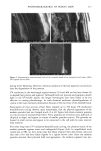
ASSESSMENT OF FACIAL WRINKLES 129 2 Figure 1. Five-grade photographic scale used to evaluate wrinkles at the outer eye corners. Grade 1 is no wrinkles grade 2 is mild wrinkles grade 3 is mild/moderate wrinkles grade 4 is moderate wrinkles grade 5 is severe wrinkles. photos of the outer eye corners selected as described above, five general observers scored the eye corner wrinkles in the photos of the second group (164 subjects), who were used to establish the five-grade scale, and the third group (247 subjects), who were used to establish the nine-grade scale, respectively. Reproducibility of the nine-grade evaluation. For the determination of the reproducibility of scores according to the photo standards, scoring was done by the same five general observers one week after the initial scoring (to avoid errors resulting from being accus- tomed to the evaluation), using the nine-grade scales.
Purchased for the exclusive use of nofirst nolast (unknown)
From: SCC Media Library & Resource Center (library.scconline.org)