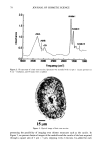
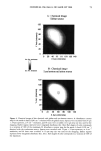
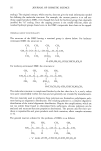
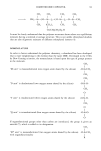
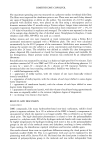
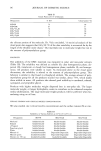
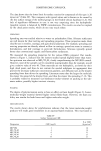
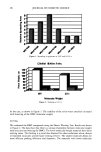
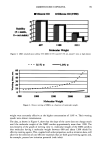
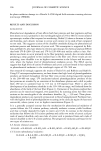
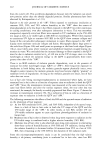
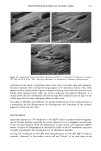
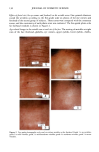
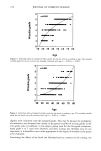
130 JOURNAL OF COSMETIC SCIENCE Efj•cts of facial site (the eye corners and forehead) on the wrinkle scores. Five general observers scored the wrinkles according to the five-grade scale on photos of the eye corners and forehead of the second group of subjects. These scores were compared with the consensus scores, and the consistency of each photo score was evaluated. The five-grade photo scale for forehead wrinkles is shown in Figure 2. Age-related changes in the wrinkle score at each site of the face. The scoring of wrinkles at eight sites of the face (forehead, glabella, eye corners, upper eyelids, lower eyelids, cheeks, 5 2 4 147 Figure 2. Five-grade photographic scale used to evaluate wrinkles at the forehead. Grade 1 is no wrinkles grade 2 is mild wrinkles grade 3 is mild/moderate wrinkles grade 4 is moderate wrinkles grade 5 is severe wrinkles.

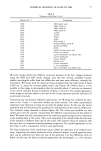
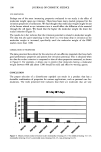
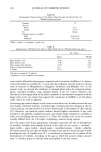
ASSESSMENT OF FACIAL WRINKLES 131 nasolabial groove, and mouth angles) was done using the five-grade standard on photos of the frontal face of 366 females (the first and second groups) by the two specialists. Clinical test of wrinkle-improving agents. A clinical test of an agent for the improvement of wrinkles (Sofina Seraty, Kao Corp.) was carried out in 15 Japanese females. This agent and placebo (a base cream) were topically applied by the subjects to both outer eye corners in the half-face manner daily for about eight weeks. Evaluations of the wrinkles of each subject were done before and after the application period by a specialist, in the double-blind manner, using the nine-grade scale. Statistica/analysis. The influence of age on wrinkling was studied using analysis of linear, logarithmic, and exponential correlation coefficients. Inter-observer agreement and in- tra-observer repeatability were analyzed and quantified by use of the kappa coefficient (11,12), a chance-corrected intraclass correlation coefficient with possible values ranging from -1 (complete disagreement) to +1 (complete agreement). Values above 0.61 are generally interpreted as indicating substantial agreement, values between 0.41 and 0.60 as moderate agreement, and values between 0.21 and 0.40 as fair agreement in general, an agreement level above fair is preferable (13). Table I shows an illustrative agreement matrix (11). In the evaluation of the improvement in wrinkles following the use of a cosmetic agent, differences between the before-use and after-use scores were analyzed by the paired Student t-test. RESULTS COMPARISON OF THE FIVE-GRADE AND NINE-GRADE PHOTOSCALES FOR EYE-CORNER WRINKLES Five general examiners performed a five-grade evaluation and a nine-grade evaluation of wrinkles on photos of the eye corners, according to the same photo scales. More than Table I An Agreement Matrix of Proportions Judge A Score 1 2 3 4 5 Y, fib Judge B 1 fl 1 * fl 2 fl 3 fl 4 fl 5 5',fl b 2 f21 f22 f23 f24 f25 Y, f2b 3 f31 f32 f33 f34 f35 5',f3b 4 f41 f42 f43 f44 f45 Y, f4b 5 f51 f52 f53 f54 f55 Y, f5b Zfai Zfa• Y. fa2 Zfa3 Zfa4 Zfa5 Zf = Nr * Numbers of notations for two-observer agreement. Y, fai: the proportion of units in which the judges agreed. 5',fib: the proportion of units for which agreement is expected by chance. Z(Y, fai x Y, fib) fo-fc f0 = Zfii fc = K - N w NT-f c
Purchased for the exclusive use of nofirst nolast (unknown)
From: SCC Media Library & Resource Center (library.scconline.org)