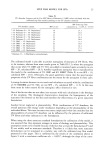
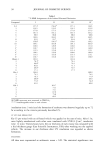
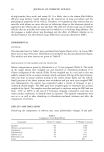
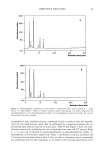
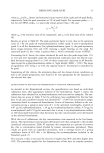
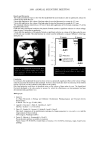
SKIN DAMAGE PROTECTION BY PRUNUS PERSICA 33 UVB + vehicle UVB + Ku-35 Figure 2. Photograph of UVB-induced erythema in guinea-pig. Ku-35 (5.0 mg/cm 2) was applied. This figure represents the complete protection of Ku-35 at 6 hr after UVB irradiation 0.2 0.1 0 0.3 I 3 mg/ear Figure 3. Effects ofP. persica extract (Ku-35) on UVB-induced ear edema in mice. UVB-irradiated control (O). Ku-35 (0). No statistically significant difference among Ku-35 treated groups was observed (n = 5). prostaglandin E• (PGE2), are well related with inflammatory responses including ery- thema and edema. We also described that Ku-35 inhibited UVB- and C-induced DNA breakage in fibroblasts and UVB-induced skin carcinogenesis in SKH-1 mice by topical treatment (4). The major constituents of Ku-35 were found to be kaempferol glycosides (fiavonoid). Therefore, the well-known anti-oxidative and UV-filtering activity of fia- yonolds may contribute to the inhibition of UV-induced skin damage by Ku-35.

34 JOURNAL OF COSMETIC SCIENCE CONCLUSIONS The extract (Ku-35) of flowers of P. persica were prepared, and four flavonoid glycosides (multiflorin B, trifolin, afzelin, and astragalin) were isolated. Ku-35 protected the formation of UVB-induced erythema and edema in animal models. Ku-35 may be a new cosmetic ingredient for protection from UVB-induced skin damage by topical applica- tion. ACKNOWLEDGMENTS This investigation was financially supported by a research grant from the Ministry of Health and Social Welfare, Republic of Korea (HMP-97-D-5-0034), which is greatly acknowledged. REFERENCES (1) B.J. Kim, J. H. Kim, H. P. Kim, and M.Y. Heo, Biological screening of 100 plant extracts for cosmetic use. II. Anti-oxidative activity and free radical scavenging activity, I,t. J. Cosmetic Sci., 19, 299-307 (1997). (2) The E,cyc/opedia ofChi,ese Medici,e (Shanghai Science Technology Publishing Co., Shogakukan, Tokyo, 1985), Vol. III, pp. 1923-1924. (3) Y. H. Kim, H. E. Yang, J. H. Kim, M. Y. Heo, and H. P. Kim, Protection of the flowers of Pm,•s persica extract from ultraviolet B-induced damage of normal human keratinocytes, Arch. Pharm. Res., 23, 396-400 (2000). (4) M. Y. Heo, S. H. Kim, H. E. Yang, S. H. Lee, B. K. Jo, and H. P. Kim, Protection against ultraviolet B- and C-induced DNA damage and skin carcinogenesis by the flowers of Pr•m•s persica extract, M•tation Res., 496, 47-59 (2001). (5) Y. Hiramatzu, S. Akita, P.A. Salamin, and R. Maier, Assessment of topical non-steroidal anti- inflammatory drugs in animal models, Arzneim.-Forsch., 40, 1117-1124 (1990). (6) S. Takagi, M. Yamaki, M. Kubota, and J. Minami, Studies on the purgative drugs. III. On the constituents of the flowers of Pmn•spersica Batsch, Yak•gak• ZasshL 97, 109-111 (1977). (7) K. Yamasaki, R. Kasai, Y. Masaki, M. Okihara, and O. Tanaka, Application of C-13 NMR to the structural elucidation of acylated plant glycosides, Tetrahedron Lett., 14, 1231-1234 (1977). (8) K. Markham, H. Geiger, and H. Jaggy, Kaempferol-3-O-glucopyranosyl(1-2)rhamnoside from Ginkgo biloba and a reappraisal of other gluco(1-2, 1-3 and 1-4)rhamnoside structures, Phytochem., 31, 1009- 1011 (1992). (9) S. Takagi, M. Yamaki, K. Masuda, and M. Kubota, On the constituents of the fruits of Rosa m•ltiflora Thumb. II, Yak•gak• Zasshi, 96, 1217-1222 (1976). (10) O. Barbera, J. F. Sanz, J. Sanchez-Parareda, and J. A. Marco, Further flavonol glycosides from AnthylliJ onobrychioides, Phytochem., 25, 2361-2365 (1986). (11) M. Y. Heo, C. H. Kim, J. S. Kang, K. N. Ur, and H. P. Kim, The flowers of Cartham•s tinctorim: Potential agent for postmenopausal disorder, J. Appl. Pharmacol. (Korea), 7, 221-226 (1999).
Purchased for the exclusive use of nofirst nolast (unknown)
From: SCC Media Library & Resource Center (library.scconline.org)