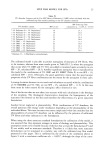
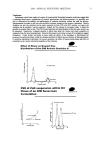
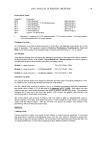
2001 ANNUAL SCIENTIFIC MEETING 67 Cross-linking an adhesive polymer can also build cohesive strength in cases where the adhesive will be exposed to ingredients or environments that are capable of dissolving or softening the layer. Many options are available for chemically cross-linking an adhesive. Heat may be used to lower the energy barrier for initiating the cross-linking reaction. For temperature-sensitive ingredients, cross-linkers employing a metal complex rely upon the removal of a volatile stabilizer during low temperature drying, at which point the system will react. Figure 2 presents the viscoelastic property, Tan b, at various frequencies for a number of cross- linked acrylic adhesive formulations. Tan •5 is defined as the ratio of G", or the loss modulus, to G', or the storage modulus. Since the storage modulus (G') reflects the elastic component of a pressure sensitive adhesive and the loss modulus (G") reflects the viscous component, it can be seen from Figure 2 that cross-linker concentration reduces G" whereby Tan •5 decreases as mole percent of cross-linker increases. Figure 2 1.2 1 08 0.4 0.2 Tan Delta vs Frequency [Acrylic Adhesive with Varying Degrees of Softness o_o o 1.o lO.O lOO.O Frequency (rad/•c) - - x. . - Increasing cross-linker concentration, thereby decreasing G", will affect the tackiness and adhesion of the system to the skin. Careful selection of the mole percent of cross-linker will allow one to tailor a pressure sensitive adhesive in order to balance the viscoelastic properties. The correct amount of cross- linking agent will provide for a balance between the adhesive and cohesive strength of the formulation. This balance should be optimized so that the adhesive will adhere to the surface of the skin for a predetermined length of time, while providing sufficient cohesive strength so as to prohibit the system from moving or sliding in parallel with the skin surface. Many aspects need to be considered when developing adhesives and it should be evident that various chemistries can be controlled when tailoring a coated product. • Therriault, Donald J., et al, Transdermal Pressure Sensitive Adhesive Drug Delivery System, US Patent 5,951,999, (1999). 2 Therriault, Donald J., et al, Water-lnactivatable Pressure Sensitive Adhesive, US Patent 5,352,516, (1994).

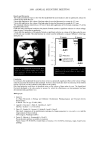
68 JOURNAL OF COSMETIC SCIENCE FRONTIERS OF SCIENCE AWARD LECTURE SPONSORED BY COSMETICS ANO TOILETRIES© Michael Balick, Ph.D. The New York Botanical Garden Ethnobotanists study one of the most fundamental relationships on earth--the relationship between plants and people. The plant world is the one of the foundations that society is built upon, with ancient peoples recognizing the importance of plants for food, fuel, medicine, construction, fiber and to protect them from their harsh environment. At first, the wilderness was the source of useful plants ultimately, gatherers became cultivators, and domesticated the plants that were most appropriate to their needs. Today, ethnobotany is a discipline with renewed interest, as it is involved with the search for new foods and medicines, in learning how to manage the earth's resources sustainably, in conservation of pristine ecosystems, and in other issues of great human concern. Some ethnobotanists work in tropical regions, where habitat destruction is proceeding at a frightening pace. It is in these regions that some of the world's greatest diversity is found, including plants, animals and other biological organisms that are as yet undiscovered. Many indigenous cultures inhabit these tropical regions and still utilize plant resources in the ancient ways of their ancestors. Ethnobotanists find work with such cultures particularly rewarding, as indigenous peoples often have a much broader understanding of how to use the resources around them in their everyday lives, then, say, a person living in a city in the United States or Europe. In our own culture, knowledge is often compartmentalized, and specialties abound, while in traditional cultures, many people are aware of the uses of the materials--plant and animal-- in their environment. Tragically, cultures are being destroyed at a faster rate than the wilderness areas that they inhabit. Globalization has brought television, media, industry, fast foods, and other components of Western society to the most remote parts of the earth. While there have been some benefits to this, the phenomenon has also meant that traditional peoples are embracing Western culture and values, and making them their own. As a result, many groups are forgetting their own languages, and it is estimated that about half of all languages and the cultures that speak them will be extinct in the next 50-100 years. As a recent cover story of Time Magazine pointed out, "when native cultures disappear, so does a trove of medical and scientific wisdom." I have been privileged to live amongst many traditional cultures in my travels, residence and study in Central and South America, the Caribbean, Asia, Africa and the Pacific. Most of my studies have involved learning about traditional healing systems, and the preparation of plants used as foods. What has always struck me however, is the success that these people have in coexisting with the stresses in their environment--wind, sun, insects, and other similar hazards. Why, when I meet a person in their 90' s, do they seem to look, and have a level of activity, much younger? While diet and exercise certainly play a large part, I have also observed that traditional peoples use many plant products to protect their hair, face and body.
Purchased for the exclusive use of nofirst nolast (unknown)
From: SCC Media Library & Resource Center (library.scconline.org)