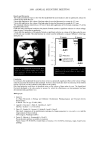
2001 ANNUAL SCIENTIFIC MEETING 69 There are many ingredients found in nature and utilized by traditional peoples that could have application to the cosmetics industry. Only a relative handful of the 265,000 species of higher plants (those which bear flowers or cones) are used commercially in the cosmetics industry. Yet indigenous peoples have traditionally used much more of the plant world for cosmetics-related purposes--to adorn their bodies, color their hair, moisturize and protect their skin, repel insects, heal skin irritations, wash and perfume themselves and for many other purposes. The cosmetics industry has recognized this, as have consumers, and, at present, the "green" segment of the industry is growing at a faster pace than most other sectors. With this growth comes responsibilities to the consumer, to the environment, and to the peoples and countries who have discovered or who have stewardship over these resources. Maria Raza, on the island of Pohnpei, making perfumed coconut oil with the petals of Cananga odorata, as her ancestors have always done. In ancient times this was an oil used to clean and anoint royalty today, it is used by many residents of the island to moisturize and heal the skin. Once, nearly two dozen plants were known to be used to make this oil at present, local people only recall a single species.

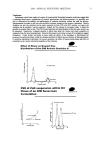
70 JOURNAL OF COSMETIC SCIENCE A NEw WAY To CHARACTERIZE STABILITY AND PERFORMANCE OF COSMETIC EMULSIONS AND SUSPENSIONS David Fairhurst', Ph.D., Andrei Dukhin 2, Ph.D. and Kenneth Klein • •Particle Sciences, Inc., Bethlehem, PA, 2Dispersion Technology, Inc., Mt. Kisco, NY SCosmetech Laboratories, Fairfield, NJ Introduction: The design of a cosmetic emulsion is quite complex and often requires several iterations to produce a stable, efficacious, safe, cost effective and elegant product. While product specifications are established to insure product consistency during manufacture, all too often they are not suff:cient to ensure that a truly high quality product has been manufactured. What is needed is an objective test(s) that will be easy to run, and predictive - a test that measures fundamental characteristics in nature. They must neither be a function of the instrument used not of the operator. Two reliable and well-established parameters are, respectively, particle (droplet) size and zeta potential (surface charge). The techniques de•Ssed to determine them are extremely diverse. Each method has its ath-actions but it is important to select the one that meets the actual requirements of the application in question. Unfortunately, the vast majority of current instrumentation utilizes light scattering. This severely limits the application to cosmetic emulsions because of the requirement to dilute the system under investigation. Cosmetic emulsions axe complex, multicomponent systems that, invariably, cannot be diluted without consequence. The (dilution) process not only destroys any structure characteristics but also can induce instaNhty leading to creaming and, often, breaking/coalescence. Hence the oft-found difficulty of correlating particle size (PS) and zeta potential (Z'P) measurements with flow properties, freeze-thaw and shelf storage behavior. PS, alignment of emulsifier at the interface and, thus, ZP may be influenced by m,'my factors. Additionally, many instruments are only suitable for studying O/W emulsions. or may have difficulty evaluating emulsions that contain significant concentrations of dispersed parUculates. as may be found •n sunscreen formulations containing zinc oxide/tit,'mium dioxide. It has been long known that ultrasound based techniques open an opportunity to eliminate dilution. However, instrumentation hardware was too complex and suffered from weaknesses in practical application of the technique to systems of high internal phase concentration. In addition. the theoretical basis of the &convolution of the raw data was not capable of dealing with particle-particle interactions - an essential feature of concentrated dispersions. Recently, all these problems have been addressed and a commercial instrument developed that convincingly demonstrates the advantages of a technique based on a combination of acoustic spectroscopy and electro-acoustics. This offers a new opportunity for characterizing these complicated cosmetic systems it gives an advantage of being able to study turbid emulsions where other techniques, such as light scattering, simply will not work and dilution, of such •'stems, can alter their physical properties. It is also sensitive enough for characterizing polydispersity. A major advantage of a technique based on sound is that a sample under investigation need not be stationary, a necessary requirement of light scattering instrumentation. Henci, an acoustic instrument holds promise of being able to study emulsions that are flowing. in-line or on-line. The technique has been successfully applied to the study of simple (3-component), model emulsions. Unfortunately, model systems, while of academic interest to the researcher. are often of littie practical use to the cosmetic formulator. In this paper we report the results of a preliminany study of a variety. of "real-world" cosmetic emulsxons, both O/W and W/O, from sunscreens to moisturizers. The aim of the study was to determine the limitations nf the acoustic method and to show proof-of-concent in the abilit' of the technique to help characterize the stability and performance of cosmetic emulsions without the need for dihit•on. Experimental: A series of emulsions were obtained from Cosmetech Laboratories Inc., Fairfield, New Jersey. They were formulated to be commercmlly wable cosmetic products. The emulsions varied widely in composition and character viz internal phase wt. fraction, viscosity and stability.. The instrument used was a DT-1200 Acoustic Spectrometer developed by Dispersion Technolog?,-, Inc., Mt Kisco, New York. This instrument has two separate sensors for measuring acoustic and electro-acoustic signals independently. The raw data output is ultrasound attenuation frequency spectra, within a frequency range from IMHz to 100MHz that is known to be typical for heterogeneous systems. The attenuation spectra contain information about particle size distribution (PSD). The electroacoustic sensor raw data output is Colloid Vibration Current: this measured parameter yields information about Z'P. Complete PSD and ZP measurements can be completed in minutes and can be made on flowing systems.
Purchased for the exclusive use of nofirst nolast (unknown)
From: SCC Media Library & Resource Center (library.scconline.org)