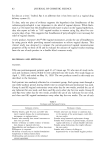
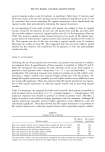
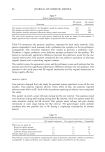
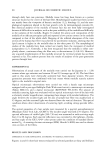
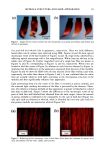
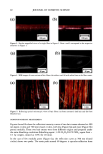
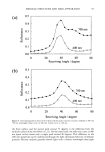
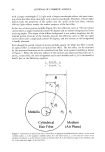
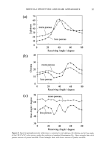
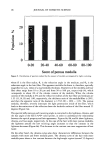
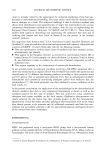
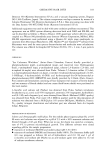
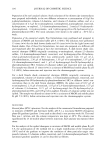
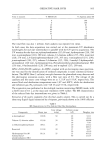
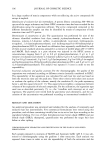
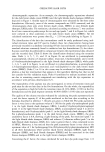
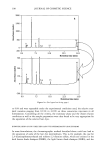
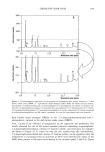
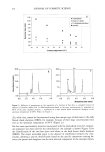
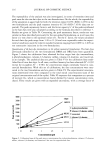
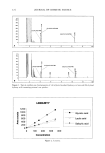
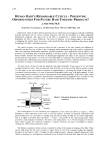
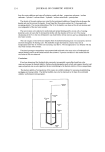
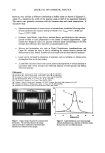
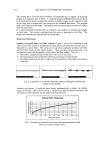
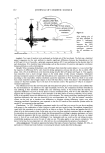
138 JOURNAL OF COSMETIC SCIENCE The camera has a 256x256 pixel resolution (3.51,tm/pixel) and is capable of acquiring images at a maximum rate of 200/s. A computer program [TRI/DCAM (Labview)] has been developed in house to operate the camera, to display images on the computer screen in real time, and to acquire and store images on the computer hard drive. The program adds a time stamp to each image. The images can be processed and converted into videos after the experiment. In a typical experiment the hair fiber is stretched on the pulleys by loading 10g weights on both ends. The system is activated and the spray is deposited on the fiber. The images are collected and analyzed after the experiment. Results and Discussion Stability of Liquid Films on Fiber surfaces: Figure 2 shows the sequential events which occur when a film of hexadecane (surface tension 27mN/m and viscosity 3cp) is deposited on a nylon fiber. The waves are set up whose amplitude increases with time until the film breaks up into small droplets. There are three factors that need to be considered in analyzing the stability of the film on the fiber surface. They are: 1) The positive Laplace pressure of the film with a convex curvature. 2) The disjoining pressure of the film which has a tendency to break the film 3) The adhesion between the fiber surface and the liquid film which fights the break up of the film. Fig. 2 Liquid film on a synthetic fiber that undergoes Raleigh instability and breaks up into droplets. Neimark and Kornev [1] analyzed these factors mathematically to define the stability region of the film. This is shown in Fig. 3, which shows that the stability increases with an increase in fiber diameter and decreases with film thickness. Critical Film Thickness 450 2•o 20o 0 0 10o 20o 30o 400 500 600 70o 8(:X:] 900 10o0 fiber radius, microns Fig. 3 Estimate of critical film thickness of thermodynamically stable films as a function of fiber radius

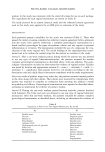
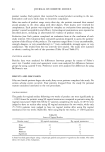
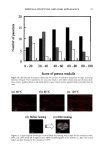
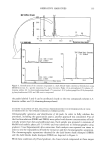
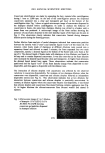
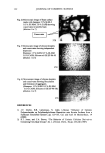
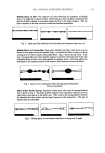
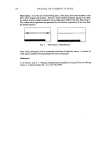
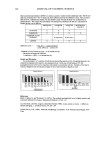
2001 ANNUAL SCIENTIFIC MEETING 139 Holding Spray on Hair: The sequence of events following the deposition of holding spray on a single hair is shown in Fig.4. Film break up to form droplets is extremely fast and the droplets coalesce by movement along the fiber to for larger droplets. This can lead to deposits on the fiber which are visine and therefore undesirable. Fig. 4 Light spray film break-up to form droplets and subsequent spray dry-out. Holding Spray on Crossing Hair: Since a hair assembly has fibers which cross over one another at low angles along with parallel fibers, we studied the effect of sprays on fibers crossing at 8 ø as well as loosely held parallel fibers. Figs. $ shows the end result. In the case of crossing fibers the spray droplets migrate to the fiber intersection and in the case of parallel fibers the fibers are pulled together by capillary forces. Both these effects are dominated by the Laplace pressure of the concave liquid meniscus between the fibers. Fig. 5 Spray on two crossing hair fibers showing liquid being drawn into the intersection. Effect of Hair Surface Energy: Interaction of hair spray with a pair of crossing bleached hair is shown in Fig. 6. The spray droplets migrate to the intersection forming a bow tie rather than a neat bead as in the earlier case. This is due to the strong adhesion between the bleached hair fiber surface and the liquid meniscus at the intersection. This type of deposits may be undesirable. Fig. 6 Holding spray on two bleached hair fibers crossing at an 8 ø angle.
Purchased for the exclusive use of nofirst nolast (unknown)
From: SCC Media Library & Resource Center (library.scconline.org)