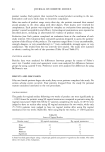
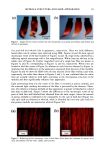
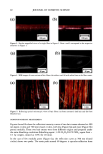
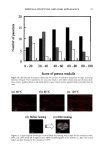
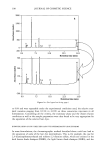
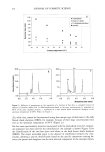
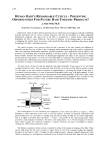
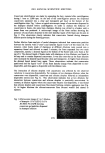
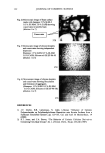
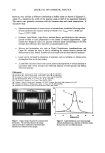
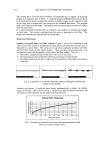
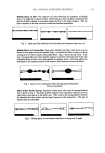
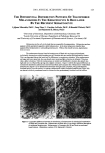
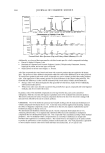
140 JOURNAL OF COSMETIC SCIENCE Shine Spray: As in the case of the holding spray, shine spray also forms droplets on the fiber, which migrate and coalesce. However, these droplets ultimately spread on the fiber by surface tension gradient generated forces (Marangoni Effect) into thin films (Fig.7). The surface tension gradients are generated by the selective evaporation of solvents from the droplet meniscii. Fig. 7 Shine spray on bleached hair. Most of the information will be presented in the form of real time videos. A number of other aspects related to this phenomena will also be discussed. References K. G. Kornev, and A. V. Neimark, Hydrodynamic Instability of Liquid Films on Moving Fibers, J. Colloid Interface Sci., 215, 381-396 (1999).

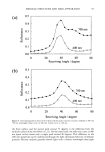
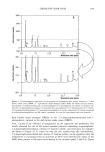
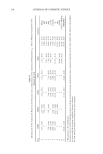
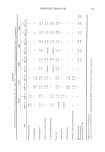
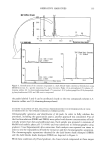
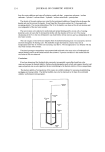
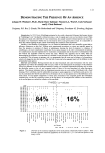
2001 ANNUAL SCIENTIFIC MEETING 141 DEMONSTRATING PmSENC OF AN Johann W. Wiechers l, Ph.D., Marie-Clare Taelman 2, Vincent A.L. Wortel l, Cock Verboom • and J. Chris DederenL Uniqema, PO. Box 2, Gouda, The Netherlands and •Uniqema, Everslaan 45, Everberg, Belgium Introduction: In 1935, Erwin Schr6dinger preõented to the world a theoretical dilemma that became known as "Schr6dinger's cat". He placed a radioactive atom, a vial of cyanide and a cat in a box that he closed. When the radioactive atom with a half-life of I hour would decay, the cyanide would be released and the cat would die. He asked if we would know whether the cat was dead or alive at any given point in time. It is impossible to know this without opening the box, which would change the conditions of the experiment. Similarly to the dilemma of Schr6dinger's cat, we wanted to demonstrate that a new emulsifier system had no influence whatsoever on skin feel. Whereas most experimental procedures in science are typically geared to show the presence or existence of objects or phenomena, showing the lack of presence, i.e. absence, of something is a lot more complicated, in particular if you cannot measure it. In order to demonstrate the absence of a contribution to skin feel implied that we would have to demonstrate that the skin feel of a formulation with and without the emulsifier would be exactly the same. Whereas this approach can be easily taken for demonstrating the influence of an emollient or a thickener on the perception of skin feel, this cannot be done for an emulsifier. This is because its primary role is to permanently mix the water and oil phases of a formulation, which will change the skin feel anyway. The skin feel of water and oil as separate layers will be different to that of emulsified water and oil. Materials and methods: Having assessed that the ideal benchmark (the same formulation with the same ingredients but without the emulsifier) did not exist, could we still demonstrate the presence of this absence? Using four different oils and six different emulsifier systems, we compared formulations differing only in either the emulsifier system or the oil, and compared some of those to the non-formulated oil using descriptive analysis. This sensory technique relies on obtaining an accurate score on a set number of attributes with a fixed meaning. The 31 attributes could be subdivided into groups to assess appearance (3 attributes), pick-up (4), rub- out (8), immediate after-feel (8) and after-feel at 20 minutes (8). As we anticipated some of the differences to be really small, we used paired comparisons in which every formulation was compared against the formulation containing the 'no skin fell' emulsifier system. In the first phase, we investigated the influence of the emulsifier, in the second phase we studied the influence of the emollient. PHASE! I p-values COMP • B4 MS 64 B3 qS D3 • • • = • ß 83 VS 63 * • * B2 VS F2 = • • B2 VS EZ • • B2 VS D2 • B2 VS C2 • BI VS FI • , A2 VB B2 • X H S k S • • K I I I I f • X X S K E E 2 2 2 • • • R D i S S 0 0 0 E I U S N•F 0 S Ct F 0 0 , attr •butes dot: •)0. OS •e•wiew of the stan•tical sign•cance I•el of all paired comparisons made in ph•e 1. Blue asteris• re•resent statistical sigm•cance at the I•el O. OI p 0.0• and red squares at the l•el • O. OI. Figure 1:
Purchased for the exclusive use of nofirst nolast (unknown)
From: SCC Media Library & Resource Center (library.scconline.org)