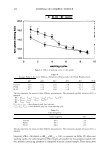
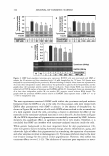
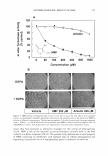
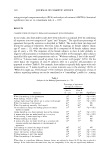
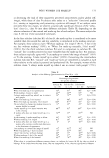
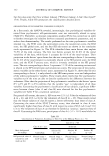
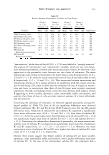
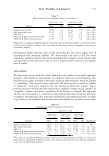
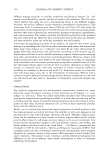
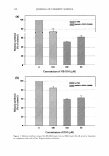
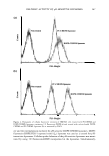
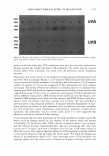
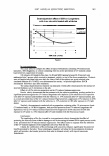
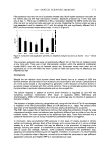
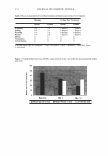
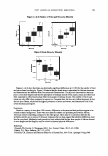
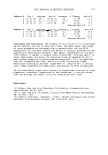
114 JOURNAL OF COSMETIC SCIENCE ♦ SL-60 _...,_control I "ii 18,0 .c 14,0 - 10,0 0 2 4 6 8 10 washing cycles Figure 4. Effect of washing cycles on dye uptake. Table V Average Value of the Color Difference Parameters Obtained after the Ninth Washing Cycle .6.E l ±S.D. .6.C 2 ±S.D. .6.L3 ±S.D. Control 32.9 ±2.2 23.8 ±1.8 -21.3 ± 1.7 PLUS 26.6 ±3.4 19.6 ±2.1 -17.6 ±3.4 SL-60 25.7 ±3.9 19.8 ±2.8 -16.3 ±2.8 The data represent the means of three different measurements. The estimated standard deviation (S.D.) is reported. 1 .6..£ = [(Lwash - Ldyed) 2 + (awash - adyed) 2 + (bwash - bdyed) 2 } 112 2 .6.C = [(awash - adyed) - (bwash - bdyed J 1 3 .6.L = Lwash - Ldyed LdyedJ adyed, bdyed = data obtained with dyed yak hair. Lwash! awash! bwash = data obtained after the ninth washing cycle. Table VI Color Longevity Color longevity Control 96.9 PLUS 86.4 SL-60 86.6 S.D. ±2.4 ± 1.2 ±2.4 The data represent the means of three different measurements. The estimated standard deviation (S.D.) is reported. longevity effect, calculated as fJ.E wa s/ fJ.E dyed x 100, is reported in Table VI after nine washing cycles, the color longevity effect results are smaller for the samples treated with the dyebath containing polymers if compared with the control sample. These data prove

EFFECT OF CELLULOSE POLYMERS ON DYE UPTAKE 115 that the desired wash-out of a semipermanent hair dye, after several washing cycles, should not be hindered by the polymer presence. CONCLUSION A systematic investigation has been made concerning the effects governing dye uptake and color loss from yak fiber with HC Blue 2, Basic Red 51, and HC Yellow 2 dyes in the presence of cationic and non-ionic polymers. It has been shown that the presence of cationic polymers in the dye bath improves the quality of the dyeing process and reduces dye fading during the first washing cycles. However, the desired wash-out for a semi- permanent hair dye, after several washing cycles, is not hindered by the presence of polymers. ACKNOWLEDGMENTS The authors thank the Spinner Consortium, financed by the Social European Fund, the Ministry of Work and of Social Policies, and the Region of Emilia Romagna, Italy. REFERENCES (1) C.R.Robbins, "Polymers and Polymer Chemistry in Hair Products," in Chemical and Physical Behavior of Human Hair, 4th ed. (Springer-Verlag, New York, 2002), pp. 345-385 and literature therein. (2) A. Pfau, P. Hassel, S. Vogt, R. Sander, and W. Schrepp, The interaction of cationic polymers with human hair, Macromol. Symp., 126, 241-252 (1997). (3) E. D. Goddard, J. A. Faucher, R. J. Scott, and M. E. Turney, Adsorption of polymer JR on keratinous surfaces-Part II,]. Soc. Cosmet. Chem., 26, 539-550 (1975). (4) R. B. Hannan, E. D. Goddard, and J. A. Faucher, Desorption of a cationic polymer from human hair: Surfactant and salt effects, Textile Res.]., 57-58 (January 1978). (5) J. A. Faucher and E. D. Goddard, Influence of surfactants on the sorption of a cationic polymer by keratinous substrates,]. Colloid. Interface Sci., 55, 313-319 (1976). (6) T. V. Drovetskaya, R. L. Kreeger, J. L. Amos, C. B. Davis, and S. Zhou, Effects of low-level hydro- phobic substitution on conditioning properties of cationic cellulosic polymers in shampoo systems,]. Cosmet. Sci., 55 (Supplement), S195-S205. (7) A. Schlosser, Silicones used in permanent and semi-permanent hair dyes to reduce the fading and color change process of dyed hair occurred by wash-out or UV radiation,]. Cosmet. Sci., 55 (Supplement), Sl23-S13 l (2004). (8) I. D. Ratee and M. N. Breuer, "Kinetics of Dyeing," in The Physical Chemistry of Dye Adsorption, (Academic Press, London, 1974), pp. 48-49. (9) R. McGregor and R. H. Peters, Some observations on the relation between dyeing properties and fibre structure,JSDC, 82, 267-276 (1968). (10) J. S. Anderson, The chemistry of hair colorants, JSDC, 116, 193-196 (2000). (11) C. Zviak, "Tinture per Capelli: non ossidanti," in Scienza delta Cura dei Capelli (Emiliano Panconesi, Masson, Milan, 1987), pp. 249-255. (12) B. Ballarin, S. Galli, and M. Morigi, Study of dyeing properties of semipermanent dyestuffs for hair, Int.]. Cosmet. Sci., 29, 49-57 (2007). (13) S. K. Han, Y. K. Karnath, and H. D. Weigmann, Diffusion of semipermanent dyestuff in human hair, Proceedings of the 7th International Wool Textile Research Conference, Tokyo, 5, 269 (1985). (14) J. T. Guthrie, A. Kazlauciunas, L. Rongong, and S. Rush, The characterization of treated and dyed hair, Dyes and Pigments, 29, 23-44 (1995). (15) P. Maillan, UV protection of artificially coloured hair using a leave-on formulation, Int.]. Cosmet. Sci., 24, 117-122 (2002).
Purchased for the exclusive use of nofirst nolast (unknown)
From: SCC Media Library & Resource Center (library.scconline.org)