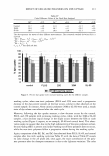
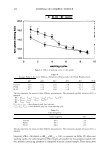
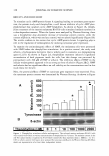
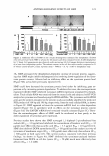
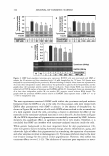
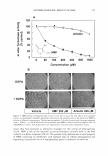
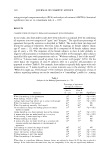
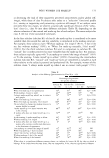
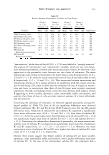
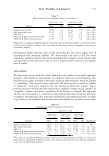
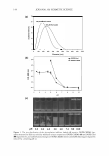
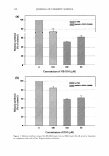
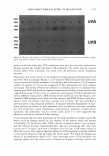
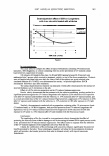
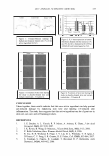
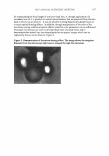
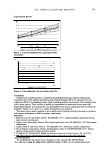
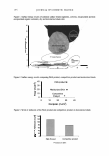
ANTIMELANOGENIC EFFECTS OF HMF 123 A 120 100 cu G) = 80 U) 0 ca ._ C: C: 60 U) 0 0 u L. ,.� 40 0 OH t- - �CH3 HMF e .... 20 · .s 0 0 50 100 200 400 800 1600 Concentration (µM) B --DOPA +DOPA Vehicle HMF 200 µM Arbutin 200 µM Figure 4. HMF inhibits tyrosinase enzyme activity in vitro and in situ in the cells. (A), In vitro tyrosinase activity was determined using B 16 melanoma cell lysates as the enzyme source in the presence of HMF or arbutin at different concentrations. The data are expressed as % of vehicle control and the graph represents mean ± SEM (n = 3). (B) B16F10 cells were pretreated with HMF or arbutin and then supplied with 1.0 mM DOPA or vehicle. Cell images shown are representative of at least three independent studies. ration thus have potential as alternative strategies for the control of melanogenesis (9,10). HMF is one of the naturally occurring furanones currently used in the food industry as a flavor compound (20,21). The present study demonstrates a novel property of HMF, indicating its interference with multiple steps of cellular melanogenesis and supporting its potential use as a depigmenting agent in cosmetics or medicine.

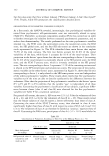
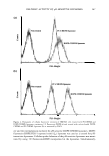
124 JOURNAL OF COSMETIC SCIENCE CONCLUSION The present study demonstrates that HMF inhibits not only tyrosinase activity (Figure 4) but also its gene expression (Figure 3). This unique dual mechanism of HMF may explain why this compound is so effective in the prevention of cellular melanogenesis (Figure 2). HMF may be useful for the prevention of undesired skin pigmentation. ACKNOWLEDGMENTS This work was supported by a BioMedical Research Institute grant from Kyungpook National University Hospital (2005). This work was also supported by the Brain Korea 21 Project (2006). REFERENCES (1) J. S. Mas, I. Gerritsen, C. Hahmann, C. Jimenez-Cervantes, and J. C. Garcia-Borron, Rate limiting factors in melanocortin 1 receptor signalling through the cAMP pathway, Pigment Cell Res., 16, 540-547 (2003). (2) R. Busca and R. Ballotti, Cyclic AMP, a key messenger in the regulation of skin pigmentation, Pigment Cell Res., 13, 60-69 (2000). (3) K. Yasumoto, K. Yokoyama, K. Takahashi, Y. Tomita, and S. Shibahara, Functional analysis of microphthalmia-associated transcription factor in pigment cell-specific transcription of the human tyrosinase family genes,]. Biol. Chem., 272, 503-509 (1997). (4) R. A. Spritz, L. Ho, M. Furumura, and V. J. Hearing, Jr., Mutational analysis of copper binding by human tyrosinase,j. Invest. Dermatol., 109, 207-212 (1997). (5) R. Balaban, E. Cheng, and D. N. Hebert, Coexpression of wild-type tyrosinase enhances maturation of temperature-sensitive tyrosinase mutants, J. Invest. Dermatol., 119, 481--488 (2002). (6) H. Y. Park, J. M. Perez, R. Laursen, M. Hara, and B. A. Gilchrest, Protein kinase C-beta activates tyrosinase by phosphorylating serine residues in its cytoplasmic domain,]. Biol. Chem., 274, 16470- 16478 (1999). (7) C. Jimenez-Cervantes, J. C. Garcia-Borron, P. Valverde, F. Solano, and J. A. Lozano, Tyrosinase isoenzymes in mammalian melanocytes. 1. Biochemical characterization of two melanosomal tyrosi- nases from B16 mouse melanoma, Eur. J. Biochem., 217, 549-556 (1993). (8) S. Briganti, E. Camera, and M. Picardo, Chemical and instrumental approaches to treat hyperpig- mentation, Pigment Cell Res., 16, 101-110 (2003). (9) K. S. Kim, J. A. Kim, S. Y. Born, S. H. Lee, K. R. Min, and Y. Kim, Inhibitory effect of piperlon- guminine on melanin production in melanoma B 16 cell line by downregulation of tyrosinase expres- sion, Pigment Cell Res., 19, 90-98 (2006). (10) K. Nakamura, M. Yoshida, H. Uchiwa, Y. Kawa, and M. Mizoguchi, Down-regulation of melanin synthesis by a biphenyl derivative and its mechanism, Pigment Cell Res., 16, 494-500 (2003). (11) E. V. Curto, C. Kwong, H. Hermersdorfer, H. Glatt, C. Santis, V. Virador, V. J. Hearing, Jr., and T. P. Dooley, Inhibitors of mammalian melanocyte tyrosinase: In vitro comparisons of alkyl esters of gentisic acid with other putative inhibitors, Biochem. Pharmacol., 57, 663-672 (1999). (12) M. Funayama, H. Arakawa, R. Yamamoto, T. Nishino, T. Shin, and S. Murao, Effects of alpha- and beta-arbutin on activity of tyrosinases from mushroom and mouse melanoma, Biosci. Biotechnol. Bio- chem., 59, 143-144 (1995). (13) R. E. Boissy, M. Visscher, and M. A. DeLong, DeoxyArbutin: a novel reversible tyrosinase inhibitor with effective in vivo skin lightening potency, Exp. Dermatol., 14, 601-608 (2005). (14) Y. C. Boo, C. 0. Jeon, and J. Y. Oh, Isolation of 4-hydroxy-5-methyl-3[2H]-furanone from pine needles as an antioxidative principle, Agric. Chem. Biotechnol., 37, 310-314 (1994). (15) Y. C. Boo, C. 0. Jeon, J. Y. Oh, E. J. Kim, and B. G. Lee, Antimelanogenesis effects of 4-hydroxy- 5-methyl-3[2H]-furanone, an antioxidant isolated from pine needles,]. Soc. Cosmet. Scientists Korea, 20, 1-13 (1994).
Purchased for the exclusive use of nofirst nolast (unknown)
From: SCC Media Library & Resource Center (library.scconline.org)