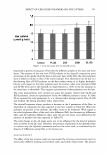
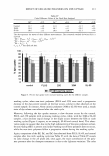
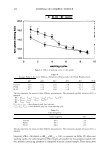
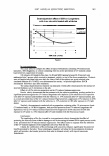
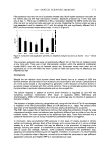
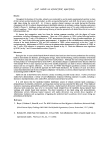
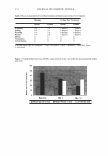
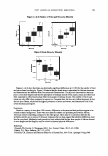
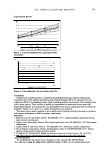
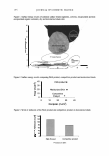
2007 ANNUAL SCIENTIFIC MEETING 193 Measurements of Suriace Energy and Work of Adhesion of Foundations: - Surf ace energy: A good SE match between the foundation and the skin represents a favourable low energy state that facilitates advantageous surface interactions. As a result, the foundation will spread out evenly and "merge" effectively with the skin. In contrast, a poor SE match implies that the surface interactions between the foundation and the skin are not optimal, so the foundation either ( 1) resists spreading & coating evenly or (2) superficially spreads without adherence. In case 1, the unfavourable energy state can also drive the pigments in the foundation to flocculate / agglomerate into larger particles instead of spreading uniformly on the surface. In case 2, the foundation tends to sit on the skin as a separate layer, often resulting in an obvious, unnatural look and poor resistance to product transfer onto clothes or other surfaces. An in-vivo SE study was conducted on facial cheek skin of panelists after applying either a P&G color cosmetic foundation product or a competitive foundation product. Measurements were performed mainly on moisturized skin, since internally conducted consumer research reveals that 81 % of liquid foundation users apply a facial moisturizer prior to using their liquid makeup. Figure 2 shows the polar and nonpolar contributions to SE of the P&G foundation, competitive foundation, and moisturized cheek skin. Polar components are responsible for the long range and strong interactions (hydrogen bonding or Lewis acid/base complexation), while nonpolar components drive the short range and weak interactions (Lifshitz /van der Waals). Polar components usually dominate interactions due to their long range and strong nature. Bare skin is relatively nonpolar, but as can be seen in Figure 2, moisturized skin has a significant polar component. The P&G product is a Si/W emulsion and it is therefore very hydrophilic, whereas the competitive product is a W/Si emulsion, making it much more hydrophobic than the P&G product. Both products have almost equivalent nonpolar components to the SE of moisturized skin. More importantly, the polar component in the competitive product is almost absent, whereas the polar component in the P&G product is very high thus, the P&G product can also interact with polar components of the moisturized skin. As a result, the P&G product will have stronger and more favorable overall interactions with the skin. - Work of Adhesion: Work of adhesion is a measure of the amount of energy required to remove the foundation from the skin. Higher works of adhesion reflect higher affinity between the foundation and the skin, and therefore better wear properties. As shown in Figure 3, the P&G product has a stronger affinity for skin and thus adheres to the skin better than the competitor product. Relationship Between Surface Energy and Cosmetic Beauty on the Skin: Overall, the P&G formulation has a good SE match with moisturized skin. The water continuous phase and volatile oils evaporate upon application to the skin, leaving behind a dry film composed of the pigment system and the non-volatile oils. This fihn spreads out evenly and flawlessly merges with the skin in the absence of any driving force for the pigments to flocculate or agglomerate. Therefore, the benefit of this product is that the foundation is continuous with the skin, resulting in a flawless and natural look rather than product pooling or migrating into areas of texture. In an internal consumer study where panelists were asked to use the P&G product, 97% of panelists agreed that the foundation provided a natural look. This natural look can be directly related to a good SE match between the formula and skin's surface. As a result, SE has proven to be an invaluable technical tool to understand how to best deliver color to the skin and to improve overall foundation performance on the skin. References 1. Toyoda, T., Iyanagi, H., Mohri, K., Nakamae, K., 2lh IFSCC Congress Proceedings, 1-9, 2006. 2. Rabe, T., Vickery, S., Wildgust, P., Altuve, A., Kalla, K., Page, S., Jones, S., Cosmetics & Toiletries, 122 (6), 75-79, 2007. 3. Padday, J.F., Surf Colloid Sci., 1, 39-251, 1969. 4. Rulison, C., Personal Communication, 2004. 5. Fowkes, F.M., Ind Eng. Chem., 56, 40-52, 1964. 6. Jones, S.R., Grey, B.D., Mistry, K.K., Wildgust, P., J ofMicroencapsulation. Submitted.

194 JOURNAL OF COSMETIC SCIENCE Figure 1. Surface energy results of common surface treated pigments, solvents, encapsulated and non- encapsulated organic colorants, dry and moisturized cheek skin. 35 30 25 10 5 0 0 Figure 2. Surface energy results comparing P&G product, competitive product and moisturized cheek. 40 f 30 S 20 o 10 a. P&G product♦ Moisturized Skin • Competitive Product • 0 ---�-�-----� 0 10 20 30 Nonpolar (mJ/rrf) 40 Figure 3. Work of Adhesion of the P&G product and competitive product on moisturized cheek cg'140 §. 120 6 100 "ia 80 � 60 40 20 0 P&G Product Competitive product Product on Skin
Purchased for the exclusive use of nofirst nolast (unknown)
From: SCC Media Library & Resource Center (library.scconline.org)