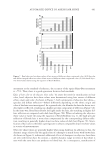
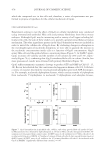
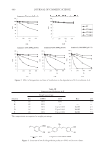
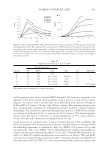
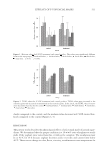
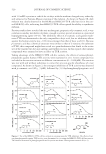
AUTOMATED DEVICE TO ASSESS HAIR SHINE 465 judgments when comparing extreme situations (e.g., UV-damaged hair with undamaged hair). However, comparisons between undamaged hair before and after use of wash-off products (shampoo and conditioner) were not possible and even comparisons between undamaged hair before and after use of leave-in styling products were diffi cult due to the number of samples required to have an 80% probability of resolving the difference with signifi cance (6). Our data using the opsira Shine-Box demonstrate that, with refi ned physical methods and appropriate stratifi cation, the sensitivity of instrumental tech- niques to assess hair shine can be substantially increased. In this case, the sensitivity of instrumental techniques to detect differences in hair shine outperforms that of panel assessments and may detect even small differences in hair shine caused by treatment with (wash-off) shampoos, conditioners, and (leave-in) styling products with signifi - cance, without losing overall correlation with subjective panel assessments. To be useful as an analytical tool for the development of hair care products—especially to be employable for claim support—the automated tool has to compete with panel assessments, which are the accepted standard of reference in these cases. Providing stringent stratifi cation of hair fi bers for color and parallelism, the automated tool competes favorably with panel assessments of hair shine. In this case, data generated with the Shine-Box are clearly superior to data generated by panel assessment in terms of sensitivity and specifi city to detect differ- ences, reliability, and repeatability, as well as workload and time consumption. The side-by-side comparison of different hair care and styling products with regard to hair shine using the automated screening tool in parallel with standard panel assessment Figure 11. (A) Objective sparkle values determined with the opsira Shine-Box of blond hair tresses treated either with standard leave-in (L-l) and rinse-off (R-O) hair care products as well as a leave-in product contain- ing glitter particles. An increase in the sparkle value is seen only with the product containing the glitter particles. (B) Inset photograph of hair fi bers carrying glitter particles after treatment with a leave-in product containing glitter particles. (C) Objective sparkle values of blond hair tresses before and after treatment with different styling sprays.

JOURNAL OF COSMETIC SCIENCE 466 showed that the automated system provides an almost identical ranking and the same statistical signifi cance as the panel assessment. With suffi cient stratifi cation of hair tresses, the automated assessment of hair shine could be brought to an excellent correlation with subjective panel assessments. Therefore, the tool is well suited to replace panel assess- ments for screening purposes during the development phase of hair care products and product claims support. A further advantage of the automated system over panel assessments is the fact that abso- lute numeric values are generated for a given hair care product. In contrast, panel assess- ments can only give rankings of a series of hair care products included in the same study. Thus, the absolute numeric data generated with the automated system allow com- parison of hair care products between studies or at different time points after treatment. The latter advantage makes claim supports such as “long lasting shine” much easier than using panel assessments. The opsira Shine-Box is the fi rst system giving absolute numeric data for hair sparkle and may therefore be employed to support special product claims on increased hair sparkle. However, our data indicate that hair sparkle is mainly determined by the geometry of the hair itself and is not affected by hair care products, unless these products introduce glitter particles onto the hair surface or change the topography of the hair surface (e.g., by hair sprays). Sparkle may increase the subjective impression of hair shine when assessed by panelists, but it has no effect on the determination of the objective absolute shine value determined by the system. As a consequence, certain products producing sparkle effects may require refi ned algorithms with integrated shine and sparkle values to align the au- tomated results on hair shine with those of panelists. CONCLUSIONS We developed and qualifi ed an automated routine screening tool, the opsira Shine-Box, to quantify hair shine. This tool is able to separately record individual properties of hair shine such as specular refl ection and multiple refl ection, as well as additional features such as sparkle, parallelism of hair fi bers, and hair color. A side-by-side comparison of different hair care and styling products with regard to hair shine using the automated screening tool in parallel with standard panel assessment showed that the automated system provides an almost identical ranking and the same statistical signifi cance as the panel assessment. Providing stringent stratifi cation of hair fi bers for color and parallel- ism, the automated tool competes favorably with panel assessments of hair shine. In this case, data generated with the opsira Shine-Box are clearly superior to data generated by panel assessment in terms of reliability and repeatability, workload and time consump- tion, and sensitivity and specifi city to detect differences after shampoo, conditioner, and leave-in treatment. The automated tool is therefore well suited to replace standard panel assessments in claims support, at least as a screening tool. ACKNOWLEDGMENTS Our special thanks go to Kerstin Haberecht, Mareike Oltmer, and Eleonor Schellenberg for conducting most of the measurements. We also thank Olaf Rieckmann and Sigrid Franke for technical support, as well as Thomas Lange for eyetracker investigations.
Purchased for the exclusive use of nofirst nolast (unknown)
From: SCC Media Library & Resource Center (library.scconline.org)